
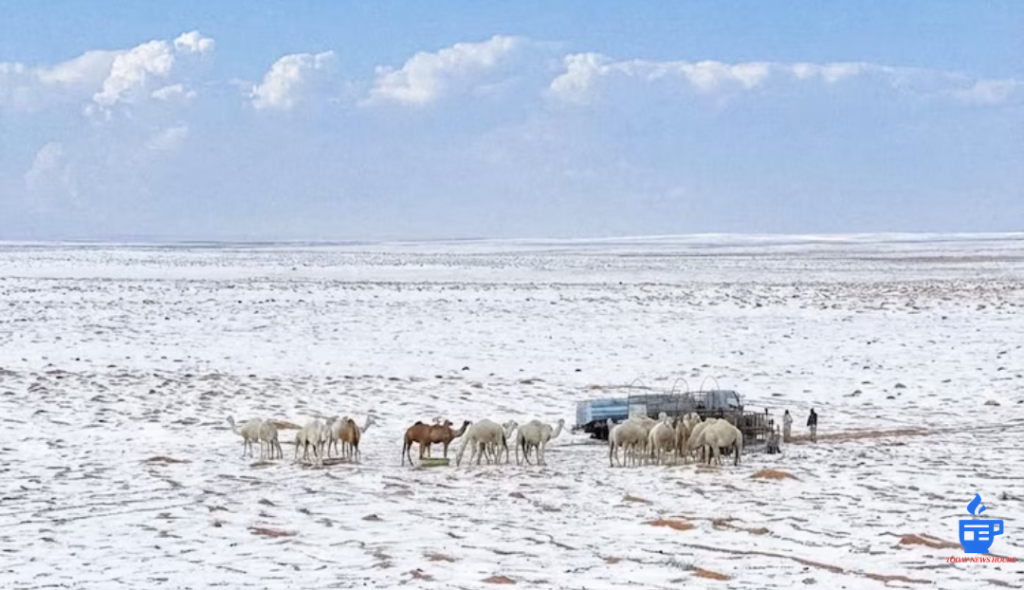
In an extraordinary weather event, Saudi Arabia has witnessed a rare snowfall that blanketed the desert landscape, a sight unseen for 30 years. The snowfall, which began on December 17, 2025, and continued through the week, has transformed the golden sand dunes of the kingdom into a stunning winter wonderland.
Snow Sweeps Across Saudi Arabia
Regions including Tabuk, Hail, Qassim, and areas near the capital Riyadh were affected by this unexpected weather event, with temperatures plummeting to freezing levels. In the Tabuk region, temperatures dropped as low as -4°C at Jabal Al-Lawz, a location known for its mountain peaks, making the snow even more remarkable for Saudi Arabia’s usually warm climate.
The Cause of the Cold Snap
The National Center of Meteorology (NCM) attributes this unusual cold wave to a deep low-pressure system originating from the Mediterranean Sea, which pushed frigid air southward into the Arabian Peninsula. According to Hussein Al-Qahtani, spokesperson for the NCM, the cold air interacted with rain-bearing clouds, resulting in the unprecedented snowfall.
Snowfall in Unlikely Locations
While snow is often seen on the mountain peaks in Saudi Arabia, it’s rare for it to cover desert plains. This time, snow was recorded in Al-Majmaah, Al-Ghat, and even areas near Riyadh, with snow accumulating on open fields and elevated terrain. In Al-Ahsa, known for its warm climate, residents were also taken by surprise when snow began to fall.
Historical Context: Cold Waves in Saudi Arabia
The NCM noted that the most intense cold wave in Saudi Arabia’s history occurred in 1992, when Hail station recorded temperatures as low as -9.3°C. However, in January 1973, a powerful polar surge from Siberia brought 20 cm of snow to Riyadh, an event that remains a significant part of Saudi Arabia’s weather history.
Climate Change and the Warming Paradox
Scientists suggest that climate change could be influencing extreme weather events like this one. Experts from the World Meteorological Organisation have highlighted that the Arab region is warming at a rate nearly twice the global average, leading to what’s known as the “warming paradox”. This phenomenon explains how higher global temperatures can hold more moisture in the atmosphere, resulting in increased intensity of extreme weather events, including both heatwaves and unforeseen cold snaps.
Saudi Arabia’s Cold Future
This rare snow event aligns with Saudi Arabia’s Vision 2030, which aims to develop a high-altitude winter destination in the Sarawat Mountains. As part of the $1.5 trillion Neom megacity project, Trojena will host the Asian Winter Games in 2029, marking a major shift for the kingdom as it embraces a colder future in its economic strategy.
Looking Ahead: More Extreme Weather?
Climatologists are warning that while no single weather event can definitively confirm climate change, the growing frequency of unusual weather patterns across the region—ranging from flash floods to sudden cold spells—suggests that Saudi Arabia and surrounding areas may continue to experience more unpredictable weather extremes in the years ahead.

