Climate & Environment
Delhi’s Green Firecrackers Aim to Cut Pollution, But Still Emit Ultrafine Particles
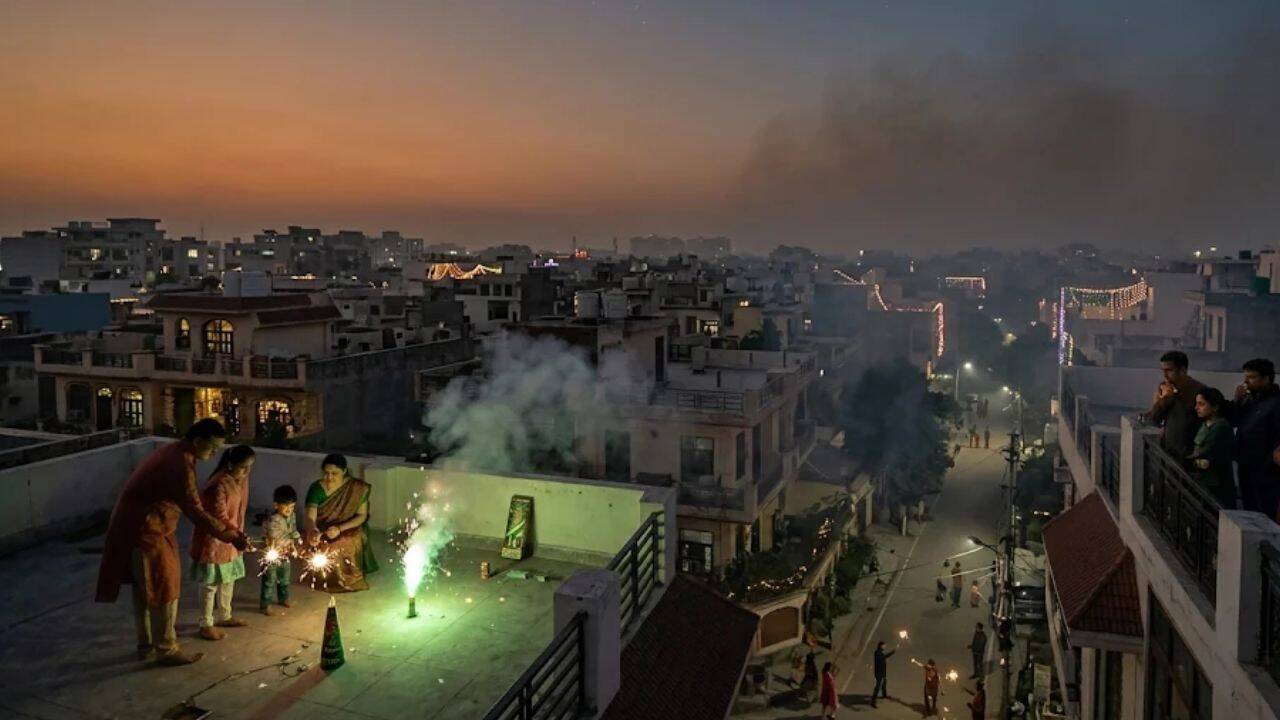
Delhi has permitted the use of green firecrackers on November 7 and 8 between 6‑7 am and 8‑10 pm, following a Supreme Court decision. Green crackers are designed to produce less air and noise pollution than conventional fireworks. They target a minimum 30 % reduction in particulate matter (PM) emissions and at least a 10 % cut in gaseous emissions, and are engineered to generate noise levels below 125 decibels at a distance of four metres from the burst point.
However, a study by Delhi Technological University found that green crackers still produce high concentrations of ultrafine particles, which are more hazardous than PM2.5 and PM10.
The chemical makeup of the two types of crackers differs. Conventional crackers contain 34 % aluminium, 57 % potassium nitrate and 9 % sulphur. Green crackers contain 29 % aluminium, 28 % potassium nitrate, 38 % of a proprietary Fe₂O₃ material developed by CSIR‑NEERI, and 5 % sulphur. Green crackers therefore use 14 % less aluminium, 44 % less sulphur, 50 % less potassium nitrate and emit 30 % less PM. The flash powder used in conventional crackers costs ₹132 per kilogram, compared with ₹95 per kilogram for green crackers.
Green crackers are made without several chemicals that appear in conventional fireworks, including barium nitrate, lithium, mercury, arsenic and cadmium. They carry a green logo of CSIR‑NEERI and PESO, along with encrypted QR codes to help consumers identify them.
Conventional fireworks can produce very high PM2.5 concentrations. Measurements taken 1–6 feet from the burst point recorded 64,500 µg/m³ for a snake tablet, 38,450 µg/m³ for a garland (ladl of 1,000), 28,950 µg/m³ for a pulpul, 10,390 µg/m³ for sparklers (fullhand), 9,490 µg/m³ for a ground spinner (chakri) and 4,860 µg/m³ for a flower pot (anar).
Delhi has imposed a series of firecracker bans over the years. In 2015, when no ban was in place, pollution readings on November 10–12 were 353, 343 and 360. In 2016, readings on October 29–31 were 404, 431 and 445. In 2017, the Supreme Court banned the sale of firecrackers for the first time; readings on October 18–20 were 302, 319 and 403. In 2018, a nationwide ban allowed only green crackers; readings on November 6–8 were 338, 281 and 390. In 2019, only green crackers were allowed in Delhi between 8‑10 pm; readings on October 26–28 were 287, 337 and 368. In 2020, a complete ban on all firecrackers in the NCR was imposed but widely flouted; readings on November 13–15 were 339, 414 and 435. In 2021, a complete ban was imposed in Delhi but flouted; readings on November 3–5 were 314, 382 and 462. In 2022, a complete ban was imposed but flouted; readings on October 23–25 were 259, 312 and 303. In 2023, a complete ban was imposed but flouted; readings on November 11–13 were 220, 218 and 358. In 2024, a complete ban was imposed but flouted; readings on October 30–November 1 were 307, 328 and 339. In 2025, only green crackers were allowed between 6‑7 am and 8‑10 pm, but restrictions were widely flouted; readings on October 19–21 were 296, 345 and 351.
Frequently asked questions
What are the key differences in composition between green and conventional firecrackers?
Conventional crackers contain 34 % aluminium, 57 % potassium nitrate and 9 % sulphur. Green crackers contain 29 % aluminium, 28 % potassium nitrate, 38 % of a proprietary Fe₂O₃ material, and 5 % sulphur.
What pollution readings were recorded during the 2025 green cracker period?
Readings on October 19–21 were 296, 345 and 351.
What noise level are green firecrackers engineered to produce?
They are engineered to generate noise levels below 125 decibels at a distance of four metres from the burst point.