Space
Euclid Telescope Discovers 31 Ancient Quasars, Including Two New Record‑Holding Distant Objects
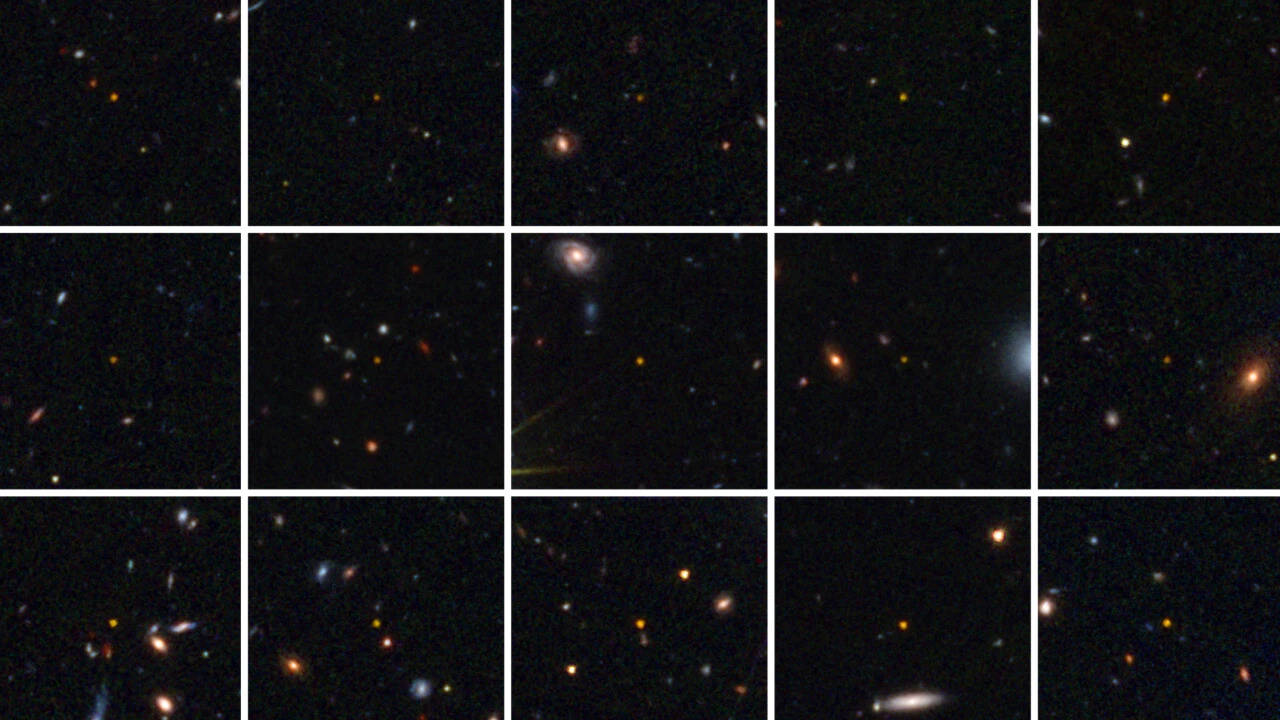
The European Space Agency’s Euclid space telescope has identified 31 quasars that existed when the Universe was only about 670 million years old, roughly five per cent of its current age. Two of the quasars, EUCL J172902.75+641018.1 and EUCL J125308.55+705432.3, hold the record for the most distant quasars ever observed, with redshifts of about 7.77 and 7.69, respectively. Their light has travelled more than 13 billion years to reach Earth, allowing scientists to study conditions in the early Universe.
Euclid, launched in July 2023, was designed to map the cosmos and investigate dark matter and dark energy. The 31 quasars were found using data from Euclid’s Wide Survey, which covered roughly 3,000 square degrees of sky during its first year and a half. Follow‑up observations were made with the Keck Observatory, the Magellan telescopes and the Large Binocular Telescope.
The study, led by Daming Yang of Leiden University and published in Astronomy & Astrophysics on 6 July 2026, notes that 12 of the quasars have redshifts of seven or higher, placing them within the first 770 million years of the Universe. Professor Daniel Mortlock of Imperial College London contributed methods for identifying these distant objects, including the use of Bayes’ theorem.
The discovery more than doubles the number of known quasars from this early period and includes some of the faintest quasars found at redshifts above 7.5, expanding the sample beyond the brightest objects previously detected.
Quasars are extremely luminous regions at the centers of galaxies, powered by supermassive black holes that accrete surrounding gas and dust. The resulting accretion disc releases vast amounts of energy, making the quasar hundreds or thousands of times brighter than its host galaxy. Studying these ancient quasars provides insight into the growth of early black holes and the evolution of the first galaxies during the cosmic dark ages.