Space
Voyager 1 to Reach One Light‑Day from Earth on Nov 18, 2026
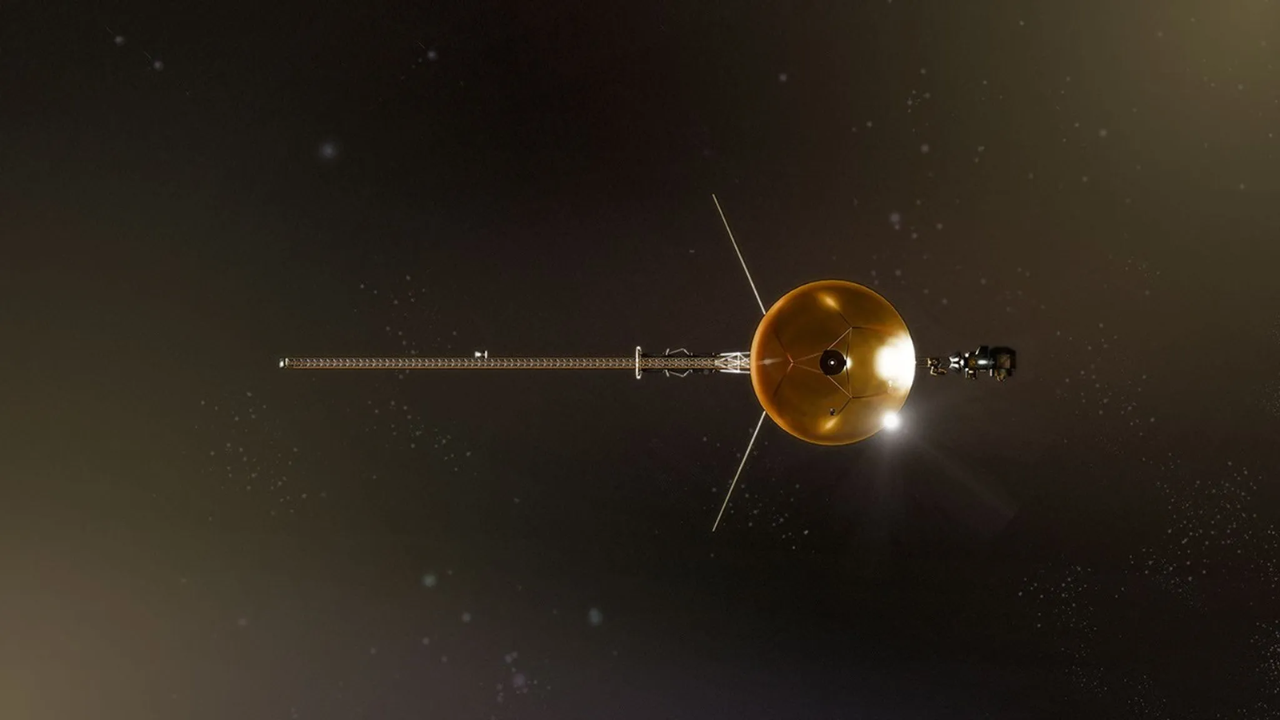
Voyager 1, launched by NASA on 5 September 1977, is expected to reach a distance of one light‑day from Earth—about 25.9 billion km—at roughly 3.46 pm IST on 18 November 2026. A message sent from Earth would take 24 hours to arrive, and a reply would take another 24 hours.
The spacecraft was originally designed to study Jupiter and Saturn. It used gravity assists from the two planets to travel faster than its launch date would have allowed, overtaking its twin Voyager 2. Voyager 1 reached Jupiter in March 1979, where it discovered active volcanoes on Io, two new moons (Thebe and Metis), and a faint ring. In November 1980 it flew past Saturn, finding five new moons, a new ring (the G ring), and revealing the complexity of Saturn’s rings. It also observed Titan’s thick nitrogen‑rich atmosphere.
In February 1990, while about 6 billion km from Earth, Voyager 1 captured the famous “Pale Blue Dot” image of Earth, a small speck in a ray of sunlight. After that, its cameras were turned off, but its scientific instruments continued to operate.
On 25 August 2012 Voyager 1 crossed the heliopause, the boundary of the Sun’s protective bubble, becoming the first human‑made spacecraft to enter interstellar space. The crossing was confirmed in 2013 after plasma measurements. Voyager 2 followed into interstellar space in November 2018. Voyager 1 now studies the interstellar medium, measuring magnetic fields, plasma waves, and high‑energy particles.
The spacecraft carries a 12‑inch gold‑plated copper disc known as the Golden Record, created by Carl Sagan and a team of scientists. The record contains 115 images, greetings in 55 languages, music from around the world, and everyday sounds, along with instructions for playback and information to locate Earth.
Voyager 1 is powered by three radioisotope thermoelectric generators that convert heat from plutonium‑238 decay into electricity. As the power output declines, NASA has shut down nonessential instruments and heaters. As of November 2026, only two instruments remain active: a magnetometer and a plasma wave detector.
The spacecraft communicates with Earth via NASA’s Deep Space Network. Recent years have seen intermittent communication loss, but contact has been restored. Engineers performed a power‑saving operation in September 2026, swapping high‑power devices for lower‑power ones.
Voyager 1 travels at about 61,000 km per hour. At this speed it will take tens of thousands of years to reach another star. In roughly 40,000 years it will pass near Gliese 445, remaining about 1.7 light‑years away. Before that, its power will eventually run out, ending its scientific mission and radio transmissions, though the craft itself will keep moving through the galaxy.
The spacecraft’s journey began nearly 50 years ago and continues to provide unique data about the outer planets and the interstellar medium, while carrying a message from Earth into the darkness between the stars.
Frequently asked questions
When will Voyager 1 reach one light‑day from Earth?
Voyager 1 will reach one light‑day from Earth on 18 November 2026 at roughly 3.46 pm IST.
How long will a message take to travel between Earth and Voyager 1?
A message sent from Earth would take 24 hours to arrive at Voyager 1, and a reply would take another 24 hours.
Which instruments are still active on Voyager 1 as of November 2026?
As of November 2026, only the magnetometer and the plasma wave detector remain active on Voyager 1.