Law & Justice
Ohio Appeals Court Affirms 1843 Land‑Use Condition for 2.63‑Acre Public Square
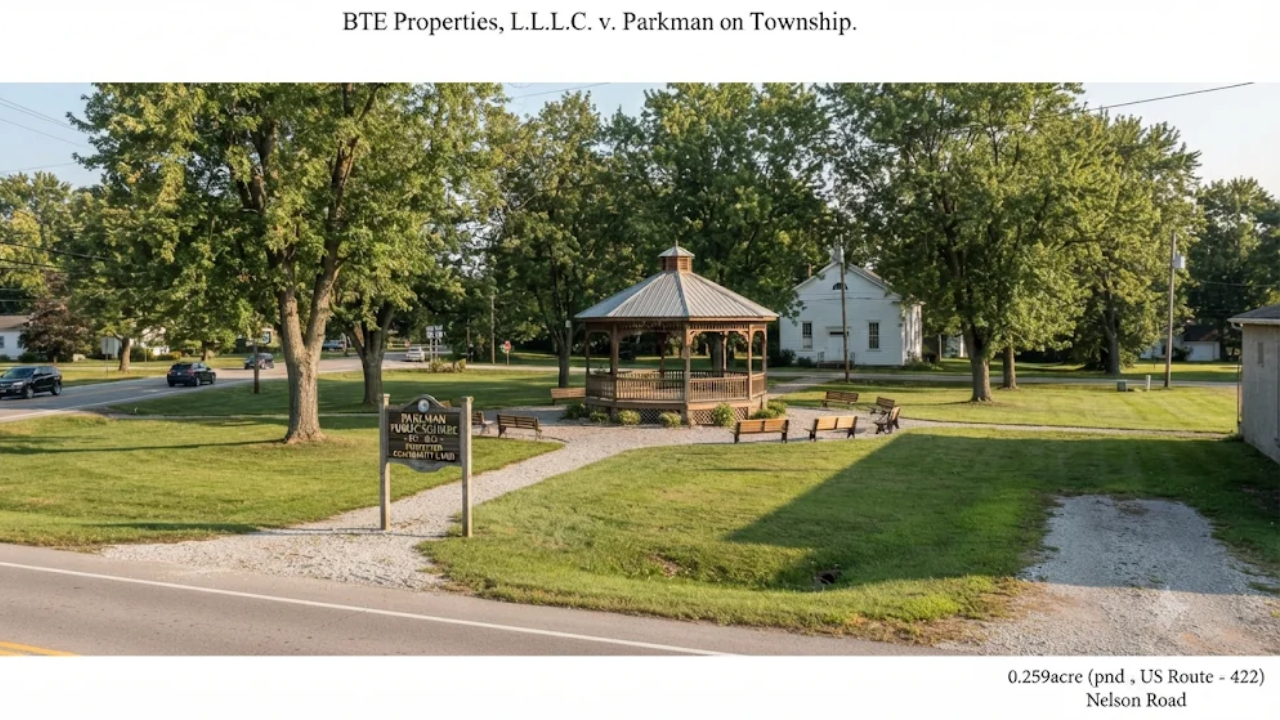
An Ohio Court of Appeals for the Eleventh District upheld a land‑use rule from 1843, keeping a 2.63‑acre parcel in Parkman Township, Ohio, protected as a public square more than 180 years after it was sold for 10 cents. On 16 November 2026, the court ruled that the condition recorded in the 1857 deed remains valid and enforceable, even after developers tried to challenge it. The case involved BTE Properties, L.L.C., ABC Development, L.L.C., A.L.L., Inc. and Parkman Township. Judge John J. Eklund wrote the decision, joined by Presiding Judge Matt Lynch and Judge Scott Lynch. The appeals court affirmed the earlier ruling of the Geauga County Court of Common Pleas, which had kept the rule in place and rejected the developers’ effort to have it removed.
The original transaction occurred on 7 June 1843, when Simon and Nancy Perkins conveyed 2.63 acres at the corner of Nelson Road and US Route 422 to Parkman Township for 10 cents. The deed, recorded on 8 June 1857, required the land to be held in trust for local residents and visitors and to remain a public square or open area. It prohibited buildings or other structures, allowing only railings along a public footpath. The parcel has served as a town park since then, with a bandstand erected in 1887, a gazebo, benches and walking paths.
Developers BTE Properties and ABC Development sought to acquire a 0.2596‑acre strip of the original Perkins land to create a driveway to a nearby parcel lacking road access. The 2018 deed for that strip reiterated the 1857 condition. BTE later combined the strip with adjacent land to form a 2.6298‑acre business lot. ABC Development agreed to purchase the lot on 12 December 2023, but the deed condition created a title issue. The parties amended their sale contract on 1 March 2024 to make the sale contingent on resolving the title problem. On 16 April 2024, BTE and ABC filed a lawsuit in the Geauga County Court of Common Pleas seeking to have the 1843 condition declared unenforceable.
In May 2024, A.L.L., Inc., a neighboring property owner, requested to join the lawsuit. The company argued it had a strong interest in preserving the public square rule. ABC opposed the request, while BTE did not protest. The trial judge allowed A.L.L. to join on 12 June 2024, and the company filed a claim for an injunction and a ruling that the condition remained active. Parkman Township filed its answer on 3 July 2024. On 17 February 2026, the trial judge ruled that A.L.L. could not remain in the case because its property did not directly border the disputed strip, but upheld the validity of the 2018 deed condition against BTE, ABC and future buyers.
A.L.L. appealed to the Eleventh District Court of Appeals. The appeals court examined Ohio Civil Rule 24(A) regarding the right of an outside party to intervene. It found that once Parkman Township filed its answer and actively defended the rule, the township’s actions satisfied the same interests A.L.L. claimed to protect. The court concluded that A.L.L. had no automatic right to intervene and dismissed the appeal, ordering A.L.L. to pay the appeal costs.
The 16 November 2026 ruling confirms that the 1843 land‑use condition remains enforceable. BTE Properties and ABC Development failed to overturn the lower court’s decision. The case is recorded as BTE Properties, L.L.C. v. Parkman Township, case number 2026‑G‑0009, citation 2026‑Ohio‑4537.
Frequently asked questions
What was the original purpose of the 1843 land‑use condition?
The condition required the 2.63‑acre parcel to be held in trust for local residents and visitors and remain a public square or open area, prohibiting buildings except railings along a public footpath.
Who were the parties involved in the 2026 appeals court decision?
The parties were BTE Properties, L.L.C., ABC Development, L.L.C., A.L.L., Inc., and Parkman Township. The decision was written by Judge John J. Eklund and joined by Presiding Judge Matt Lynch and Judge Scott Lynch.
What was the outcome for A.L.L., Inc. in the appeals case?
The appeals court dismissed A.L.L., Inc.’s appeal, finding it had no automatic right to intervene, and ordered it to pay the appeal costs.