Climate & Environment
Typhoon Faxai Tears Apart Japan's Largest Floating Solar Plant Months After Launch, Prompting Redesign
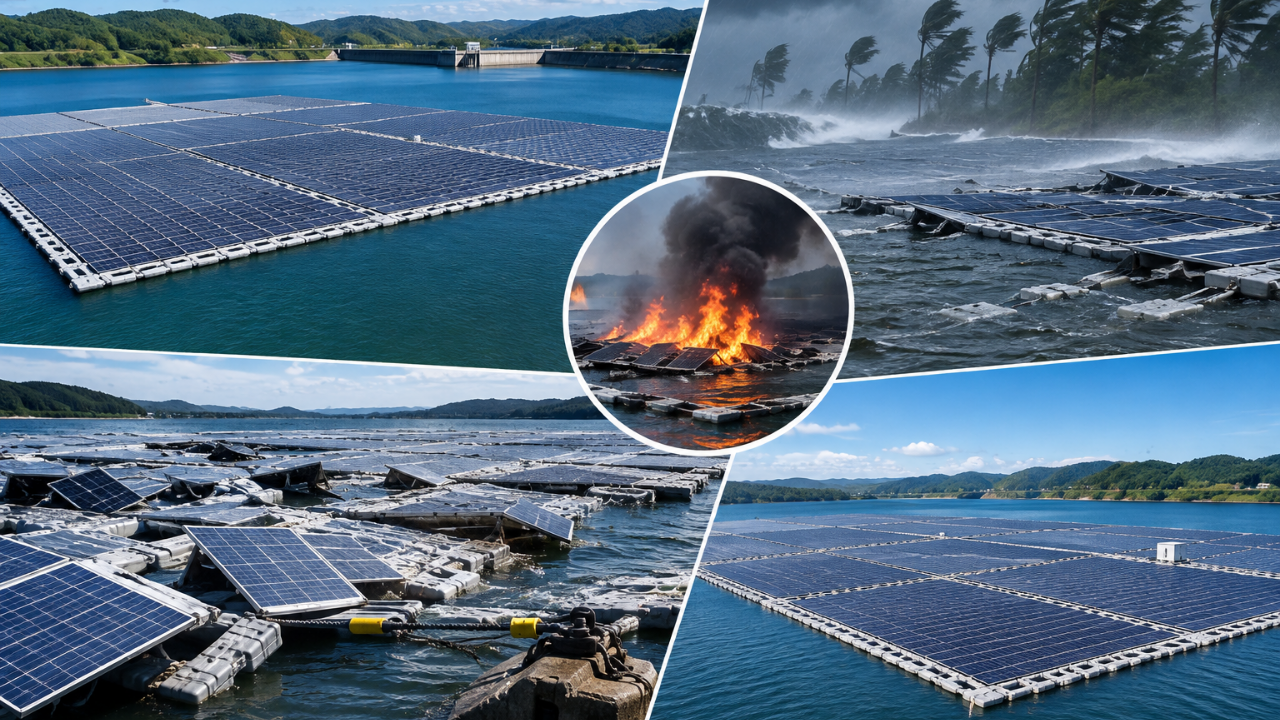
A major typhoon in 2019 severely damaged one of Japan's largest floating solar installations, just 18 months after it began operating, exposing engineering vulnerabilities in reservoir-based solar technology.
The 13.7-megawatt floating solar plant at Yamakura Dam in Ichihara, Chiba Prefecture, was inaugurated in March 2018 by Kyocera TCL Solar, a joint venture between Kyocera and Tokyo Century. At launch, it was recognized as Japan's largest floating solar plant by output, featuring 50,904 solar modules supplied by Kyocera spread across approximately 180,000 square metres, or about 44 acres, of the reservoir surface.
The facility was projected to generate about 16,170 megawatt-hours of electricity annually, enough to power roughly 4,970 households. Because Japan has limited land available for large-scale solar projects, developers chose the industrial-use reservoir as a site for the array rather than agricultural or urban land.
In September 2019, Typhoon Faxai struck the Chiba region with wind gusts reaching approximately 207 km/h, or about 129 mph, according to readings from a nearby weather station—among the strongest storms to hit the greater Tokyo area in years. At the dam, winds reported at around 120 mph tore sections of the floating array loose from their moorings.
According to pv magazine, displaced modules became stacked on top of other panels, and firefighters investigating the scene said the resulting heat buildup likely triggered a fire involving approximately 50 solar panels. The damage extended well beyond the fire itself, with a later investigation revealing that a significant portion of the floating structure had been destroyed.
Japan's Ministry of Economy, Trade and Industry conducted an investigation and identified anchor failure as the primary cause of the disaster, according to pv magazine. The floating platform had been secured using 420 anchors and 823 mooring lines. During the storm, seven anchors on the central-southern portion of the array detached. This failure caused wind loads to redistribute unevenly across the remaining structure, triggering a chain reaction of failing resin bolts that ultimately split the floating island into three separate sections. Investigators also pointed to the size, shape, and safety margins used in the original construction as contributing factors.
Following the incident, reconstruction efforts began with floating-solar specialist Ciel & Terre partnering with Kyocera to redesign the damaged sections. Rather than rebuilding the original large, interconnected floating structure, engineers opted for smaller, square-shaped floating islands intended to reduce stress concentration and improve resilience against extreme weather.
By October 2021, Renewables Now reported that Kyocera had fully restored the approximately 14-megawatt floating solar facility, demonstrating that the plant could return to full operation despite the extensive typhoon damage.
The Yamakura Dam incident has become a notable case study for the floating solar industry, highlighting both the potential benefits of using reservoir space for renewable energy generation and the unique engineering challenges such installations face, including uplift forces, structural stress, and mooring system demands during severe storms.