Climate & Environment
Delhi and 200+ Cities Hit Severe Air‑Pollution Spike After Diwali
By Anjishnu Das, Pragya Srivastava, Rupanjal Chauhan
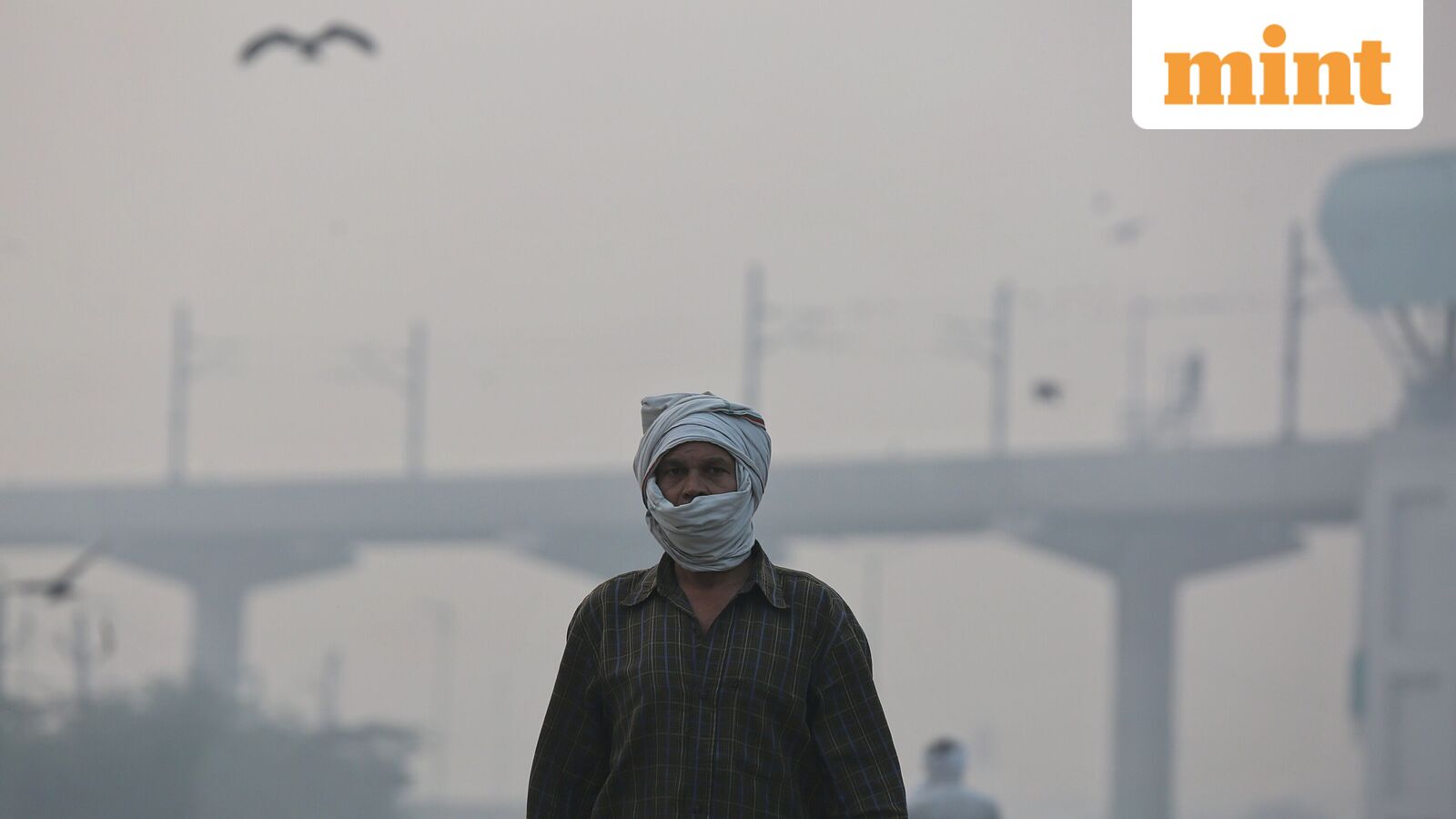
Delhi and surrounding areas routinely wake to dense smog a day after Diwali, with visibility poor and a metallic odor from fine particles. Air‑quality stations record readings so high that they go blank for hours, raising doubts about data reliability and underscoring Diwali’s harsh impact on pollution. While Delhi dominates headlines, more than 200 cities, mainly in northern and central India, also see sharp declines in air quality after the festival.
The surge is not limited to fireworks. Stubble burning in October and November adds to the problem, and winter’s cold air traps pollutants near the ground, keeping clean air unlikely until February.
Mint analysis of 15‑minute PM2.5 data from 59 Delhi stations shows levels rise around 5 pm on Diwali and spike between midnight and 2 am to 500–700 µg/m³, equivalent to smoking 25–26 cigarettes in one day. Data from 2023‑2026 confirm that this post‑Diwali surge is a regular annual pattern, not an anomaly. In 2025‑2026, levels reached dangerously high values even though the Supreme Court had allowed only certified green crackers during specific hours.
Data gaps appear after the spike. Between 12 pm on 8 November and 12 pm on 9 November, 5,664 data points were recorded, but only 4,439 were available—22 % missing, up from 14 % three years earlier. Missing points, mainly around midnight, are likely due to sensor saturation (max 1,000 µg/m³) and filter tape clogging. Delhi Pollution Control Committee data show a reading of 3,744 at Mundka around 2 am on 9 November, and 11 of 30 stations recorded brief peaks above 2,000 µg/m³.
Nationally, Delhi’s high pollution is mirrored in other cities. On Diwali, 191 cities had moderate or worse air quality; the next day, that number rose to 246. The worst 24‑hour reading on 9 November was in Bahadurgarh, Haryana, with an AQI of 400. Of 278 cities with data for both days, 213 saw AQI rises, and 30 increased by more than 100 points. In Bihar, Bettiah and Arrah saw increases over 200 points, moving from good/satisfactory to poor. Fifty‑one cities slipped from good/satisfactory to moderate/poor.
The Diwali effect is compounded by pre‑existing conditions. Delhi’s AQI was already “very poor” before Diwali because cold air trapped pollutants and stubble burning had begun to raise PM2.5 levels from 20 October, peaking at 16.3 % on 4 November and falling to 5 % by 8 November. A 2026 study found that open burning contributed 8 % to India’s annual PM2.5 in 2022, a smaller share than industry (18 %) or residential and power generation (15–16 %), but the timing of stubble burning in October‑November worsens the situation.