Climate & Environment
Legal Challenges Mount as Southeast Asian Nations Seek Accountability for Haze Fires
By John Power
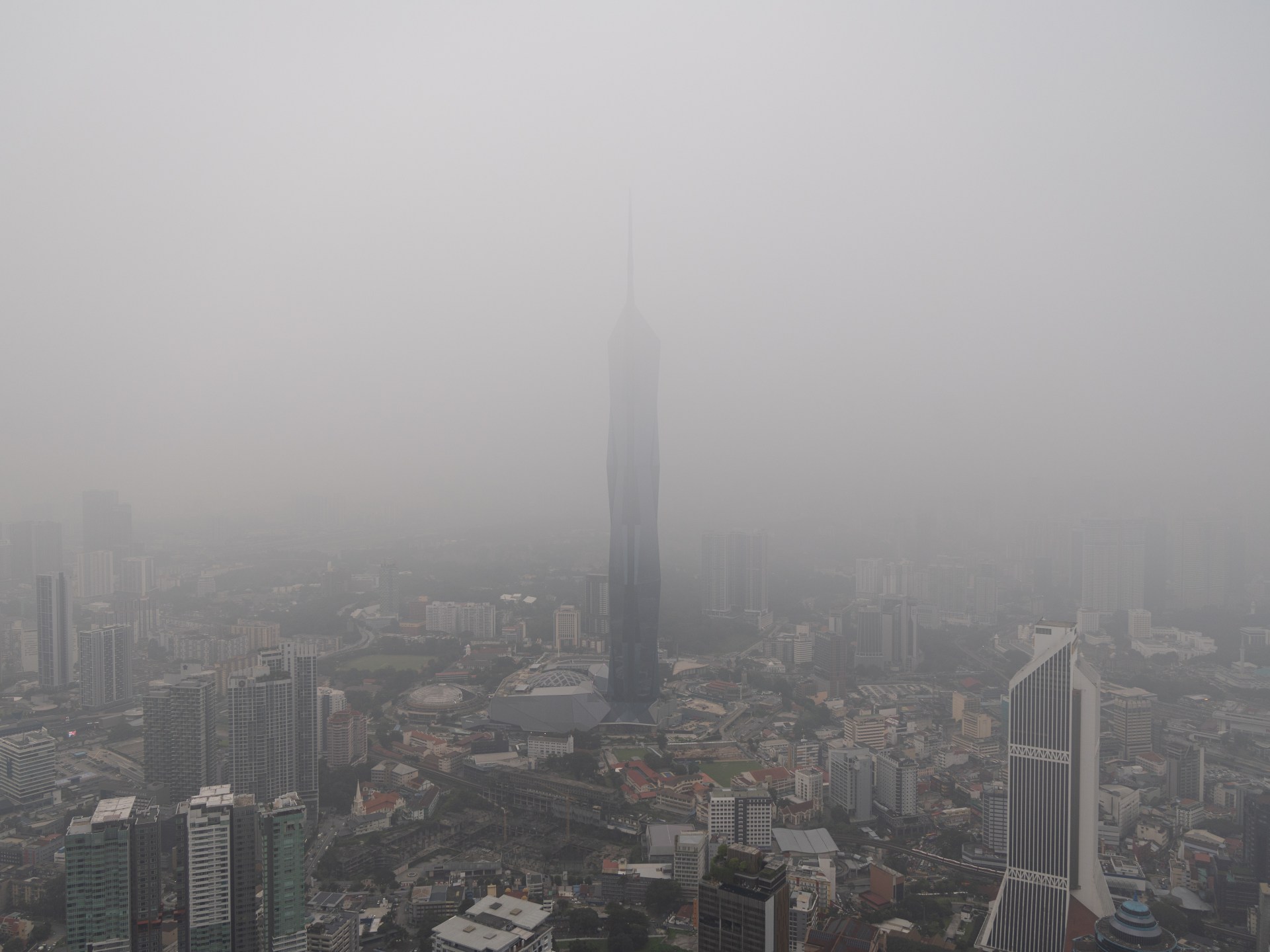
Southeast Asian governments are calling for legal action against polluters responsible for the region’s worst haze in a decade, but experts say that ASEAN’s consensus‑driven culture and weak enforcement mechanisms make such action difficult. Kuala Lumpur, Malaysia – Toxic haze from Indonesia’s large wildfires has clouded skies across Malaysia and Singapore for the past two months, prompting a growing demand for legal accountability. While a mix of domestic and international laws theoretically allows Southeast Asian states to hold polluters responsible for cross‑border haze, national sovereignty concerns, lack of enforcement mechanisms and the practical difficulties of collecting evidence make legal action hard to pursue.
The ASEAN Agreement on Transboundary Haze Pollution, signed in 2002, commits the 11 ASEAN members to tackle haze through “concerted national efforts and intensified regional and international co‑operation.” The treaty does not provide for enforcement by a judicial body such as the International Court of Justice, and disagreements over interpretation can only be settled through negotiation. Implementation has been slow; the treaty’s coordinating office in Jakarta opened only this April, nearly 25 years after the agreement was conceived.
Greenpeace Southeast Asia campaign strategist Heng Kiah Chun told Al Jazeera that diplomatic engagement, emergency firefighting and public‑health measures have not addressed the underlying causes of haze, including forest and peatland destruction, unsustainable land‑use practices and inadequate corporate accountability. Malaysia and Singapore have refrained from criticizing Indonesia, instead offering assistance to fight the fires, which are estimated to have burned more than 2 million hectares (about 5 million acres) in the archipelago.
Associate professor and legal expert Mohd Hazmi Mohd Rusli of Universiti Sains Islam Malaysia said that Southeast Asia’s emphasis on consensus and non‑interference has hampered action. He added that economic interests and diplomatic considerations also play a role, and that Malaysia and Singapore traditionally favor diplomatic engagement over direct confrontation. Rusli argued that ASEAN should strengthen its existing treaty through independent monitoring, clearer compliance procedures, greater corporate accountability and stronger domestic enforcement.
With diplomatic efforts having little impact, attention has turned to the possibility of using domestic laws with extraterritorial reach, an approach pioneered by Singapore. Singapore’s 2014 Transboundary Haze Pollution Act allows authorities to prosecute polluters for activities taking place overseas, with violators liable for fines of 100,000 Singapore dollars ($78,300) a day up to a maximum of 2 million Singapore dollars ($1.56 million). The act also enables the National Environment Agency to issue notices directing companies to cease burning on their lands. The agency has issued such notices to 10 Indonesia‑based firms during this year’s wildfire season, but no company has been prosecuted under the law.
Evidentiary challenges remain. Prosecutors would likely struggle to establish guilt beyond a reasonable doubt without firsthand evidence from Indonesia. Alan Khee‑Jin Tan, an environmental law expert at the National University of Singapore, said that direct evidence can only be obtained if Indonesian authorities investigate and share evidence with Singapore. He noted that companies could defend themselves by claiming the fires started outside their concessions.
Malaysia’s government has said it could consider legislation similar to Singapore’s, but cautioned that implementation would be difficult. In 2023, the government abandoned proposals for a law against cross‑border haze, citing the difficulty of obtaining evidence for prosecution. Legal action also risks inflaming diplomatic tensions. In 2016, Singapore and Indonesia were embroiled in a dispute after Singapore’s environmental agency attempted to summon the director of an Indonesian company linked to the haze. Indonesia’s then environmental minister, Siti Nurbaya Bakar, accused Singapore of lacking “mutual respect.”
Tensions have flared again during the latest haze season. Indonesian President Prabowo Subianto criticized countries that “like to insult” his nation over the fires, while pledging to expose foreign companies he claimed were also responsible. Prabowo said his government would “step up our response” after authorities arrested individuals who started fires.
NUS law expert Tan said that Singaporean authorities could launch a test‑case prosecution against Indonesian companies without Jakarta’s assistance, but they are unlikely to do so unless Indonesian authorities act first. He warned that a failed prosecution could expose the legislation as toothless and that unilateral action could be politically controversial.
Associate professor of law Eugene Tan Kheng Boon at Singapore Management University said Indonesia’s failure to take stronger action is the ultimate stumbling block, but countries could strengthen their own laws and regulations. He suggested requiring commodities such as palm oil sold in the region to be certified as sustainably sourced, encouraging consumers to boycott products from responsible companies, and holding banks that finance polluters accountable.
Matthew Baird, director of the Asian Research Institute for Environmental Law, said that stronger political will is needed. He compared the situation to China’s 30‑year effort to reduce air pollution in Beijing, noting that Southeast Asian governments must work together on strategic options, hold directors and companies accountable, and enforce criminal offences for land burning.