Science
From Rich People Snatching Candy to Splash-Free Urinals: 2025 Ig Nobel Prizes Celebrate Quirky Science
By Jack Guy
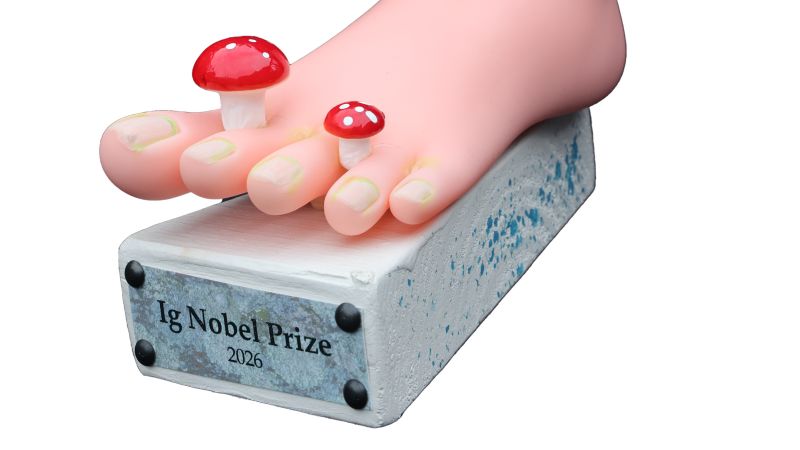
Scientific research doesn't always involve white lab coats and high-tech equipment. Sometimes it means gently poking a venomous snake to see what provokes it to bite. That unusual study was among ten pieces of research honored Thursday at the 36th annual Ig Nobel Prize ceremony in Zurich, Switzerland, an event designed to celebrate science that "first makes people laugh, and then makes them think."
Organized by the magazine Annals of Improbable Research as a lighthearted parody of the Nobel Prizes, this year's ceremony was themed around fungi. The event featured the traditional paper airplane throwing and included a new operatic performance about fungi, with actual Nobel laureates dressed as mushrooms.
Among this year's winners, a study on unethical behavior among the wealthy took the economics prize after finding that upper-class individuals were more likely to take candy from a supply meant for children, among other unethical acts. The chemistry prize went to research revealing that cockroach milk contains three times the energy of cow's milk.
In the medicine category, a study titled "How to Blow the Nose — An Aerodynamic Study of the Nose Blowing" was recognized. The biomechanics prize was awarded to researchers who examined the evolutionary history of kissing. Matilda Brindle, an evolutionary biologist at the University of Oxford and co-author of that study, told CNN that science faces growing skepticism, particularly in fields not directly tied to commercial or technological outcomes. "Curiosity for its own sake is fundamental to how science moves forward," she said.
The physics prize went to research on designing splash-free urinals, while the technology prize was awarded for a technique using mosquito mouthparts as 3D printing nozzles — a process the researchers called "necroprinting." Changhong Cao, an associate professor of mechanical engineering at McGill University in Canada and co-author of that study, said the Ig Nobels help "legitimize exploratory thinking," adding that the discovery came from paying attention to something that initially seemed irrelevant.
Carly Anne York, an associate professor of biology at Lenoir-Rhyne University in North Carolina who was not involved in the awards, praised this year's winners for transforming seemingly odd ideas into legitimate scientific work. She noted that about half of all economic growth in the United States can be traced to discoveries stemming from basic research. York, author of a book on unconventional scientific discoveries, suggested the mosquito-inspired 3D printing model could eventually lead to new, painless methods of administering medication. "Gaining knowledge is never a frivolous endeavor," she said, "no matter how silly the topic may seem."