Science
Early Blindness and Musical Training Reduce Auditory Internal Noise, Enhancing Pitch Discrimination
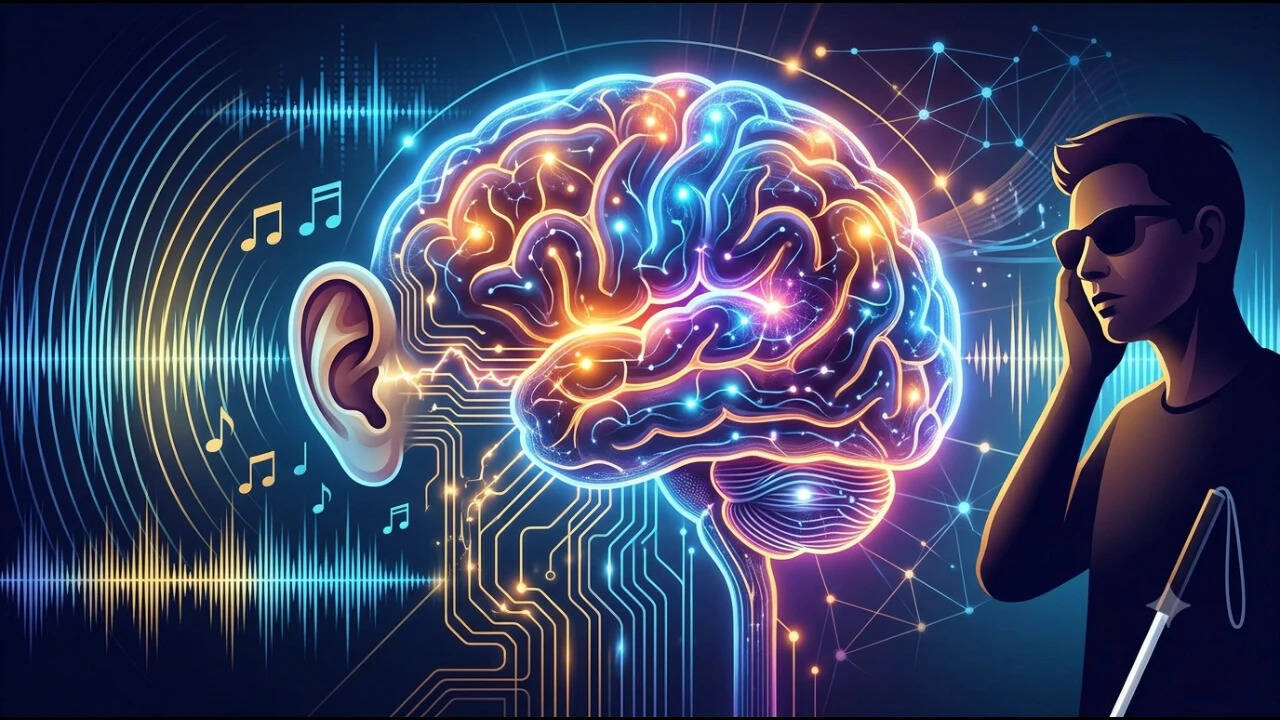
A study published in the Journal of Neuroscience found that people who became blind before age two have better pitch discrimination than sighted peers, not because their ears are more sensitive but because their brains process sound more consistently. The research examined nine early‑blind participants and 18 sighted individuals, all with varying musical training. Participants completed two hearing tasks: detecting a tone amid background noise, which tests cochlear frequency response, and identifying which of two tones had a higher pitch, which relies on cortical interpretation. Only the pitch‑discrimination task showed superior performance by the early‑blind group. A mathematical model revealed that these individuals had lower levels of “internal noise,” a measure of how consistently the auditory system responds to the same sound over time. Lower internal noise means more reliable sound processing, facilitating discrimination of similar pitches.
Sighted musicians also exhibited reduced internal noise and more consistent auditory responses compared to non‑musicians, suggesting that both early blindness and musical training can shape auditory processing through brain plasticity. The authors propose that sensory experiences help the brain develop refined templates for interpreting sound, making responses more reliable.
The findings may inform training methods to improve auditory abilities, such as helping people with emerging vision loss rely more on hearing for navigation. Future research will explore how much training is required, which auditory experiences are most influential, and whether the benefits extend to complex everyday listening. The team also plans to investigate whether the timing of vision loss or musical training affects the degree of plasticity.
Source: Journal of Neuroscience
Frequently asked questions
What does the study reveal about pitch discrimination in early‑blind individuals?
The study found that people who became blind before age two have better pitch discrimination than sighted peers, due to lower internal noise in their auditory processing.
How does musical training affect auditory processing according to the study?
The study shows that sighted musicians also have reduced internal noise and more consistent auditory responses compared to non‑musicians, indicating that musical training can shape auditory processing through brain plasticity.