Space
Pakistan’s Zeeshan Ali to Join China’s Shenzhou‑24 Mission to Tiangong Space Station
By Abid Hussain
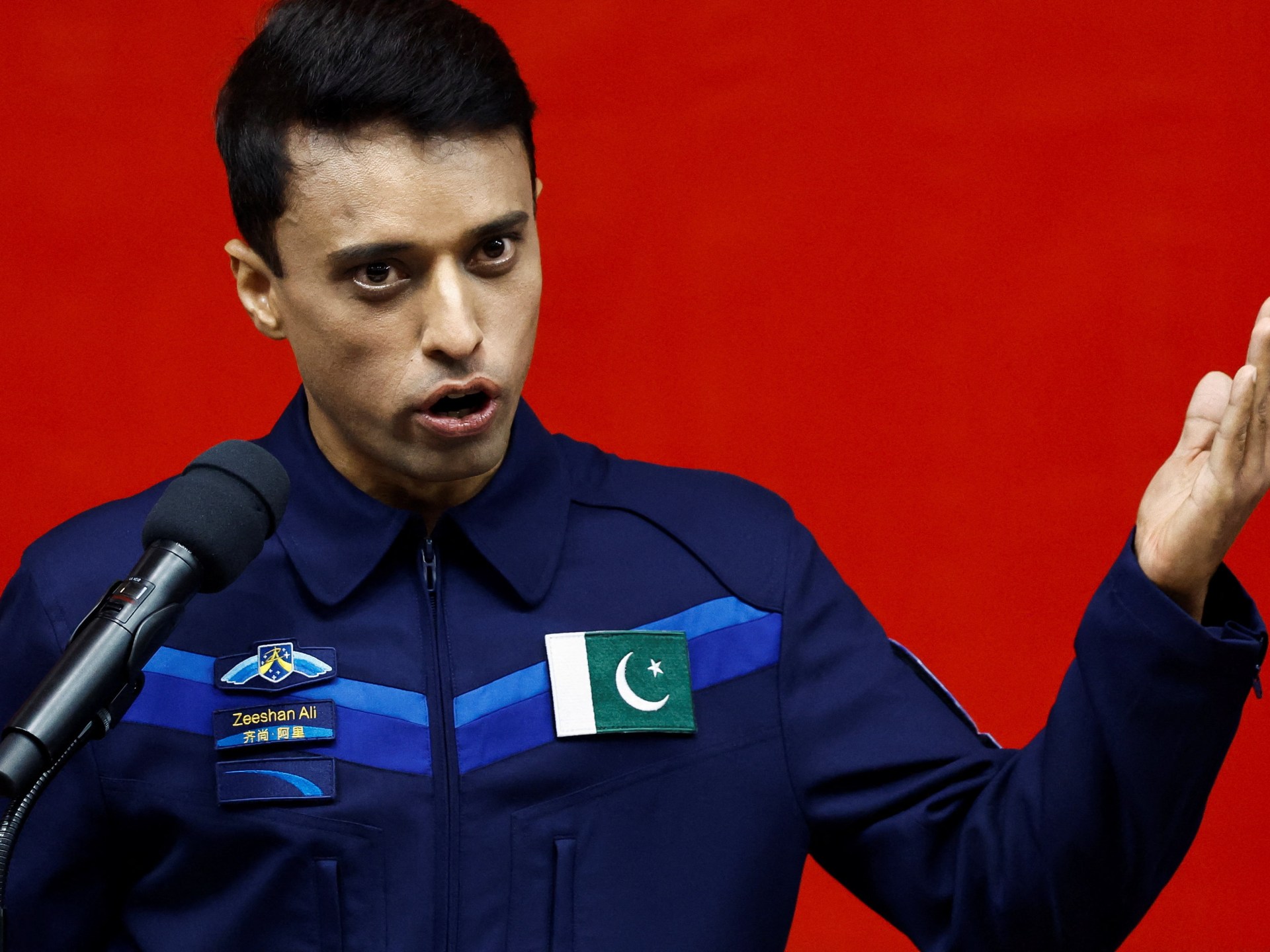
Pakistan is preparing to send its first astronaut to space on Wednesday when Air Force pilot Muhammad Zeeshan Ali, 40, will board China’s Shenzhou‑24 spacecraft for a brief mission aboard the Tiangong space station. Ali will serve as a payload specialist alongside commander Tang Hongbo and flight engineer Wu Yi. The launch is scheduled from the Jiuquan Satellite Launch Center in northwest China at 8:18 am Beijing time (00:18 GMT), which is 5:18 am Pakistan time.
China Manned Space Agency (CMSA) spokesperson Zhang Jingbo said the flight would be the first joint mission involving Chinese and foreign astronauts in China’s crewed space program. After reaching orbit, the spacecraft will perform an autonomous rendezvous lasting about three and a half hours before docking with the forward port of the station’s Tianhe core module.
Ali’s stay on the station will be short; he will return to Earth aboard Shenzhou‑23 after a brief joint flight, while Zhu Yangzhu, a member of that crew, will remain in orbit for a year. Pakistan’s Space and Upper Atmosphere Research Commission (SUPARCO) has stated that Ali will spend about a week on the station.
During a news conference in Jiuquan, Ali told reporters that he carries the name of Pakistan and the hopes of 250 million Pakistanis on his shoulder. He and fellow Air Force pilot Khurram Daud were selected through a three‑stage process that included screening, medical, psychological and technical assessments. CMSA named them reserve astronauts on 22 April, and they began training in Beijing on 24 April.
Planning Minister Ahsan Iqbal, who is in China for the launch, praised both men on X, noting their excellent performance in training. Ali thanked his instructors, SUPARCO and CMSA, at the conference, saying that history had already been made.
Scientific experiments on the mission will focus on biotechnology and materials. Ali will oversee China‑Pakistan experiments, install samples and equipment, and conduct tests in orbit, including an experiment with cyanobacteria. SUPARCO said the experiments cover materials science, fluid physics, life sciences and biotechnology, with potential applications in climate resilience, food security and industrial innovation.
Training for the mission emphasized professional skills, crew coordination and language. Ali described mastering technical Chinese as a major challenge. He noted that the two countries had moved quickly after signing their astronaut agreement in February 2025.
Zhang highlighted the flight as a milestone in China‑Pakistan cooperation, noting that Pakistan is a strategic partner and that the mission opens a path for international collaboration on the Chinese station.
Looking ahead, Ali said the mission is a launchpad for future cooperation, including multiple joint flights and potential missions to the Moon, Mars and beyond. SUPARCO confirmed that Pakistan is working with China on a lunar mission tentatively planned for 2028, though details remain undisclosed. The country’s lunar program has so far focused on robotic missions, such as the iCube‑Qamar satellite that reached lunar orbit on China’s Chang’e‑6 mission in 2024 and a rover scheduled for Chang’e‑8 in 2028.
China aims to place astronauts on the Moon by 2030, with preparations underway for the Long March‑10 rocket and Mengzhou crewed spacecraft.
Frequently asked questions
When and where will Zeeshan Ali launch into space?
He will launch from the Jiuquan Satellite Launch Center in northwest China at 8:18 am Beijing time (00:18 GMT), which is 5:18 am Pakistan time on Wednesday.
How long will Ali stay on the Tiangong space station?
Ali will spend about a week on the station, performing experiments before returning aboard Shenzhou‑23.