Space
University of Washington Builds Life‑Free Earth Model to Benchmark Exoplanet Atmospheres
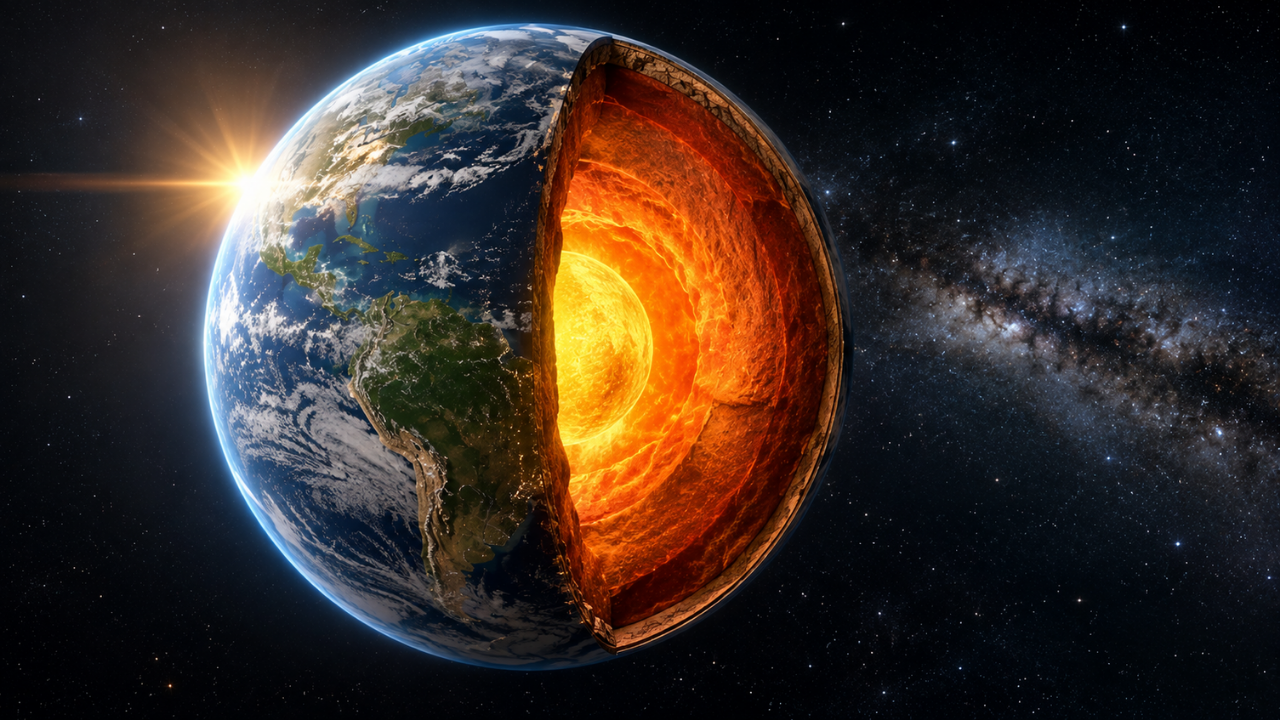
Scientists at the University of Washington have created a detailed computer simulation of Earth that tracks the movement of chemicals between the planet’s core, mantle, crust, surface, and atmosphere over roughly five billion years, from its formation about 4.5 billion years ago to 500 million years into the future. The model deliberately excludes biological processes, allowing researchers to examine how a planet’s environment could evolve through natural geological and atmospheric mechanisms alone. The study, published on 18 September 2026 in The Planetary Science Journal under the title *A Whole‑planet Model of the Earth without Life for Terrestrial Exoplanet Studies*, shows that the simulation reproduces 19 key observations of pre‑industrial Earth, including mantle heat flow, within estimated measurement uncertainties.
The research builds on earlier work by senior author Rory Barnes, an associate professor of astronomy, who had developed a model that included the core, mantle, crust, and stellar radiation but omitted surface and atmospheric processes. The new version, led by Samantha Gilbert‑Janizek, adds these systems to provide a more complete representation of the planet.
The authors argue that the model can serve as a baseline for studying rocky exoplanets. By inputting basic parameters of a distant world, astronomers can simulate how its atmosphere might develop without life and compare the predicted composition with telescope observations. If the model reproduces the observed gases, they may have a non‑biological origin; if not, the planet could become a higher‑priority target for further investigation.
Lead author Gilbert‑Janizek noted that the model helps differentiate non‑living but habitable planets from those that might host life. Senior author Barnes described the work as a step toward more reliable simulations of distant planets and a tool that could inform the design of future space telescopes aimed at probing exoplanet atmospheres.
The study does not claim to have found extraterrestrial life, nor does it confirm its existence elsewhere. It provides a scientific reference for separating natural planetary processes from potential biological influences as astronomers continue to discover new worlds beyond our solar system.
Frequently asked questions
What does the UW model simulate?
It simulates the movement of chemicals between Earth's core, mantle, crust, surface, and atmosphere over about five billion years, excluding biological processes.
How can the model help exoplanet studies?
By inputting basic parameters of a distant rocky planet, astronomers can simulate its atmosphere without life and compare predicted composition with observations to assess non‑biological origins.