Science
Children’s Family Drawings Offer Insight Into Their View of Home Life
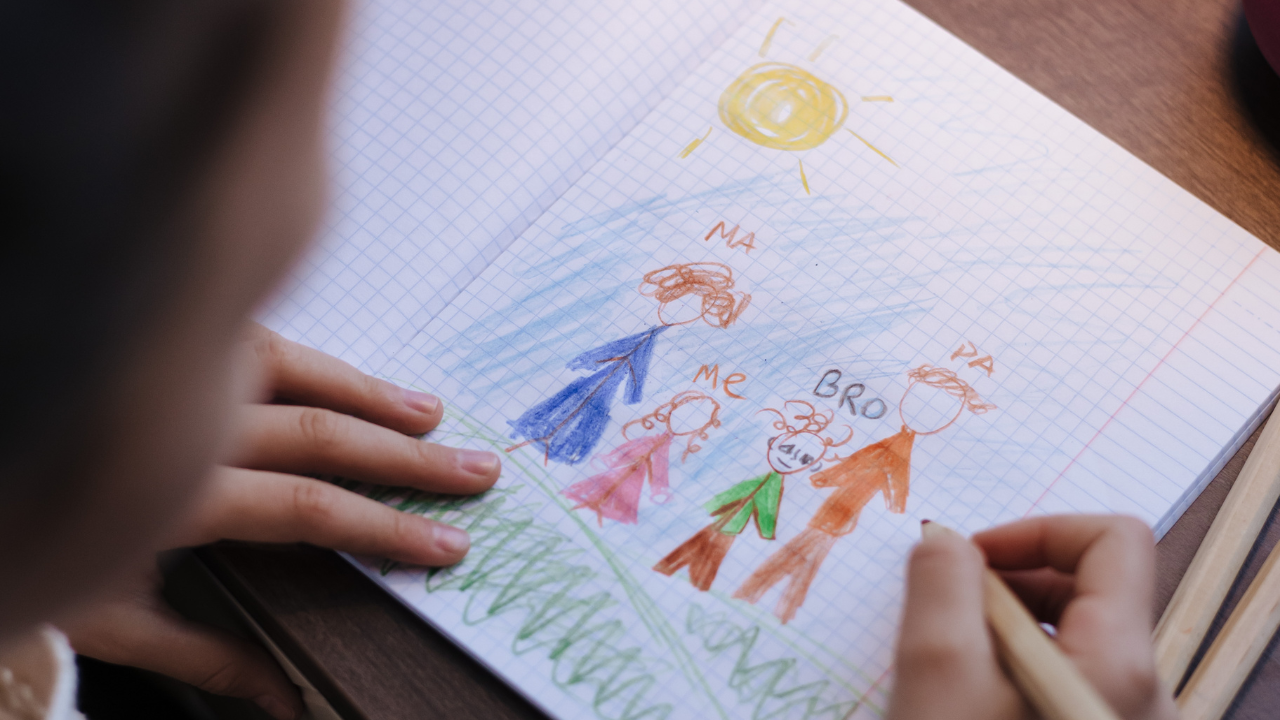
A child sits with a sheet of paper and crayons and is asked to draw their family. Some children depict everyone holding hands, others place a grandparent at the centre, and a third spends most of the time drawing a pet. While these drawings may seem ordinary, psychologists have long studied them to understand how children perceive family relationships, emotional closeness, and their own place within the household.
Family drawing is a technique used in developmental and clinical psychology. One variation, the Kinetic Family Drawing test, asks children to draw family members doing something rather than simply standing together. This shifts the focus from who belongs to the family to how the child imagines family members interacting. A child might draw a parent helping with homework, a sibling playing with toys, or the entire family sitting together at dinner.
A 2013 study published in *The Arts in Psychotherapy* examined kinetic family drawings from 120 preschool children, comparing drawings from children with different levels of internalising problem behaviours. The researchers found significant differences across several drawing categories, suggesting that the technique could contribute to understanding children’s experiences. However, the findings do not mean that a particular scene reliably identifies anxiety or emotional difficulties. The drawings should be used as one source of information, not as a diagnostic test.
In a family drawing, children make choices about whom to include, how to arrange people, and what each person is doing. These choices may reveal which relationships or experiences are most prominent in their minds. For example, a child who draws a grandparent helping them eat, a parent reading a bedtime story, or a sibling sharing toys is representing familiar interactions. Asking about these scenes can help parents discover which moments the child remembers and values.
The distance between figures can also be worth discussing. If a child draws two family members on opposite sides of the page, a parent might wonder whether this reflects how the child sees their relationship. But the distance could equally be explained by the child running out of space or simply arranging the picture that way.
A 2022 paper in *Frontiers in Psychology* reviewed the strengths and limitations of family drawings as a way to explore attachment. It discussed how trained professionals examine combinations of features, including the arrangement of figures, their completeness and the overall emotional tone of a picture. The authors also highlighted the importance of asking children to identify the people they have drawn and explain their relationships. Psychologists do not interpret a single feature in isolation; the wider drawing, the child’s explanation and other information about their experiences all matter.
If a child leaves someone out, it may be tempting to assume that the omitted person is less important. That conclusion would be premature. Children may leave people out because they are tired, distracted, short of time or focused on a particular family activity. They may also understand the instruction differently from how an adult intended it. Nevertheless, the omission can become an opportunity for a gentle conversation. Instead of asking, “Why didn’t you draw Grandma?” a parent could ask, “Tell me about everyone in your picture. Is there anyone else you would like to add?” The response may reveal something unexpected.
A 2010 study examining kinetic family drawings from 51 children explored how sibling relationships appeared in children’s drawings and accompanying accounts. The researchers identified examples in which siblings were absent from the drawing or the child’s story, or appeared at a distance from other family members. Such findings illustrate why drawings can be useful starting points for exploring children’s perceptions, although they cannot establish what an omission means in an individual case.
The activities children draw may be just as revealing. A child may draw everyone eating together, playing a board game, watching television or helping with household chores. Another might depict a parent working on a laptop while the child plays nearby. These scenes can help parents understand which routines their children notice and how they remember spending time together.
A 2024 study published in the *European Early Childhood Education Research Journal* examined kinetic family drawings alongside questionnaires and interviews involving 46 children aged five to six in China. The findings explored how children perceived family interactions, including the roles of parents and grandparents and relationships between siblings. The study offers an example of how children’s drawings can be considered alongside their own accounts and other information to understand family life from their perspective. Its relatively small sample and specific cultural setting mean that its findings should not be generalised to every child or family.
Interpreting family drawings is more complicated than identifying a symbol and assigning it a meaning. A child drawing themselves smaller than a parent does not automatically indicate low self‑esteem. Dark colours do not necessarily mean sadness, and a missing smile does not prove that a child is unhappy at home. Drawing ability, age, attention, imagination, the available materials and the child’s immediate mood can all influence the result. A 1998 review in the *British Journal of Clinical Psychology* concluded that children’s drawings are too ambiguous to serve as reliable standalone indicators of their emotional experiences or psychological state.
Parents should therefore resist comparing siblings’ pictures or treating one drawing as evidence of a family problem. If a child repeatedly expresses distress, shows significant changes in behaviour or shares worries about a relationship, those concerns deserve attention in their own right. A qualified child psychologist can help assess persistent concerns using appropriate methods.
The most useful response to a child’s family drawing may be curiosity rather than interpretation. Parents can try a simple activity at home: give the child paper and crayons and invite them to draw the family doing something together. Let them decide whom to include and what the family is doing. Once the picture is complete, ask open‑ended questions such as: “Can you tell me what’s happening here?” “What is everyone doing?” “Which part of this picture would you like to tell me about?” “If you could add anything to this picture, what would it be?” Listen without correcting the child or suggesting what they should have drawn. Avoid turning the activity into a test of affection by asking who they love most or why one person is bigger than another. Most importantly, allow the child to change the subject if they wish.
A family drawing cannot tell parents everything about a child’s inner world. But when approached without assumptions, it can offer something valuable: a chance to see familiar relationships through the child’s eyes and hear what they might not otherwise think to say.