World
Mexico President’s Economy‑Class Trip to China Highlights Leadership, Bloomberg Reports
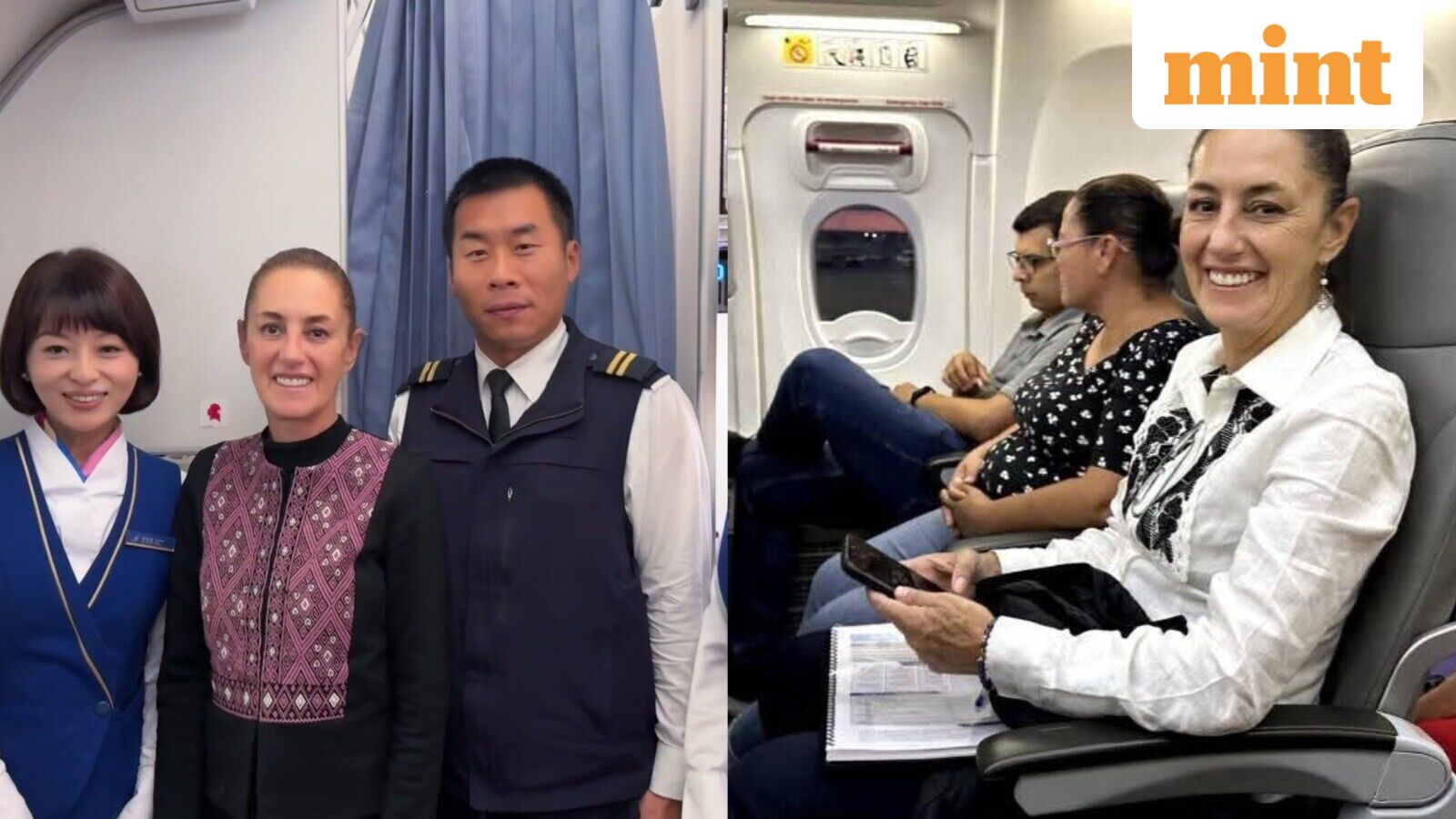
Industrialist Harsh Goenka praised Mexican President Claudia Sheinbaum for flying to China in economy class for the APEC summit, calling her 21‑hour journey a lesson in leadership and public accountability. In a post on X, Goenka noted that Sheinbaum travelled in a middle seat and used an ordinary airport shuttle after arriving in China. He added that Mexico had earlier sold its $200 million luxury presidential aircraft, directing the proceeds to public priorities such as hospitals.
The trip has attracted attention in China, where a hashtag related to her arrival reportedly received 10 million views on Weibo. Bloomberg reported that a Weibo user under the handle Signal and Noise 001 said fellow passengers on a Mexico City‑Shenzhen flight operated by China Southern Airlines confirmed that Sheinbaum was seated in 33B, an economy‑class seat toward the rear of the aircraft. A Mexican diplomat familiar with the matter told Bloomberg that the president travelled in economy class on the China Southern Airlines flight from Mexico City. The aircraft made a technical stopover in Tijuana, with the total journey taking around 21 hours.
Footage shared on Sheinbaum’s X account showed her being welcomed at Shenzhen airport by a military guard and a dancing troupe dressed in pink. She was seen arriving on an airport bus rather than being greeted as she stepped off an aircraft.
Claudia Sheinbaum Pardo, an environmental engineer and politician, has served as Mexico’s president since 2024. She is the first woman and the first Jewish person elected to the country’s highest office. Born on June 24 1962 in Mexico City, she studied physics at the National Autonomous University of Mexico (UNAM), graduating in 1989, and earned a master’s degree in 1994 and a PhD in energy engineering in 1995 from the same university. She worked as a faculty member and researcher at UNAM’s Institute of Engineering from 1995 to 2000 and again from 2006 to 2015, authoring more than 100 articles and two books on energy, the environment and sustainable development. She was also a member of the Intergovernmental Panel on Climate Change (IPCC). In 2007, the IPCC and former U.S. vice president Al Gore jointly received the Nobel Peace Prize for their efforts to build up and disseminate greater knowledge about man‑made climate change.
Before becoming president, Sheinbaum held several political and administrative positions, including secretary of the environment of Mexico City (2000‑2006), head of the Tlalpan delegation (2015‑2017), and head of government of Mexico City (2018‑2023). Her predecessor, Andrés Manuel López Obrador, sold Mexico’s presidential aircraft in 2023 to the government of Tajikistan after taking office in 2018. Bloomberg reported that the former president, who rarely travelled outside Mexico and was critical of foreign summits, sold the aircraft at a loss to the government.
Sheinbaum’s warm reception in China comes against the backdrop of tensions over Mexico’s trade policy. Her government has embraced higher duties on a range of Chinese imports, drawing a sharp rebuke from Beijing. The move also came as U.S. President Donald Trump pressured countries in the Americas under his so‑called Donroe Doctrine to assert U.S. dominance over the Western Hemisphere. After a brief meeting with Trump in Shenzhen, Sheinbaum told reporters that Mexico and the U.S. were close to reaching a trade agreement that negotiators had long struggled to finalise.
“Even so, Sheinbaum is well received in China,” said Alfredo Montúfar‑Helu, managing director for Ankura China Advisors based in Beijing. He added that Sheinbaum’s popularity reflected growing awareness of Mexico in China, including interest in Mexican food and cultural celebrations such as the Day of the Dead, which gained popularity in China following the 2017 release of Pixar’s animated film Coco.
Sheinbaum met Chinese President Xi Jinping in Shenzhen on Tuesday. The two G20 leaders discussed strengthening trade ties and increasing Mexican exports to China. She described the meeting as “very cordial” and said the two countries discussed cooperation in areas including trains, vehicles, agriculture, tourism and health.