World
Iran Intensifies Gulf Attacks Amid U.S. Sanctions and Blockade
By Urooba Jamal
Tehran has increased attacks in recent days as the U.S. naval blockade and sanctions campaign hurt the country economically. The Islamic Revolutionary Guard Corps (IRGC) said it targeted radars at a U.S. military base in Bahrain, and Iran has intensified attacks over the past week, hitting tankers in the Strait of Hormuz and downing U.S. drones. At least 25 tankers have been struck in and around the Strait of Hormuz, through which a fifth of global oil and gas passes, in the past seven days, causing Gulf oil flow to drop sharply. Iran’s President Masoud Pezeshkian said his country is facing a “silent economic war” amid U.S. sanctions and a naval blockade.
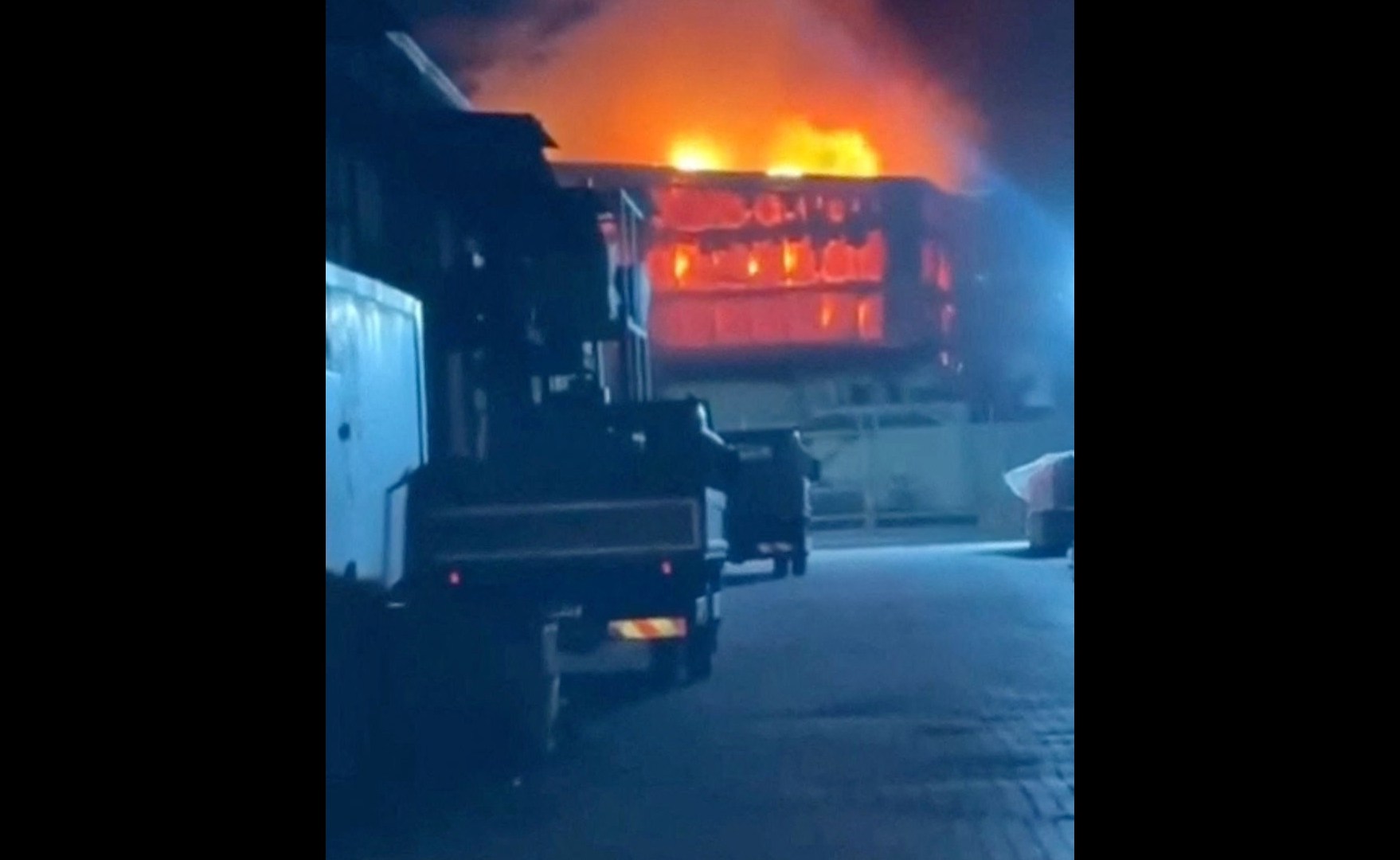
Bahrain has borne the brunt of Iran’s attacks in recent days. On Saturday, Manama reported an Iranian strike on a civilian industrial facility that started a fire, while the IRGC carried out a combined missile and drone operation targeting U.S. military positions at the al‑Riffa and Awali bases, claiming to have destroyed two U.S. Patriot air‑defence radars. Iranian state media reported that an interceptor missile launched from the U.S. Fifth Fleet base in Bahrain crashed on Sitra Island near Manama, sparking a large fire. The IRGC said the operation was retaliation for a U.S. strike on a radar installation on Iran’s Hengam Island. Iran has justified the attacks as a response to continued violations of its airspace, including by U.S. MQ‑1 and MQ‑9 reconnaissance and combat drones.
Bahrain has faced three drone attacks in recent days after a lull in fighting for several weeks. Iran’s army said its air defences fired a missile at a U.S. F‑16 jet over the Gulf the previous evening, damaging the aircraft, the IRNA news agency reported. However, U.S. Central Command (CENTCOM) denied the claim, stating that “all U.S. fighter jets in the Middle East are safe and accounted for”. Iranian forces on Sunday also said they shot down another MQ‑1 drone east of the Strait of Hormuz. The IRGC claimed it was the 20th U.S. drone of this type to be shot down since the war began in late February and the fourth in the past 24 hours.
Meanwhile, British maritime authorities reported two incidents involving tankers struck by unidentified projectiles in the Strait of Hormuz near Oman. Al Jazeera correspondent in Tehran, Resul Serdar, said incidents involving tankers had increased sharply over the past week, with about 25 since November 14. Last week, the Iranian army also said it targeted U.S. drone and missile installations at Kuwait’s Ali Al Salem base after the U.S. struck Qeshm Island in the Strait of Hormuz, which remains under effective Iranian control.
Oil passing through the Strait of Hormuz has seen a considerable dip as Iran has escalated attacks on a near‑daily basis. According to the UK Maritime Trade Operations (UKMTO), 263 ships passed through the key waterway between November 12 and 18, 15 percent fewer than the previous week and 20 percent fewer than the week before that. Of those vessels, 37 were oil tankers, down from 52 the previous week. The figures could be higher as vessels passing through as part of shadow fleets are not officially registered. About 135 ships passed daily through the vital strait before the war began in February. Last week, the U.S. maritime agency warned that the Iran blockade was adding to rising Gulf premiums, with insurance rates up from 0.10‑0.25 percent before the war to 3.5‑7.5 percent. Oil prices spiked, crossing $100 a barrel before settling down to $83, still more than $15 from before the war. Cumulative losses from the conflict have now reached 2.8 billion barrels of oil and 60 billion cubic metres of gas supply from the Gulf, the International Energy Agency (IEA) said on Thursday. The IEA added that the conflict could cut world oil demand by more than 4 percent by 2035 if governments accelerate electrification, efficiency and fuel‑switching measures in response.
As Iran has ramped up attacks, senior officials have asked the U.S. to choose between surrendering to missiles or to diplomacy. The attacks indicate that Iran is using its leverage in the conflict, sending the message that U.S. allies in the region will continue to bear the brunt of its actions if the war does not end. The attacks aim to diminish U.S. military capabilities in the region and “also to spread the pain of the war widely to include the entire Gulf region and, indirectly, global economies via higher shipping costs and stressed supplies of essentials”, Rami Khouri, a public policy fellow at the American University of Beirut, told Al Jazeera. The single biggest driver of this strategy, Khouri said, is for Iran to continually ensure that it will no longer “suffer alone from U.S.–Israel‑imperial assaults”. Tehran is hoping to change U.S. policy by revealing its inability to protect its own facilities or those of its Arab allies, which could prompt Arab governments to press U.S. President Donald Trump to end the war, Khouri, who is also a nonresident senior fellow at the Arab Center Washington DC, added.
Meanwhile, Deputy Foreign Minister Kazem Gharibabadi told Iranian media that he considers the economic blockade imposed by the U.S. on Iran an act of war. “We consider the economic siege a hostile act, and we will take any necessary measures to break this economic siege,” Gharibabadi told Iranian reporters. The ongoing U.S. naval blockade on Iran, overland trade disruptions and a wave of new sanctions imposed in August as part of Operation Economic Outcast are hurting Iran economically. U.S. Treasury Secretary Scott Bessent, who has led Washington’s sanctions regime against Tehran, has claimed the economic embargo will result in a 25 percent contraction of the Iranian economy by the year ending March 2027. However, Iranian authorities insist they can withstand the economic pressure. The strikes on U.S. interests in the Gulf in recent days have therefore been viewed as a defiant response to the U.S. campaign. But there are signs that the country’s economy and common Iranians are suffering from the current conditions.
Could there be renewed military confrontation? Trump may choose to declare victory and walk away from the war on Iran rather than negotiate a deal, but continuing the naval blockade on Iran would risk further military escalation, says Trita Parsi, executive vice president of the Quincy Institute for Responsible Statecraft. Speaking to Al Jazeera, Parsi said Trump was unlikely to accept an agreement that could be seen in Washington as showing the war had failed. “If he continues the blockade, there will be escalation,” Parsi warned, arguing that Iran would not refrain from retaliating against continued economic pressure. He said Trump would need to “slowly, perhaps imperceptibly, lift the blockade, as well as lift some of the sanctions” if he wanted to withdraw from the confrontation without renewed fighting. Hassan Ahmadian, professor at the University of Tehran, said Iran is forcing a “binary” choice on Trump. If Washington lets the tankers pass, the U.S. blockade “ends without an agreement or war”, Ahmadian said on X. However, if the U.S. attacks the vessels, it could face “Iranian responses that will be difficult for [Trump] to avoid”. Trump said on Saturday he had plans to make a deal with Iran that is “permanent” and prevents it from getting a nuclear weapon. He also told U.S. broadcaster Fox News that he was never very interested in regime change in Iran, but called its new leadership “more rational”.