Law & Justice
Imran Khan Appeals to Supreme Courts for Medical Care Amid Prison Conditions
By News Desk
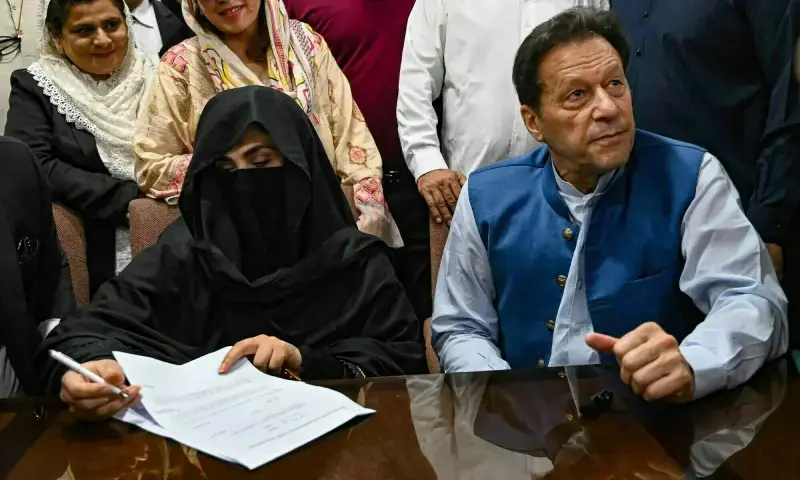
Imran Khan, the former prime minister and founder of the Pakistan Tehreek‑e‑Insaf (PTI), has written an open letter to the chief justices of the Federal Constitutional Court (FCC), the Supreme Court (SC) and the Islamabad High Court (IHC) requesting medical treatment for himself and his wife, Bushra Bibi. The letter was posted on X by Khan’s lawyer, Barrister Salman Safdar, who met the former premier in Adiala jail on November 2 and November 11. Safdar says that during the November 11 meeting Khan instructed him to “carry his words to your lordships.” The letter, signed by Safdar, details Khan’s deteriorating health and that of his wife, pleading for the courts to grant them access to medical care.
Khan writes that he has spent his life building hospitals to provide free treatment for the poor and now asks only that he and his wife receive medical attention. He says he is writing from a solitary cell, the only way his voice can leave the walls. He recounts his service to Pakistan as a cricketer, social worker, philanthropist and the country’s 22nd prime minister, and states that he has never faced a criminal case in seventy years. He describes a “unprecedented and ruthless campaign of political victimisation” that began after he turned 70, including numerous prosecutions, more than a hundred court appearances, repeated bail applications, and an assassination attempt that he survived.
Khan says that he has always fought the cases on their merits and never used illness as a tactic. He notes that relief from the courts had previously renewed his faith in justice, but after constitutional amendments the relief became limited and then ceased. He claims that the system he trusted failed to help him when he needed it most.
The letter explains that Khan and his wife have faced successive criminal trials while in Adiala jail, and their appeals remain pending. He says that after the Toshakhana‑2 judgment, in which he and Bibi were sentenced to 17 years for the purchase of a Bulgari jewellery set gifted by the Saudi crown prince in May 2021, he was isolated, denied contact with family and lawyers, and subjected to solitary confinement for up to twenty‑two hours a day. He alleges that the jail administration violated prison rules by restricting visits and communication.
Khan reports that his right eye vision has deteriorated by 85 percent, a fact that was not disclosed to his family or counsel. He says he has only met his lawyer four times in a year, while Bibi has met her counsel once. He cites the jail’s medical board, which recorded his anxiety and advised more frequent contact with family, reading material and television, but notes that the advice was not followed.
He also describes Bibi’s health problems: in April she suffered a retinal detachment and underwent a “complicated eye surgery in secrecy” before being returned to solitary confinement. Khan says that Bibi can no longer tolerate light or open her eyes and that without another surgery she may lose sight permanently. He claims that her medical records are withheld, doctors denied, and her sentence suspension unheard.
On August 18, the SC directed that Khan be transferred to Shifa International Hospital within two days, that a medical board examine him, and that he be allowed contact with family. Khan says the order has not been implemented and that his case is now on the FCC docket. He notes that his appeal in the Al‑Qadir trust case is being heard before older cases concerning health and unimplemented court orders.
Khan says his blood pressure has risen to 192 and 193 on November 10, and doctors warn that he is highly vulnerable to brain haemorrhage and cardiac arrest. He states that at 74 he may not return alive. He concludes by asking the courts for the implementation of the SC orders and proper treatment for their medical conditions, emphasizing that he wants justice before it is too late.
Khan has been in prison since August 5, 2023, while Bibi was arrested on January 17, 2025, in a separate case that sentenced the couple. The IHC allows Khan twice‑weekly meetings with family, lawyers and associates, but his visits have been largely restricted. Khan’s right central retinal vein occlusion was discovered in late January, leading to multiple hospital visits. The SC’s August 18 order to transfer him to Shifa International Hospital was not carried out; instead he was taken to PIMS and then returned to prison. Information Minister Attaullah Tarar blamed security concerns created by PTI workers for the diversion, a claim denied by PTI.
Bibi suffered a retinal detachment in April and was taken to hospital for surgery. She has sought immediate examination by an ophthalmologist and permission to receive treatment from doctors of her choice at her own expense, citing concerns over her deteriorating eyesight. Doctors who examined her diagnosed a mature cataract and advised another eye surgery.
Frequently asked questions
What does Imran Khan request in his open letter to the courts?
He requests that the courts grant him and his wife medical treatment and enforce the Supreme Court's orders for transfer to Shifa International Hospital and family contact.
What prison conditions has Khan described?
He describes solitary confinement up to 22 hours a day, denial of family and lawyer visits, and lack of medical care for his deteriorating eye vision and his wife's retinal detachment.
What did the Supreme Court order on August 18?
The SC ordered Khan to be transferred to Shifa International Hospital within two days, to have a medical board examine him, and to allow contact with family.