Agriculture
Bloomington Teen Gathers Coffee Grounds to Grow Mushrooms and Reduce Food Waste
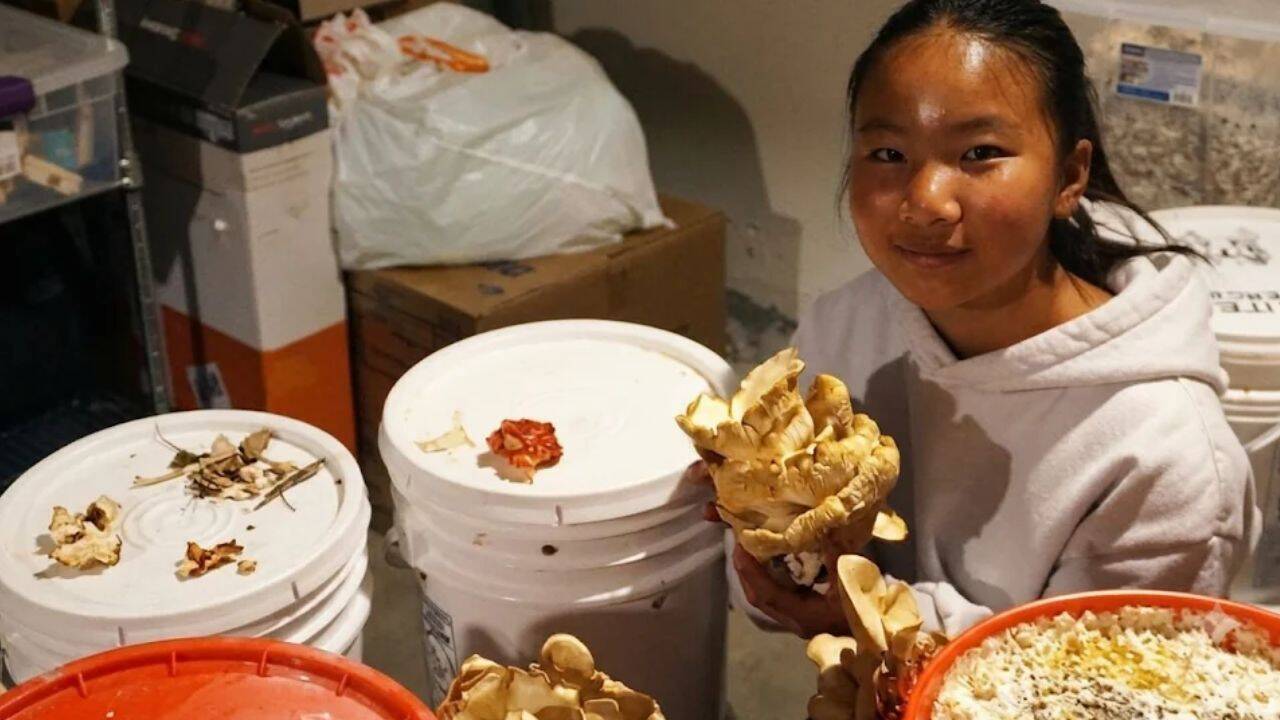
A 14‑year‑old eighth‑grader in Bloomington, Indiana, is collecting used coffee grounds from nearly a dozen local coffee shops and turning them into a growing medium for oyster mushrooms. Gloria Chi founded the nonprofit “Fungi For Future” in March after starting the project. The initiative gives discarded coffee grounds a second life by using them to grow mushrooms. Chi has repurposed more than 122 pounds of coffee grounds in her family’s basement, where mushrooms grow in plastic buckets filled with layers of grounds and straw. According to Indiana Public Media, the project has expanded beyond food production to reducing food waste and helping the environment. She plans to donate harvested mushrooms to Hoosier Hills Food Bank and give the remaining mixture to local orchards and composters.
Chi attends Jackson Creek Middle School and has been collecting coffee grounds from nearly a dozen coffee shops in Bloomington. Her partners include Starbucks, Soma Coffee House & Juice Bar, Crumble Coffee and Bakery, The Inkwell Bakery & Cafe, Hopscotch Coffee and the Bloomington Bagel Company. At Crumble Coffee and Bakery, baristas collect the used grounds in a three‑gallon bucket behind the counter on Saturdays instead of throwing them away. Chi collects the bucket before the shop closes. The shop uses at least one five‑pound bag of espresso beans daily, and often more during Indiana University semesters.
Chi began the project in early March and said collecting the grounds has not always gone smoothly. From a science project to mushroom‑growing buckets, she moved to Bloomington from Pennsylvania in July 2025. Before turning to mushrooms, she tried growing tropical fruit trees, but said the cold weather made the project difficult. She said, “It was, like, really hard because, like, it was cold, and for tropical fruit trees, you need to be warm.” “It was sort of like a failed project.” By September, she had shifted her attention to fungi after researching mushroom cultivation online. She first used a mushroom‑growing kit to learn the basics. When those mushrooms died, she decided to try growing them herself. Chi ordered mushroom spawn online and began filling buckets with layers of coffee grounds and straw. In her family’s basement, she has 10 five‑gallon buckets with holes drilled into their sides. Pink, blue and pearl oyster mushrooms grow through the openings, while white mycelium spreads through the mixture inside.
Oyster mushrooms survive by breaking down and digesting dead organic matter. As mycelium spreads through the buckets, it breaks down complex compounds in the coffee grounds. Indiana University biology professor Richard Phillips said, “Fungi produce extracellular enzymes.” “These are enzymes that release out into the soil and are involved in decomposition.” As the grounds decompose, nutrients such as nitrogen, phosphorus and potassium become more available for plants to absorb. The leftover mixture of coffee grounds, straw, and mycelium can then be used as compost. Chi plans to donate it to local orchards and composters after harvesting the mushrooms. She referred to mycoremediation, a process she described as mushrooms cleansing toxic material, and said the mixture should make good fertiliser.
Chi hoped her mushrooms could become a sustainable food source. She said, “I'm not growing as many mushrooms as I thought I would.” “I was really hoping I could solve hunger with my mushrooms.” The project has also taken on a wider purpose that is reducing food waste and helping the environment. Phillips said similar projects could potentially grow beyond one basement operation if more people became involved. Phillips said, “It sounds like the kind of project that could probably scale up very well, if it's something that a lot of people got interested and involved in.” “That could definitely have an impact on reducing food waste.” Chi has received $1,500 in grants and continues to apply for further financial support. She is working with food resource organisations around Bloomington. She said, “I am looking into some help from the community.” “I hope I can do this forever but I can’t do all this work by myself.”
Frequently asked questions
How many pounds of coffee grounds has Gloria Chi repurposed?
More than 122 pounds.
Which nonprofit did Gloria Chi found?
Fungi For Future.
Where does Gloria Chi plan to donate harvested mushrooms?
Hoosier Hills Food Bank.