Climate & Environment
Paris Agreement Turns Ten: Global Emissions Still Far From 1.5°C Target
By Marium Ali
The Paris Agreement, which entered into force on 4 November 2016, bound nearly every country to keep global warming well below 2 °C and pursue efforts to limit it to 1.5 °C. A decade later, the treaty has spurred stronger climate policies and a rapid expansion of clean energy, yet emissions remain near record highs, temperatures continue to climb, and many nations are still far from the cuts needed to keep the 1.5 °C limit within reach.
The agreement was adopted by 196 parties at the United Nations climate summit in Paris (COP21) on 12 December 2015. The United States, the world’s second‑largest greenhouse‑gas emitter after China, has joined and left the agreement twice. President Donald Trump ordered withdrawals that took effect in November 2020 and again in January 2024; President Joe Biden rejoined in February 2021. Today, 194 parties – 193 countries and the European Union – are members.
Rather than impose uniform cuts, the Paris Agreement requires each government to set its own targets through nationally determined contributions (NDCs). Countries submit a new, more ambitious NDC every five years, and a Global Stocktake assesses collective progress on the same cycle. The agreement also covers reporting, climate finance and support for developing countries, but it does not force countries to meet their targets, relying instead on transparency and international pressure to raise ambition.
Temperatures have continued to rise since the deal was adopted. In 2024, the planet was more than 1.5 °C warmer than preindustrial levels for the first time over a full calendar year. The past three years – 2023 to 2025 – were the hottest on record and the first three‑year period to average more than 1.5 °C of warming. The long‑term warming average now stands at about 1.4 °C, and scientists expect it to surpass 1.5 °C around the end of this decade. In October, the UN Environment Programme (UNEP) said the chance of keeping warming to 1.5 °C without overshooting it has been lost. “Every additional fraction of a degree and additional year of warming above 1.5 °C increases climate impacts and risks, such as the deadly floods, heatwaves and wildfires that have plagued many nations this year,” UNEP Executive Director Inger Andersen said.
The outlook is less bleak than it was in 2015. When the Paris Agreement was signed, existing policies put the world on course for about 3.6 °C of warming by 2100. According to the Climate Action Tracker, that projection has since fallen to about 2.6 °C as countries adopted climate policies and clean energy expanded. Progress has stalled since 2021, however, and current policies still point to far more warming than the agreement promised.
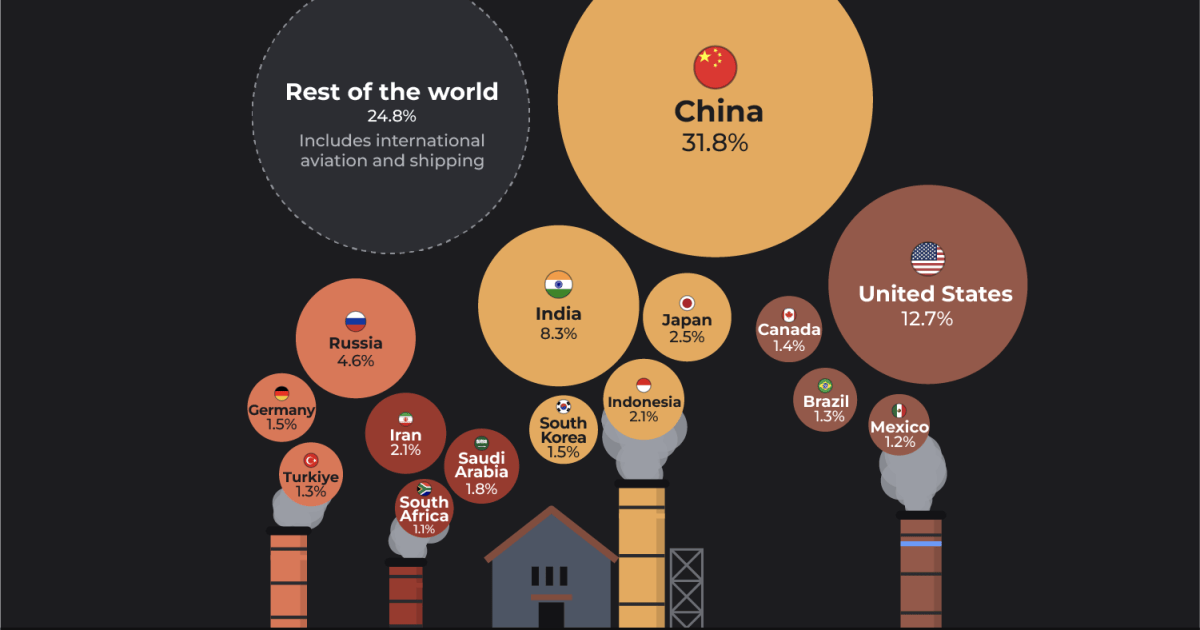
Carbon dioxide, the main driver of warming, comes mainly from burning coal, oil and natural gas, while deforestation removes trees that once absorbed it. China, the United States and India now produce more than half of the world’s annual emissions. China alone emits more than the United States, India, Russia and Japan combined, although the United States has released the most carbon emissions historically. Investments in clean energy are now almost double those in fossil fuels, but emission cuts have been too slow to keep 1.5 °C within reach.
The largest emitters in 2024 are China, India and Indonesia, whose emissions have kept rising alongside those of other fast‑growing economies that burn more coal to meet soaring power demand. Indonesia has climbed into the top 10, replacing Canada. Germany, Japan and the United States have cut their emissions, largely by replacing coal with renewables and gas. However, growth elsewhere has outweighed those cuts, and global emissions are 9 % higher than in 2016.
Frequently asked questions
How many parties are currently part of the Paris Agreement?
194 parties – 193 countries and the European Union.
What is the current average global warming relative to preindustrial levels?
About 1.4 °C.
Which countries are the largest emitters in 2024?
China, India, and Indonesia.