World
Europe’s Rising Living Costs Spark Widespread Protests
By Ayush Pandey
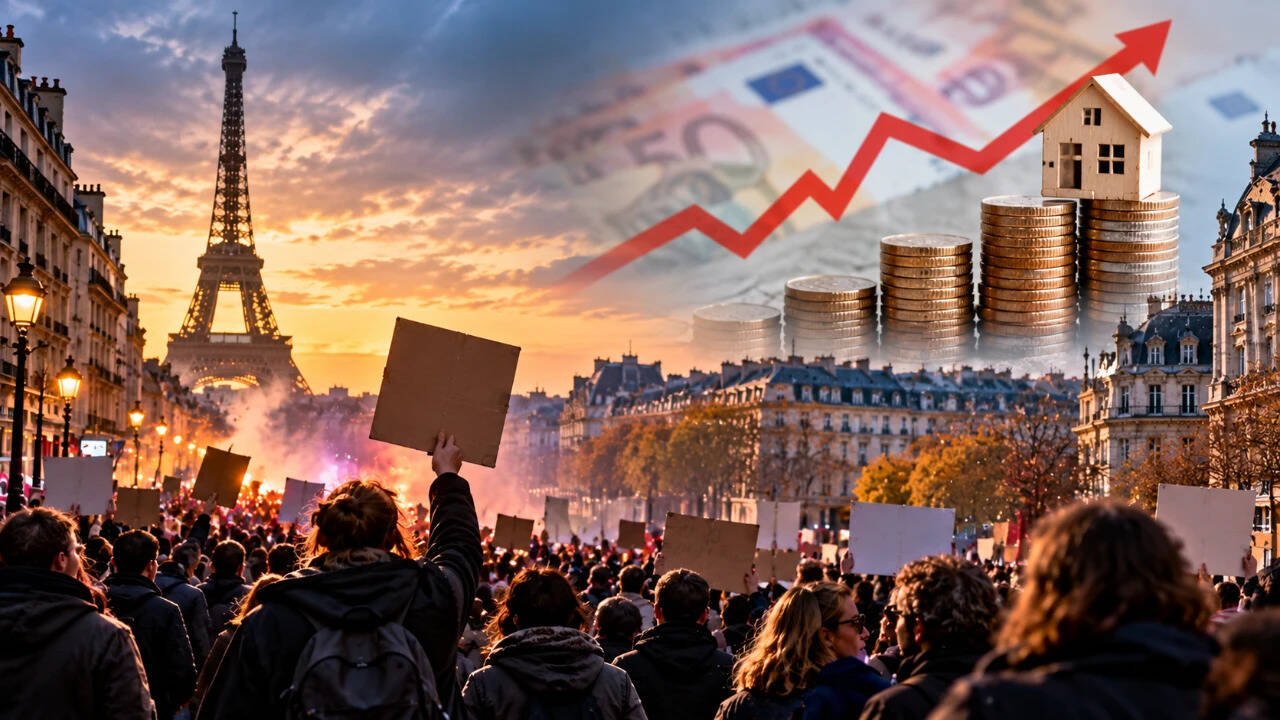
On Halloween, France is preparing for large‑scale demonstrations, with 70,000 police and gendarmes deployed nationwide to prevent a repeat of the violence that erupted earlier this month. Thousands are expected to take to the streets on Saturday as shops are boarded up and security tightened. The protests are driven by frustration over rising living costs, strained public services and the difficulty of making ends meet.
The unrest is not limited to France. Across Europe, high housing costs, expensive essentials, stagnant wages and mounting pressure on public services are turning household budgets into a source of public discontent. In Lisbon, two earners sharing a three‑bedroom city‑centre apartment have only €253 left after paying rent. In Milan, the amount is €697. In contrast, a working couple in Zurich has €9,140 remaining after rent, while in Geneva the figure is €8,783. These figures come from Deutsche Bank Research Institute’s Mapping the World’s Prices 2026 report and compare combined net salaries of two local earners with the monthly rent of a city‑centre apartment.
Eurostat’s Housing in Europe 2025 report shows that EU households spent an average of 19 % of their disposable income on housing in 2024, with Greece at 36 %, Denmark at 26 % and both Germany and Sweden at 25 %. For households at risk of poverty, housing consumed 37 % of disposable income across the EU. Between 2010 and 2024, EU house prices rose 53 %, rents 25 % and general consumer prices 39 %. Greece has the highest share of households with arrears on mortgage, rent or utility bills (43 %) and the highest housing expenditure relative to disposable income.
Food is another significant expense. Eurostat estimates that food and non‑alcoholic beverages accounted for 13.1 % of total household expenditure in the EU in 2024. The share was 18.1 % in Portugal, 15.7 % in Greece and 14.7 % in Italy; Germany and France recorded 11.1 % and 12 % respectively. The price‑level index for food and non‑alcoholic beverages is 106.8 in France, 105.3 in Greece, 104.5 in Belgium, 102.4 in Germany, 102 in Portugal and 101.1 in Italy, with Spain at 95.3 and Romania at 79.8.
Eurostat reported euro‑zone inflation of 3.8 % in September 2026, up from 3.2 % in August. Energy prices rose 18.9 % year‑on‑year, while food, alcohol and tobacco prices increased 1.3 %. Unprocessed food inflation was 4 %.
The protests have varied triggers. In France, demonstrations began over school infrastructure and teacher shortages and expanded to broader concerns about living costs, wages and public services. Spain and Portugal focus on housing affordability and the impact of tourism on local housing markets. Portugal also demands higher wages and pensions. Italy’s protests cover employment, healthcare, education, housing and opposition to rearmament. Belgium’s demonstrations address living costs and education expenses, while Albania’s protests focus on corruption and government accountability. German youth‑led demonstrations raise demands on schools, housing, climate spending and oppose restoring compulsory military service.
Professor Gulshan Sachdeva of Jawaharlal Nehru University notes that each protest has its own dynamics but that a common economic thread links many of them: economic stagnation, rising living costs, housing shortages, demographic pressures, immigration anxieties and changing political dynamics. He highlights the particular pressure on housing in southern Europe, where tourism has increased competition for residential properties.
Economists point to a broader crisis of growth, public spending and political trust. Years of weak economic growth, demographic changes, pressure on government finances and competition from emerging economies have limited governments’ ability to respond to public demands. The Ukraine conflict and Europe’s shift away from Russian energy supplies have increased energy costs, affecting production and transportation.
France’s public debt stood at 119.1 % of GDP at the end of the second quarter of 2026, while Greece, Italy and Belgium were also above the 100 % mark. Finance Minister Roland Lescure warned on 30 October that without a budgetary turnaround, France was headed “straight for a wall.”
The protests are also influenced by domestic electoral calculations. Spain will vote on 29 November 2026, France’s presidential election is scheduled for 18 April 2027 (possible runoff on 2 May), Greece is expected to hold parliamentary elections in spring 2027, and Italy’s election is due by 22 December 2027, with a possible snap poll in April 2027.
The underlying crisis is the extent to which households can retain earnings to live. If two full‑time workers in Lisbon have only €253 left after rent, before accounting for food, electricity and transport, the pressure on European households remains acute.
Frequently asked questions
How many police officers are deployed for the protests in France?
70,000 police and gendarmes are deployed nationwide.
What is the average percentage of disposable income EU households spent on housing in 2024?
EU households spent an average of 19% of their disposable income on housing in 2024.