Agriculture
Mustard Cultivation Expected to Rise to 9.5 million ha in 2026‑27 Rabi Season
By Vijay C Roy
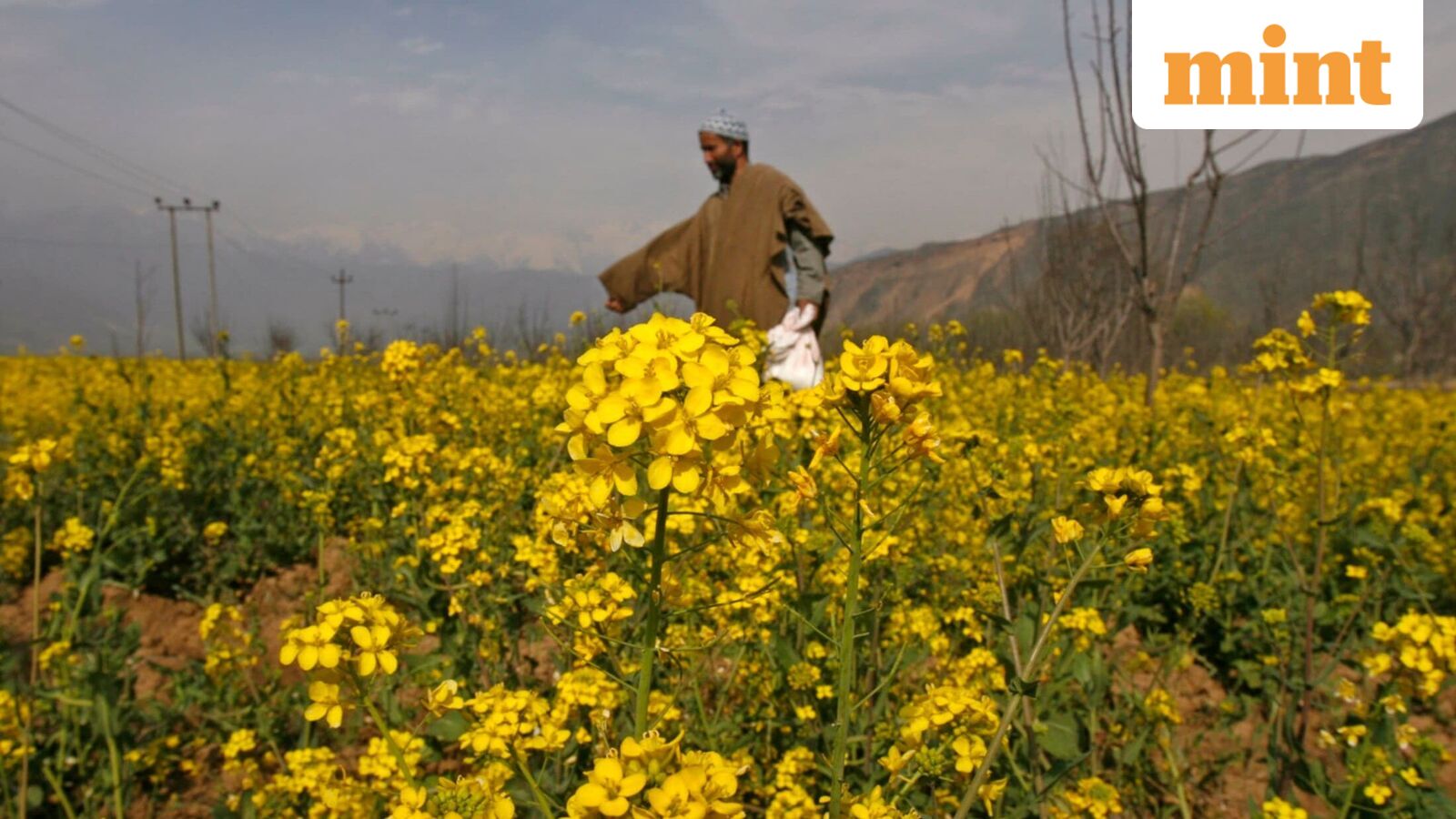
Farmers are likely to plant more mustard this winter, driven by a higher government support price and a need to reduce imports of cooking oil. The mustard area under cultivation in the ongoing 2026‑27 rabi season is projected to reach 9.50 million hectares, up from 9.42 million the previous year, said Vijay Veer Singh, director at the ICAR‑Indian Institute of Rapeseed‑Mustard Research in Bharatpur, Rajasthan, the country’s largest mustard‑producing state. Improved seeds and hybrid varieties are expected to increase yield per hectare. India imports about 60 % of its edible oil, and the war in West Asia has made those imports more expensive and harder to ship, making domestic mustard production more attractive.
If yields remain at 1,460 kg per hectare, the expanded area could lift mustard output to 13.9 million tonnes this season, up from 13.77 million last year. Edible oil demand is projected to rise to 26.5 million tonnes in FY27 from 25.7 million a year before, according to Mint on 22 October.
Experts advise close monitoring of the crop situation. Singh noted that moisture availability could be a major constraint on mustard acreage in 2026‑27, while favourable prices and the crop’s lower irrigation requirement compared with wheat could support planting where conditions permit. Rajasthan, Uttar Pradesh, Madhya Pradesh, West Bengal and Haryana are the top five major mustard‑growing areas. Other states include Jharkhand, Assam, Gujarat, Bihar, Punjab, Chhattisgarh, Maharashtra, Uttarakhand, Himachal Pradesh and Andhra Pradesh.
The Minimum Support Price (MSP) for rapeseed and mustard is ₹6,613 per quintal for the current rabi marketing season, approved by the Cabinet on 30 September 2026, an increase of ₹413 per quintal over the previous year. This rise is expected to drive the area under cultivation.
Data from CCS Haryana Agricultural University, Hisar, show that the highest area of 9.42 million hectares was achieved in 2025‑26, and the highest productivity of 1,524 kg per hectare was achieved in 2020‑21. Mustard area has increased from 6.70 million hectares in 2020‑21 to 9.42 million hectares in 2025‑26, a 40.6 % rise over five years.
Namit Singla, a trader in Delhi, said, “We are expecting mustard acreage to remain healthy this rabi season, supported by favourable prices and steady demand. If weather conditions remain favourable, acreage could see a further increase over last year.” Baldev Raj Kamboj, vice chancellor of CCS Haryana Agricultural University, added, “The mustard crop has become an attractive crop because of reasonably good yield, consistent increase in MSP and market price over and above MSP. Area has shifted to mustard from wheat and other location‑specific rabi crops.”
In Haryana, mustard was cultivated on 649,000 hectares in 2025‑26, producing 1.46 million tonnes with a productivity of 2,255 kg per hectare. Kamboj expects mustard acreage in Haryana to increase by 6‑10 % in the upcoming rabi season, supported by high‑yielding seed varieties and a favourable MSP.
Short‑duration mustard varieties can bring additional rice‑fallow land into oilseed cultivation, especially in eastern India. ICAR’s Vision 2050 for the Directorate of Rapeseed‑Mustard Research estimates about 11.65 million hectares of rice‑fallow land in the eastern and northeastern states. Bringing even 10 % of this area under rapeseed‑mustard could increase oilseed production by at least 1 million tonnes.
Vijay C. Roy, a journalist with over 21 years of experience covering agriculture and related beats, reports for Mint and has covered farm policy, food inflation, crop trade and rural livelihoods. He joined Mint in February 2025 and focuses on food security and climate change policies and their impact on stakeholders.