Auto
Comparing Flagship Diesel SUVs: Kia Sorento HTX(A) vs Toyota Fortuner 4x4 AT Neo Drive 48V
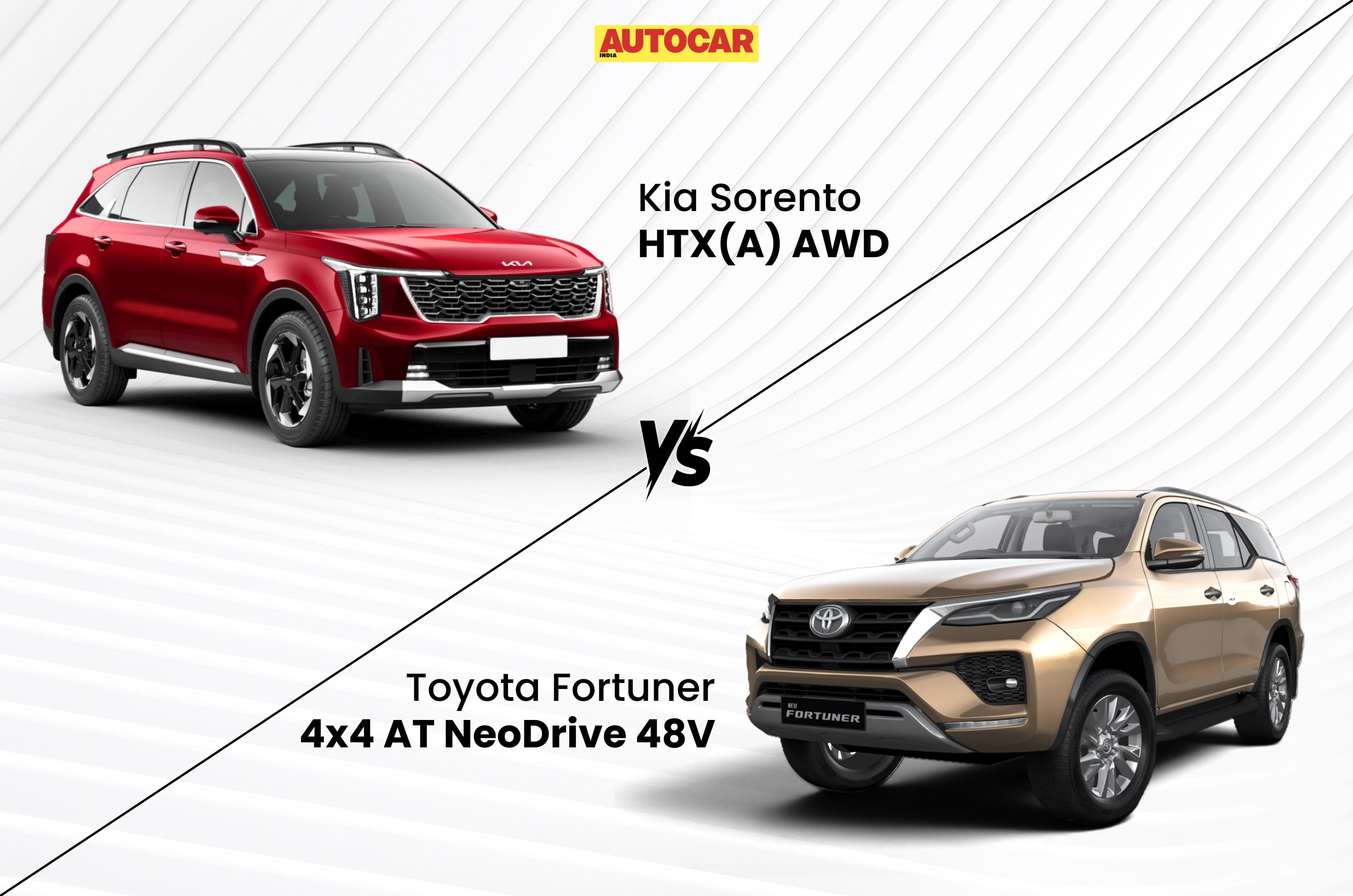
Kia has launched the Sorento in India as its flagship petrol-diesel SUV, positioning it in the three-row premium segment alongside rivals such as the Skoda Kodiaq, Volkswagen Tayron, and Jeep Meridian. Notably, the Sorento's price range also overlaps with the Toyota Fortuner, a ladder-frame SUV long popular in the Rs 30 lakh to Rs 50 lakh segment for its ruggedness and off-road ability, even though it is less premium and modern than the Sorento.
This comparison examines the top-spec diesel variants of both SUVs — the Kia Sorento HTX(A) and the Toyota Fortuner 4x4 AT Neo Drive 48V — to determine which offers better value.
In terms of dimensions, the Sorento is only 20mm longer overall than the Fortuner, but its wheelbase is 70mm longer, and it is 45mm wider. The Sorento also comes with larger wheels and offers a 6-seat configuration with second-row captain's chairs. The Fortuner, however, is 50mm taller than the Sorento.
On the powertrain front, the Fortuner has a larger and more powerful diesel engine, paired with a 48-volt mild-hybrid system that supports torque assist, engine start/stop, and brake energy recuperation. The Sorento, meanwhile, uses an 8-speed automatic transmission compared to the Fortuner's 6-speed unit, which may offer better fuel efficiency on highways. The top Sorento diesel variant also comes with a front-wheel-drive layout for buyers who don't require all-wheel drive capability.
Exterior features are closely matched between the two SUVs. The Sorento is the only one with sequential turn indicators, while the Fortuner uniquely offers rear fog lamps and puddle lamps. Both SUVs come only in monotone paint finishes, though the Sorento offers two more colour choices than the Fortuner.
When it comes to interior features, the Sorento holds a clear advantage, offering larger infotainment screens, a bigger sunroof, more speakers, wireless smartphone connectivity, rear-seat ventilation, ambient lighting, and a fully digital interior rearview mirror — some features being optional accessories.
In terms of driving features, the Sorento provides an additional drive mode (Eco, Sport, Smart, Normal) compared to the Fortuner's three modes (Eco, Normal, Sport). However, the Fortuner offers two more terrain modes (Mud, Sand, Rock, Dirt, Deep Snow) compared to the Sorento's three (Snow, Mud, Sand), reflecting its off-road orientation. The Sorento adds convenience with a smart park assist function and adaptive cruise control that automatically adjusts vehicle speed.
Safety-wise, the Sorento again leads, featuring side parking sensors and three more airbags than the Fortuner. It also includes technologies absent in the Toyota SUV, such as Level 2+ ADAS, rain-sensing wipers, an electronic parking brake with auto-hold, a tyre-pressure monitoring system, a 360-degree camera system, and a built-in dual-channel dashcam — some as optional extras.
Despite offering considerably more features, the top-spec Sorento diesel variant is priced around Rs 4.5 lakh lower than the equivalent Fortuner variant. Given that the Fortuner's underlying platform is nearly a decade old, it appears dated next to the newer Sorento.
For buyers who mainly drive on paved roads and prioritise advanced features, the Sorento presents a stronger overall package. However, for those who value off-road capability, raw power, and long-term durability, the Fortuner remains a credible choice. All prices mentioned are ex-showroom, India.