Auto
Kia Sorento And Toyota Fortuner Face Off: Contrasting Philosophies In The SUV Segment
By Adarsh
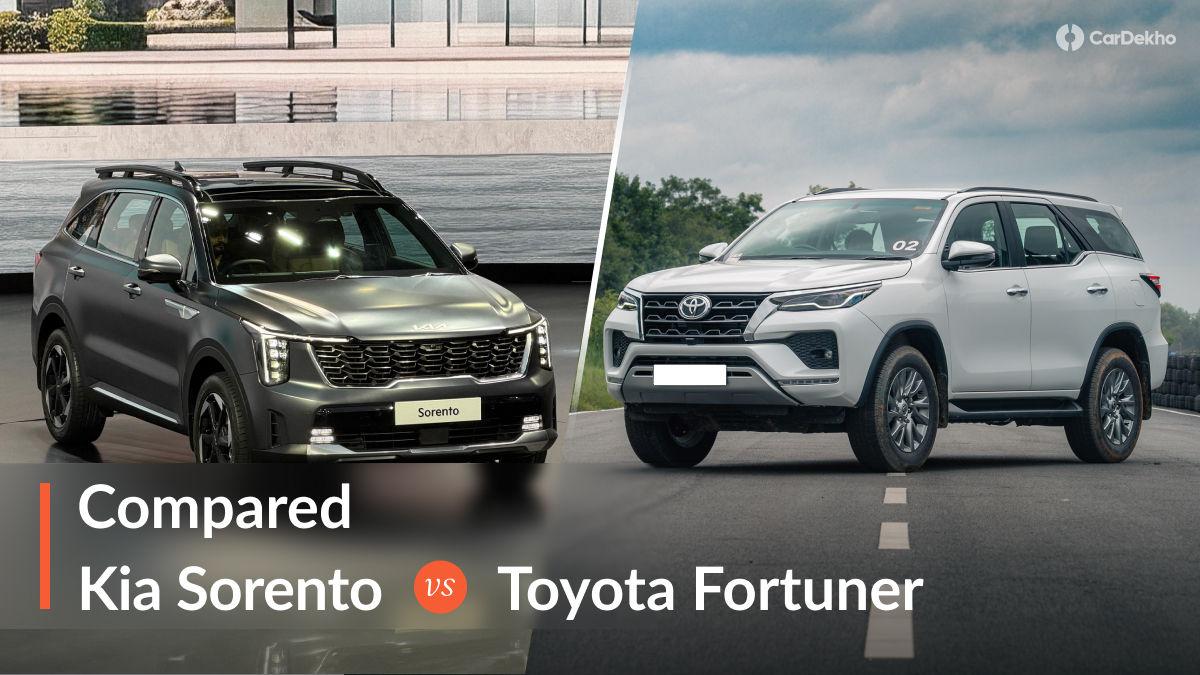
Kia has entered the premium seven-seater SUV market with the launch of the Sorento, priced from Rs 28 lakh (ex-showroom). This positions it against rivals such as the Mahindra XUV 7XO and the Toyota Fortuner. With a long list of features and generous proportions, the Sorento raises the question of how it compares with the Fortuner and which buyers each model suits.
In terms of dimensions, the Sorento is larger than the Fortuner in nearly every measurement except height. The Fortuner, which is mainly diesel-powered, has an 80-litre fuel tank compared to the Sorento's 67 litres, though this gap narrows when considering the Sorento's hybrid variant. The Fortuner is offered only as a seven-seater, while the Sorento provides both six- and seven-seater layouts.
Both SUVs offer eight colour choices, but the Sorento's palette is brighter and more varied, while the Fortuner sticks to more conventional shades. The Sorento also offers a matte finish exclusively on its Dark Gun Metal colour. On Indian roads, however, the Fortuner is typically seen only in white or black.
Despite looking like the bigger SUV, the Fortuner actually has smaller wheels than the Sorento by one inch, compensated with tyres that have thicker sidewalls suited for off-roading. Both vehicles come equipped with modern exterior features and roof rails, though the Sorento's rails are larger and enhance its SUV-like stance.
On comfort and convenience, the Sorento outshines the pricier Fortuner, which lacks several modern features. The Fortuner's small TFT driver display appears basic given its price point. The Sorento also offers greater seating flexibility with its six- and seven-seat configuration options.
In terms of safety, the Sorento—despite being a soft-roader—includes a strong set of off-road-related features, while the more rugged, ladder-frame Fortuner misses out on modern safety technology such as a tyre-pressure monitoring system, 360-degree camera, and blind-spot monitor. The Sorento, in keeping with Kia's typical approach, offers a comprehensive suite of active and passive safety systems.
The two SUVs diverge sharply in their powertrain philosophies. The Fortuner continues with a traditional approach, offering naturally aspirated petrol and diesel engines paired with 2WD or 4WD systems. The Sorento, by contrast, targets buyers seeking refinement and everyday usability, with a hybrid powertrain suited to urban driving.
The drivetrain systems also differ significantly. The Sorento's all-wheel-drive system primarily powers the front wheels, engaging the rear wheels only when additional traction is needed, and includes multiple traction modes for varying terrain. The Fortuner, however, features manually operated high and low gearing along with locking differentials for serious off-road use, and defaults to rear-wheel drive.
Overall, despite being similarly priced, the Sorento and Fortuner cater to very different types of buyers. The Sorento appeals to those who prioritize modern comfort, technology, refinement, and fuel efficiency, while the Fortuner suits buyers who value traditional off-road capability, rugged styling, and a simpler feature set. The comparison also suggests that the Fortuner's pricing may appear steep given the technology and size the Sorento offers at a similar cost.
Other SUVs worth considering in this segment include the Mahindra XUV 7XO, known for its strong features, styling, and powerful engine, making it a favorite for long-distance travel. The MG Hector Tomahawk PHEV stands out as the only plug-in hybrid in its class, offering over 100 km of claimed EV range and more than 1,000 km of combined range as a petrol hybrid, appealing to buyers who prefer a minimalist yet feature-rich cabin. The Jeep Meridian, best suited as a five-seater despite its seven-seat layout, offers long-distance comfort but is limited to an aging 2-litre diesel engine that lacks refinement. Finally, the Tata Safari, the brand's flagship SUV, is praised for its suspension and power on long journeys, though concerns remain about Tata's reliability and after-sales service.