Business & Finance
Sarafa Association Sets Daily Gold Rate, Shop Prices Vary With Premiums
By Today News Hours Editorial Desk
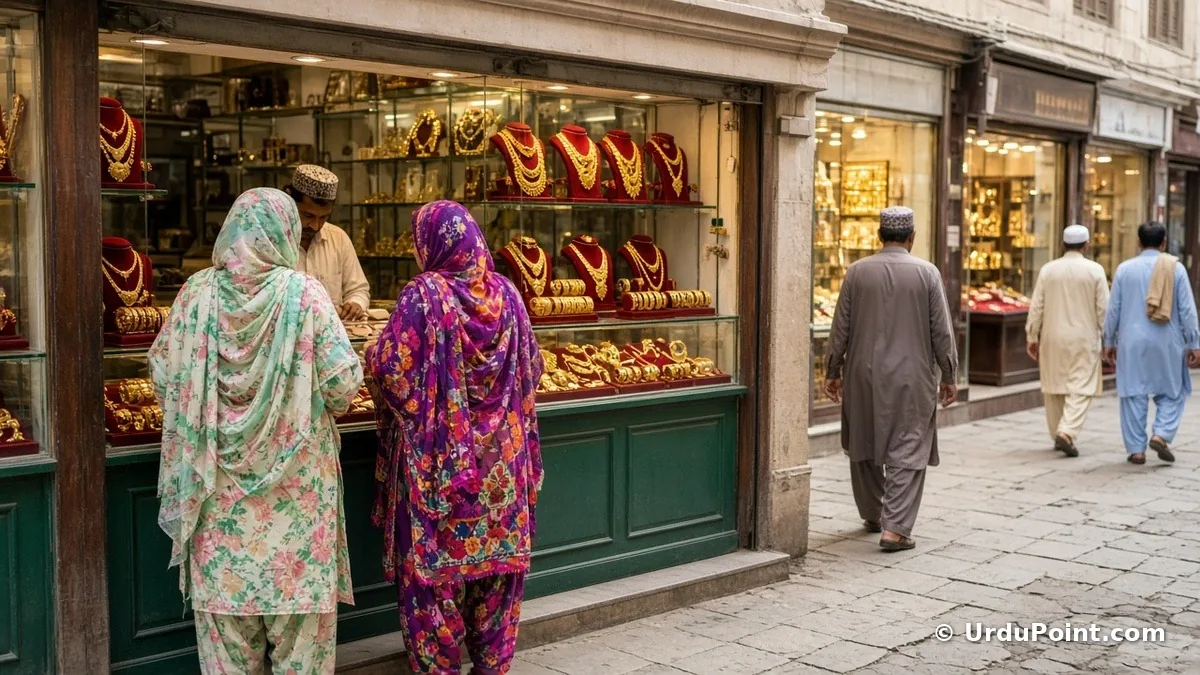
Pakistan’s daily gold rate is announced by the All Pakistan Gems and Jewellers Sarafa Association, not by the government. The association derives its rate from the world price of gold, the rupee‑dollar exchange rate, and a local premium that reflects import costs, demand and market supply. On 24 November 2026 the Sarafa Association set 24‑karat gold at Rs 385,436 per tola, Rs 1,300 above the previous day’s Rs 384,136. It also posted Rs 330,449 per 10 grams of 24‑karat gold and Rs 302,922 per 10 grams of 22‑karat gold. The world price had risen by $13 to $3,629 per ounce.
The association’s calculation uses three components: the world price of gold in US dollars per troy ounce (≈31.1035 grams), the interbank rupee‑dollar rate (Rs 276.47 on 24 November 2026), and a local premium. Using these figures, the international value per tola is about Rs 376,241; the announced rate of Rs 385,436 implies a local premium of roughly Rs 9,200 per tola, or about 2.4 %.
Gold is sold in Pakistan by tola, which the Sarafa Association defines as 11.664 grams. This explains why the per‑tola rate matches the per‑10‑gram rate when converted. The international market uses the ounce, about 2.67 tolas.
Karat indicates purity: 24‑karat gold is almost pure (999 fine), 22‑karat gold is 91.6 % pure, and 21‑karat gold is 87.5 % pure. Most jewellery is 22‑karat.
Shop prices often differ from the association’s rate because they include making charges (banwai), buy‑back deductions, and daily market movements. The wholesale board may revise its rate if the world price changes sharply, and the live market can drift from the announced rate during the day. For example, on 24 November some Karachi market quotes had 24‑karat gold around Rs 392,700 per tola, about Rs 7,300 above the announced rate.
When buying new jewellery, shops add making charges that vary by design and shop. When selling or exchanging old jewellery, shops usually do not refund making charges and deduct a cut (kat) from the weight, often about 12.5 %. A 24‑karat bar held for saving avoids making charges and kat, though a small dealer spread may apply.
For overseas Pakistanis, the world price and the rupee‑dollar rate move together: a weaker rupee can lift the local tola rate even if the ounce price is unchanged.
Frequently asked questions: - Does the government set the gold rate? No, the Sarafa Association sets it. - How many grams are in a tola? 11.664 grams. - Why is the shop bill higher than the board rate? Because the board rate is metal only; shops add making charges and the live market can drift. - Why don’t I get the full rate when selling old gold? Making charges are usually not refunded and a kat deduction is taken. - What is the difference between 24‑karat and 22‑karat? 24‑karat is almost pure; 22‑karat is 91.6 % pure, so the same weight costs less.
Frequently asked questions
Does the government set the gold rate?
No, the Sarafa Association sets it.
How many grams are in a tola?
11.664 grams.
Why is the shop bill higher than the board rate?
Because the board rate is metal only; shops add making charges and the live market can drift.