Business & Finance
Industry Groups Clash Over LTCG and STT Changes Ahead of 2027 Budget
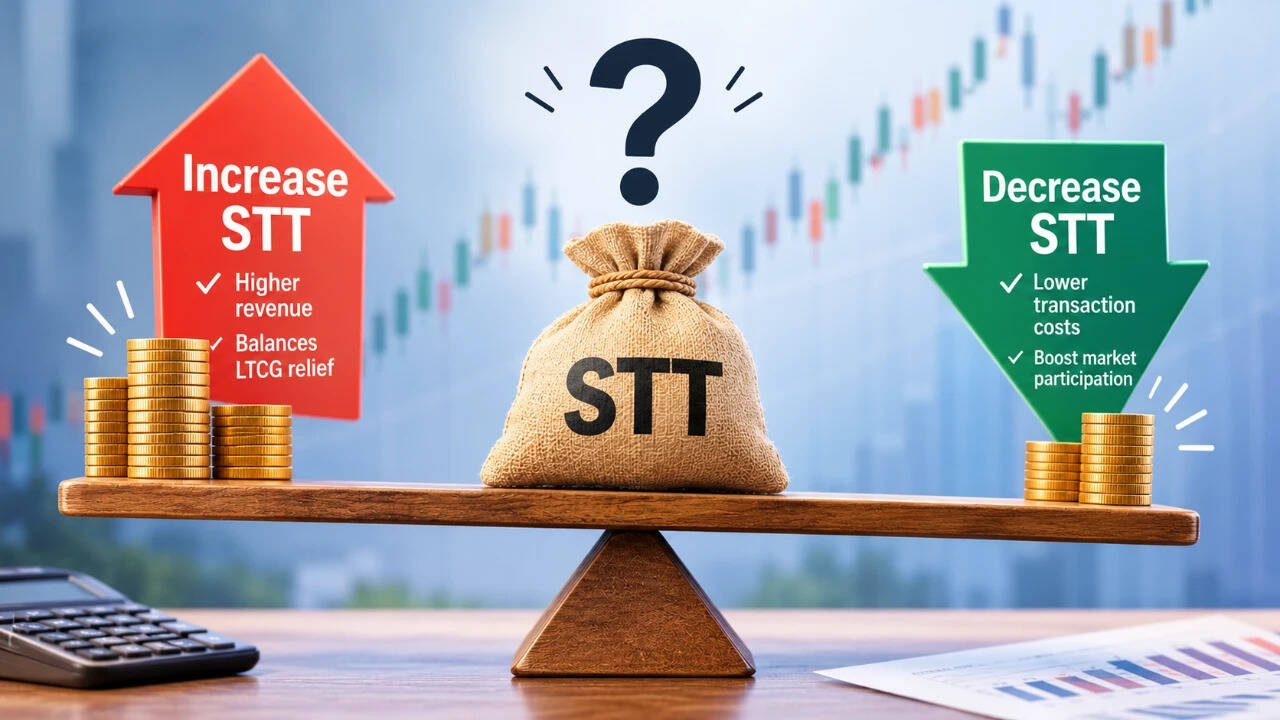
The pre‑budget consultation has concluded, bringing the long‑term capital gains (LTCG) tax back into focus. Most industry bodies now call for the LTCG levy to be lowered or eliminated, though they differ on how it should be structured. SBI has proposed a graded, slab‑style tax. The sharpest disagreement concerns the Securities Transaction Tax (STT). With the 2027‑28 Budget approaching, two opposing views have emerged.
SBI Research’s Ecowrap report examined scrapping or revising the 12.5 % equity LTCG tax, which would cost the exchequer about ₹40,000–₹50,000 crore in FY28. To offset that loss, it suggests raising STT by 50 %, which would generate roughly ₹45,000 crore. PHDCCI argues the opposite: it wants equity LTCG abolished, the short‑term capital gains (STCG) tax cut from 20 % to 10 %, and STT rates lowered simultaneously. The debate centers on whether a higher STT can truly replace the revenue lost from eliminating LTCG, and whether lighter gains taxation would attract more equity capital.
STT is levied on each securities transaction on recognised stock exchanges, regardless of whether the trade is profitable. It is measured against the transaction value, whereas LTCG tax is based on the realised gain after a qualifying holding period. PHDCCI contends that STT, which is not deductible when calculating capital gains, constitutes double taxation and hurts the competitiveness of Indian capital markets. FICCI takes a more balanced stance, supporting the reinstatement of the LTCG exemption and considering a higher STT on delivery‑based trades to cover any revenue shortfall. SBI Research also lists an STT hike as a possible financing mechanism for abolishing LTCG.
The last budget, Union Budget 2026, lifted STT on futures and options from 1 April 2026 to curb speculative trading and systemic risk. Delivery‑based equity trades and mutual fund units were unaffected. Critics of further STT increases argue that the derivatives market has little capacity to absorb additional costs. Former senior public sector banker Kulvinder Singh Sethi warned that raising STT by another 50 % could compress trading activity and liquidity, potentially reducing actual revenue gains and diverting liquidity toward lower‑friction instruments or offshore venues.
The tax has evolved since its introduction in 2004 as a substitute for LTCG tax on listed equities. Finance Acts have alternately raised and lowered rates and changed the base of calculation. Recent hikes have boosted revenue: as of 17 September, STT collections for 2026‑27 were ₹40,214.36 crore, up nearly 53 % from ₹26,305.72 crore a year earlier. The increase is largely due to higher rates on futures (0.02 % to 0.05 %) and options (premium turnover from 0.1 % to 0.15 %, exercised options from 0.125 % to 0.15 %).
However, higher STT has not attracted stronger foreign investor interest. NSDL data shows net foreign portfolio investor flows fluctuating between inflows and outflows through 2026. Sethi noted that foreign investors weigh rupee dynamics and capital gains rules; STT’s upfront toll raises execution friction for hedged, arbitrage, or cross‑market strategies, making other Asian markets comparatively cheaper.
The market’s sensitivity was evident on 13 October 2026 when the BSE Sensex rose over 1,100 points and the Nifty 50 gained about 1.6 %, adding more than 350 points. The rally followed Finance Minister Nirmala Sitharaman’s openness to stakeholder input on LTCG tax and STT ahead of the 2027 Budget. At the Bloomberg New Economy Forum 2026, she said the budget preparation was underway and she would welcome suggestions, but she could not yet confirm any decisions.
Observers stress that how the revenue gap is bridged matters as much as the relief itself. Sethi argued that easing transaction friction or offering calibrated LTCG relief without punitive STT hikes is healthier for price discovery than using STT as a mechanical revenue plug. He added that because STT is charged on transaction value regardless of profit or loss, increasing the rate will penalise liquidity and discourage market participation.