Climate & Environment
Discovery of Five Baby Orangutans in Odisha Forest Triggers Trafficking Probe
By Today News Hours Editorial Desk
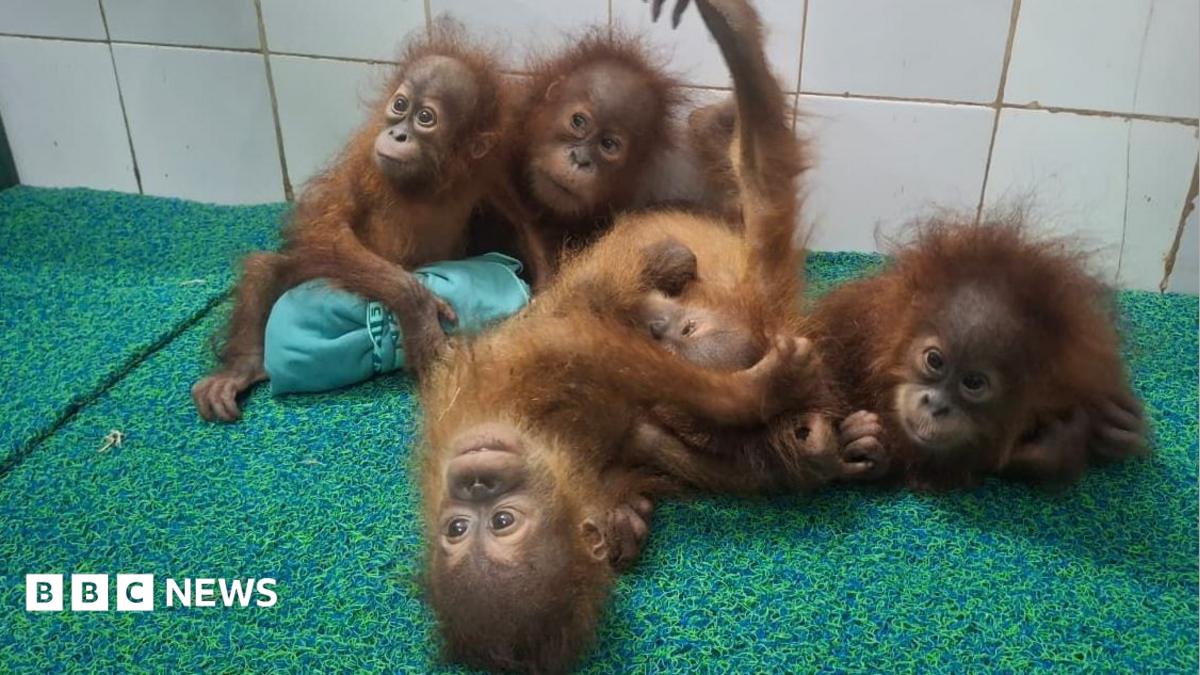
Authorities in India's eastern Odisha state have launched an investigation after five baby orangutans were discovered in a forest area far removed from their natural habitat, raising suspicions of international wildlife trafficking. Images and videos circulating online show the young primates seated together on the forest floor, eating bananas—an unusual sight given that orangutans are not indigenous to India and exist in the wild only in Indonesia and Malaysia. Odisha's forest minister confirmed that officials are exploring whether the critically endangered animals were smuggled into the country by a trafficking network and later abandoned near a highway. The orangutans were discovered early Tuesday in the Balasore district after residents noticed them and notified forest officials. The animals received first aid before being transferred to Nandankanan Zoological Park in Bhubaneswar, the state capital, where they remain under quarantine and observation. Pratik Prakash Indalkar, the Balasore District Forest Officer, told the BBC that the orangutans could not have arrived in Odisha through natural means and were likely transported by road. He noted that the animals were found in Ranakata, a proposed reserve forest in the Bhogarai block near the border with West Bengal, an area dominated by casuarina trees rather than dense forest and located close to a state highway. The Odisha government has reportedly requested that India's Wildlife Crime Control Bureau join the investigation, which now involves police, forest officials, and a special task force. Forest officials estimate the orangutans had been in the area for only two to three days, and a subsequent search of the forest turned up no additional orangutans or evidence explaining their presence. While officials described the animals as infants, some local reports estimate their age at between one and two years. Wildlife expert Biswajit Mohanty said the young age of the animals is especially troubling, since orangutans typically stay with their mothers for several years to learn survival skills, and females generally give birth only once every eight years. The absence of any adult orangutans near the five infants, combined with their distance from their native range, has fueled concerns about how they ended up in Odisha. There are three recognized orangutan species—Bornean, Sumatran, and Tapanuli—all classified as critically endangered by the International Union for Conservation of Nature due to deforestation, habitat destruction, and hunting. International commercial trade in orangutans is banned under the Convention on International Trade in Endangered Species (CITES), and the animals are also protected under India's wildlife protection laws. Nevertheless, orangutans remain targets for illegal trafficking, often sold as exotic pets to private buyers. This is not an isolated incident in India. In 2022, two baby orangutans were found abandoned at a checkpoint on the border between Assam and Mizoram, with officials suspecting they had been smuggled in via Myanmar.