World
Aid Groups Rate Trump‑Era Gaza Plan as a Failure Amid Expanding Israeli Control
A coalition of five international aid organisations – the Danish Refugee Council, Norwegian Refugee Council, Oxfam, Refugees International and Save the Children – has issued a humanitarian scorecard that grades the United Nations‑backed 20‑point Comprehensive Plan, adopted by the Trump administration, at just four out of 26 possible points. The plan received a zero for humanitarian access and only one point for civilian protection.
The scorecard was released as Israeli forces launched a new ground offensive in central Gaza this week, advancing with tanks west of the area known as the “Yellow Line” and issuing new forced evacuation orders, in violation of the plan’s prohibition on territorial occupation and requirement for Israeli withdrawal.
According to the United Nations Office for the Coordination of Humanitarian Affairs (OCHA), Israel’s military “Yellow Line” has moved further west, expanding control of Gaza from 58 percent at the start of the ceasefire 13 months ago to 65 percent today. Israel itself reports controlling 70 percent of the territory. Because Palestinians are not allowed to cross the line, roughly 2.1 million people are now confined to about 128 sq km (49 sq miles), a density of 16,000 people per sq km. Recent analysis by NPR suggests the confinement area may be as small as 109 sq km (42 sq miles), raising the density to nearly 19,300 people per sq km.
Ramy Abdu, founder and chairman of the Euro‑Mediterranean Human Rights Monitor, warned that Israel is carrying out unlawful acquisition of territory by force. The human cost has been devastating, with at least 1,650 Palestinians killed and 5,975 wounded since the ceasefire was declared in October last year.
Shaun Hughes, World Food Programme country director for Palestine, said: “When you’re in Gaza, it does not feel like a ceasefire. Israeli military control across nearly 70 per cent of Gaza means that people have almost no space to grow their own food. Fishing in the sea is prohibited and also life‑threatening. Unemployment is over 80 per cent, so without humanitarian assistance, people have little or no alternate means of survival.”
Lilu Thapa, executive director for the Middle East, Asia and Europe at the Danish Refugee Council, added: “Palestinians in Gaza are being confined as the “Yellow Line” expands. This is displacement by design, and a ceasefire that allows it is a ceasefire in name only.”
The diplomatic framework overseeing the crisis, the Board of Peace and International Stabilization Force (ISF) established by President Donald Trump, has drawn scrutiny from human rights experts who accuse the body of abandoning its mandate. Abdu told Al Jazeera that the Board “has effectively become a political shield for Israel’s occupation and its crimes, contributing to the perpetuation of genocidal conditions while providing political cover for grave violations of international law.”
Mohsen Abu Ramadan, a board member of the Palestinian NGOs Network, said the Board of Peace failed the international community and continues to provide political cover for ongoing genocide and atrocities.
The peace plan stipulated that a minimum of 600 UN‑coordinated humanitarian aid trucks would enter Gaza daily. In September, an average of just 49 UN‑coordinated trucks entered the Strip each day. Only two per cent of these limited convoys carried medical supplies, leading to critical shortages and deaths from treatable illnesses. Israeli authorities have increasingly prioritised the entry of commercial trucks carrying expensive goods that the impoverished population cannot afford. During the week of 12 October, of 315 commercial trucks that entered Gaza, 223 carried food, 51 carried non‑essential items, 12 carried hygiene and shelter materials and only one carried medical supplies.
Jan Egeland, CEO of the Norwegian Refugee Council, said the crisis stems from political decisions and that the suffering of Gaza’s 2.1 million people is not inevitable. Oxfam America President Abby Maxman noted that the reality on the ground is a “direct result of policy choices made in Israel, the US and at the UN.”
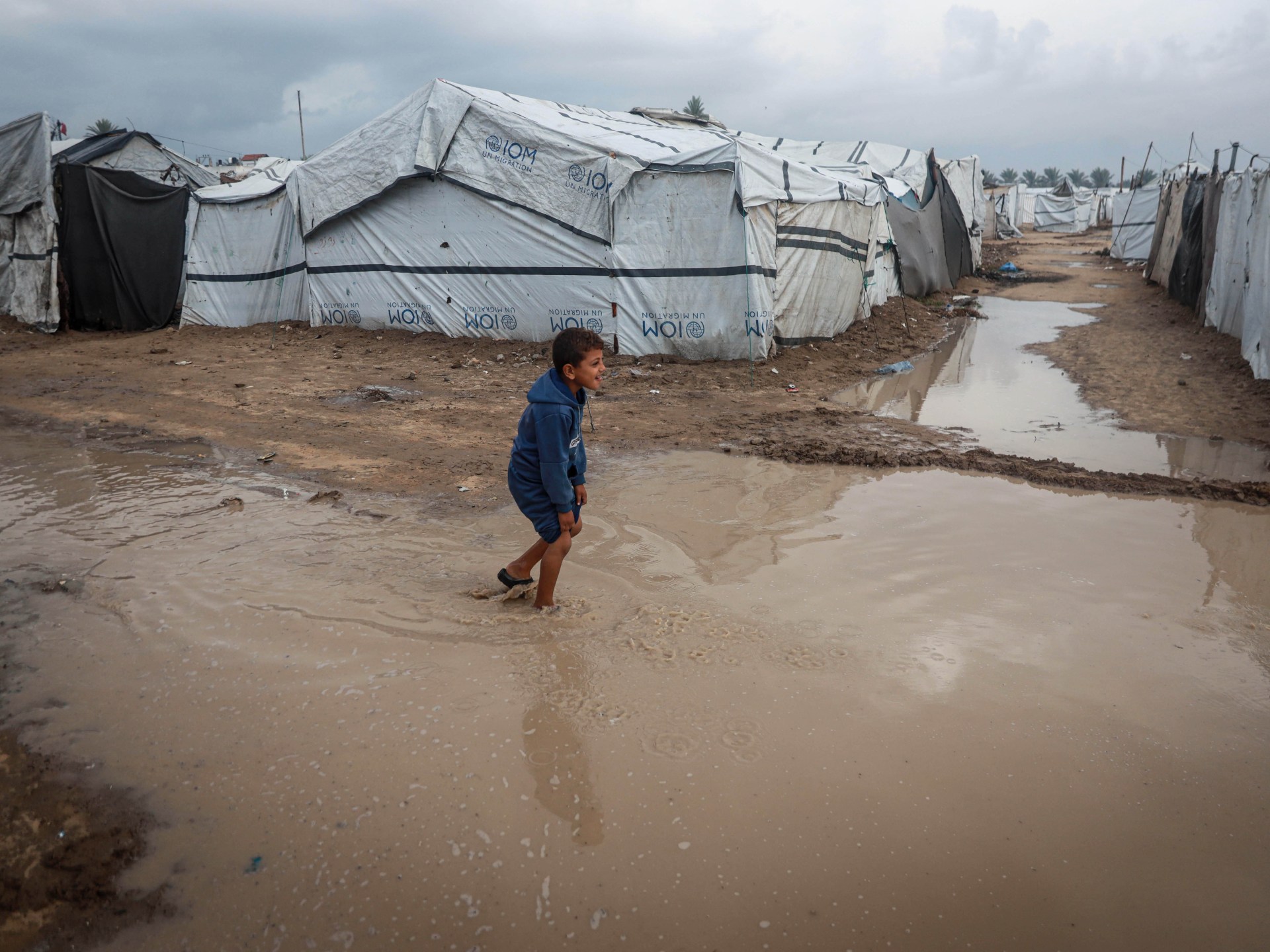
Gaza is entering its fourth winter of displacement. Nearly 1.4 million Palestinians live in makeshift shelters. A recent winter storm flooded more than 70,000 tents in a single day, resulting in the drowning of an infant and the deaths of five displaced people. While stocks of tents and blankets inside Gaza are virtually exhausted, more than 150,000 tents and 500,000 blankets are locked outside the territory’s borders, waiting for permission to enter.
Save the Children International CEO Inger Ashing said: “One year ago, the world was promised that Gaza’s children would finally see safety, relief and a chance to rebuild their lives. Instead, they are colder, hungrier, more traumatised and more at risk than they were before.”
Jeremy Konyndyk, president of Refugees International, called on international backers to act, urging the United States and other UN Security Council members to use their leverage to ensure obligations are met.
The health ministry in Gaza reports that 2,027 patients have died while awaiting transfer and 21,000 remain on waiting lists. Abdu outlined five complementary paths toward accountability, including enforcement of International Criminal Court arrest warrants for Israeli Prime Minister Benjamin Netanyahu and other officials, continuation of International Court of Justice genocide proceedings against Israel, pursuit of universal jurisdiction in national courts, regional arms embargoes on Israel and a UN Security Council briefing to examine the Board of Peace’s failures.
In response to Al Jazeera’s request for comments, the Board of Peace’s head of communications, Brad Klapper, sent an official report that acknowledged failures to implement the peace plan but placed blame on Israeli political indecision. The report noted that implementation on the ground has been limited pending decisions by the Israeli government, and that the absence of decisions on the training, deployment and return of civilian police, as well as the entry of the National Committee for the Administration of Gaza (NCAG) and the International Stabilization Force (ISF), continues to impede full implementation. The report also stated that Hamas and Palestinian factions had accepted a 15‑point roadmap on 30 July to relinquish weapons and transfer full authority to a transitional administration, but that execution mechanisms remain paralysed. The Board concluded that a ceasefire that delivers nothing visible cannot be sustained indefinitely and that the people of Gaza have paid the highest price for this war.