Technology
Centre Trials 3D Concrete Printing for Rural Homes in Andhra Pradesh
By Vijay C Roy
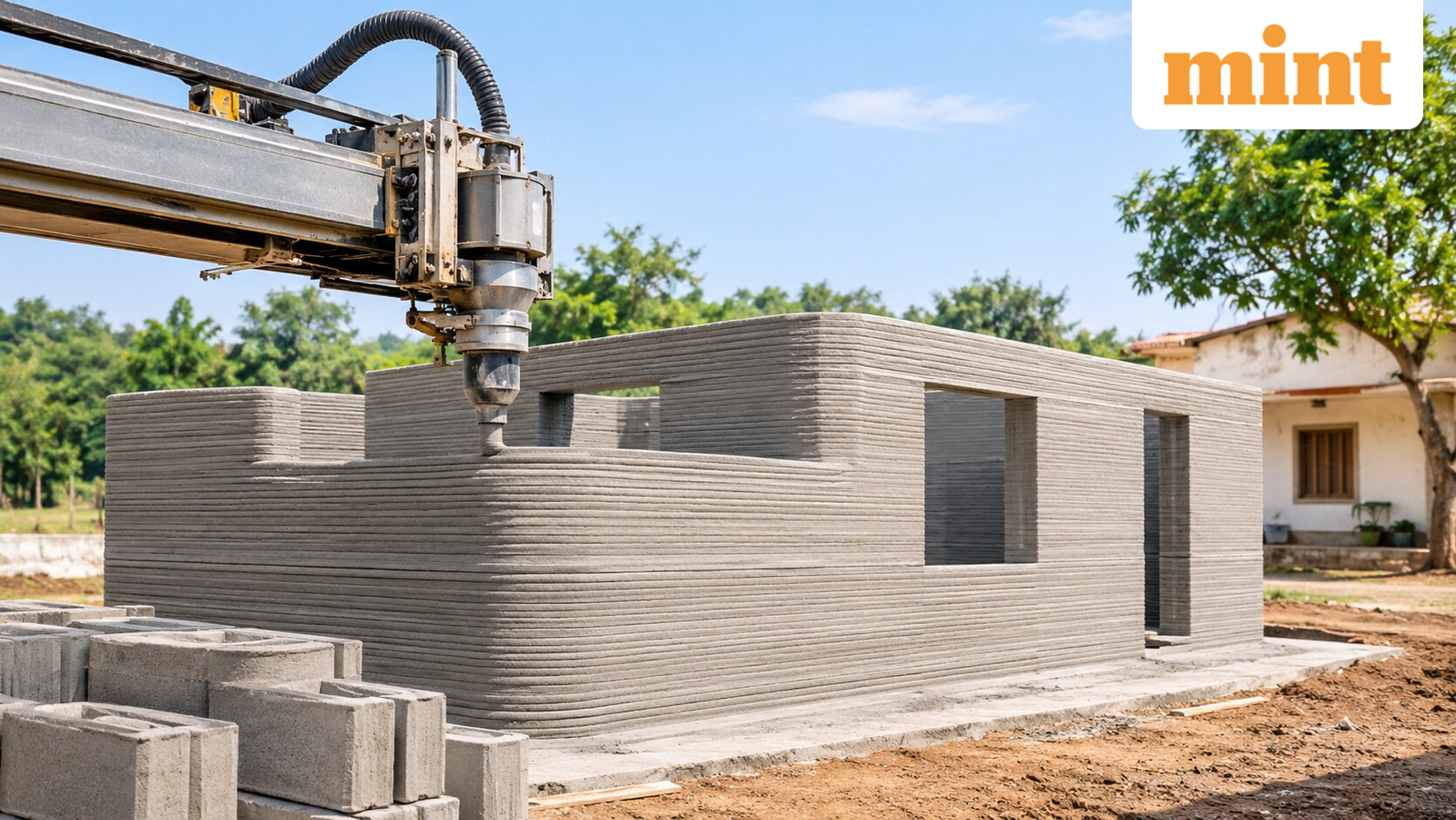
The Ministry of Rural Development is testing 3D concrete printing under the Pradhan Mantri Awaas Yojana‑Gramin (PMAY‑G). A ₹14‑crore pilot covering 177 houses is underway in the villages of Burripalem and Obulanaidupalem in Guntur District, Andhra Pradesh, to evaluate the scalability of the technology for rural housing.
Unlike conventional rural houses that rely on bricks, cement mortar and manual labour, 3D concrete printing (3DCP) replaces brick masonry with digitally designed, machine‑produced hollow interlocking concrete blocks. The blocks are made from a mix of cement, sand, fly ash and bagasse ash and are produced at a production yard using a 3D printer. They are then assembled on site with mortar and Murfor reinforcement to form the walls.
The CSIR‑Central Building Research Institute (CSIR‑CBRI) developed the technology for the pilot. It is expected to cut cement use, incorporate agro‑industrial waste, reduce the number of workers needed and shorten construction time. The government estimates that 3DCP can reduce construction time by about 40 % and manual labour by 50 %. Walling with 3D‑printed blocks is projected to cost roughly 40 % less than conventional brick masonry, at ₹48,496 compared with ₹79,920 for the prototype house.
Beneficiaries stand to receive houses earlier, with better thermal insulation, noise reduction and greater resistance to earthquakes, fire and moisture. The houses will also feature accessible design and individual household toilets without extra cost.
The Guntur pilot will run in six phases over 80 weeks. It will demonstrate construction of PMAY‑G rural houses using 3DCP, establish standardised yet replicable designs and protocols, and generate technical learnings for scaling the technology across states and Union territories. The Ministry of Rural Development will retain perpetual, royalty‑free rights to use and adapt the technology.
CSIR‑CBRI will produce standard operating procedures, construction manuals, safety checklists and inspection formats, and will provide technical support for replication. Rohit Kansal, secretary of the ministry, said the learnings will help develop standardised construction protocols and inform future decisions on scaling the technology.
Challenges to wider adoption include the availability and operation of printing equipment at scale, a shortage of trained personnel, and the need to develop concrete mixes suited to local materials and climatic conditions. Site preparation and soil stabilization are also critical; the pilot will address these through pile foundations for black cotton and clay soils, flood‑resilient plinths and climate‑specific insulated walls.
Frequently asked questions
What is the purpose of the 3D concrete printing pilot?
To evaluate the scalability of 3D concrete printing technology for rural housing under the PMAY‑G scheme in Andhra Pradesh.
How many houses are included in the pilot project?
The pilot covers 177 houses.
What are the expected benefits of using 3D concrete printing?
It can reduce construction time by about 40 %, manual labour by 50 %, and walling cost by roughly 40 % compared to conventional brick masonry.