Science
Recycled Water-Treatment Byproduct Shown to Filter Out Up to 97% of Microplastics in Real-Water Trials
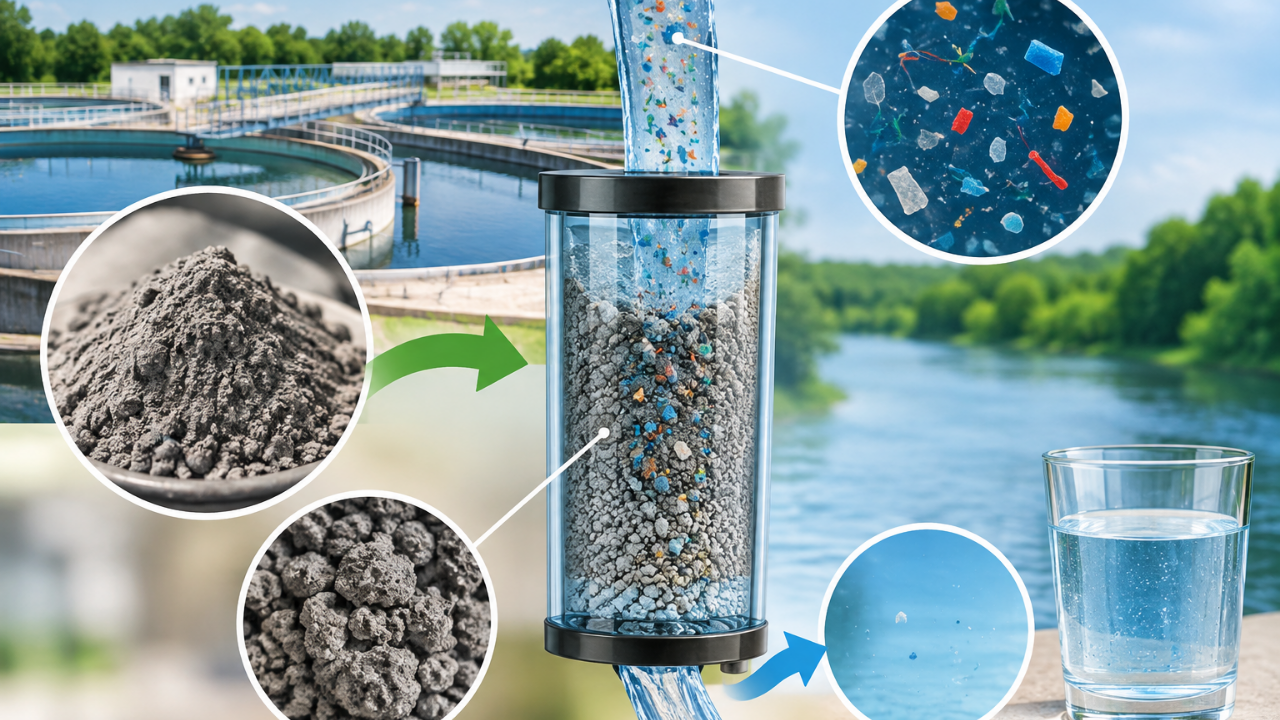
A 2026 study has found that a byproduct generated during water purification can be repurposed into an effective filter for removing microplastics, offering a potential solution to two environmental problems at once: treatment waste and plastic pollution.
Published in the journal Water Research, the study examined the use of aluminum-based water-treatment residual (WTR), a material typically discarded during the water-treatment process, as a low-cost medium for capturing microplastic particles. Rather than treating this residual as waste requiring disposal, researchers tested whether it could be repurposed as a functional filtration material.
Using real water samples rather than only laboratory-prepared solutions, the researchers reported microplastic removal efficiencies ranging from 86.9% to 97.1 percent, with results varying depending on water conditions and the type of particles being filtered.
Water-treatment plants routinely produce residual materials, including concentrated solids and other substances extracted from raw water, which must be managed and disposed of, often at significant cost. The new research explores whether some of this residual material could instead serve as a resource rather than a disposal burden.
The approach relies on the residual's physical properties, which allow it to trap and retain unwanted particles as water passes through it, functioning similarly to purpose-built filtration materials. This fits within the broader concept of resource recovery, in which waste generated by one process becomes an input for another.
Microplastics, generally defined as plastic particles smaller than 5 millimeters, vary widely in size, shape, density and chemical composition, making them difficult to remove consistently from water. While some particles can be captured through conventional processes such as coagulation, sedimentation and filtration, smaller particles may pass through certain treatment stages. Removal efficiency for existing systems depends heavily on both particle characteristics and the specific treatment process used, according to prior research cited in the study.
A key aspect of this research was its use of real water samples rather than solely controlled laboratory conditions. Natural water often contains organic matter, suspended solids and other contaminants that can interact with both filtration materials and microplastics, potentially reducing capture efficiency. The reported removal rates of 86.9% to 97.1% under these more realistic conditions suggest the material retained meaningful filtration capability, though performance may still vary depending on particle type, water composition and operating conditions.
The method's potential benefits extend beyond microplastic capture alone. Conventional filtration processes can generate their own waste streams, since captured contaminants must still be managed after removal from water. Wastewater-treatment plants, for instance, can remove large quantities of microplastics from water only to transfer them into sludge or other residual materials. Any practical use of this recycled filtration material would need to address how the used filter and captured plastics are ultimately handled and disposed of safely.
Despite the promising results, the study's authors caution that this research remains an experimental demonstration. Questions remain regarding the filter's long-term performance, lifespan, potential for regeneration, contaminant accumulation, operating costs and safe disposal methods, all of which would need further investigation before the technology could be deployed at scale.
Nonetheless, the findings suggest a potentially valuable strategy that combines waste reduction with pollution control. If future research confirms the material's durability, safety and economic feasibility, water-treatment residuals could eventually become part of a more circular system, helping to filter out microplastics using material that would otherwise simply be discarded.