World
Debate Rages Over Future of Hitler’s Eagle’s Nest After Fire
By Today News Hours Editorial Desk
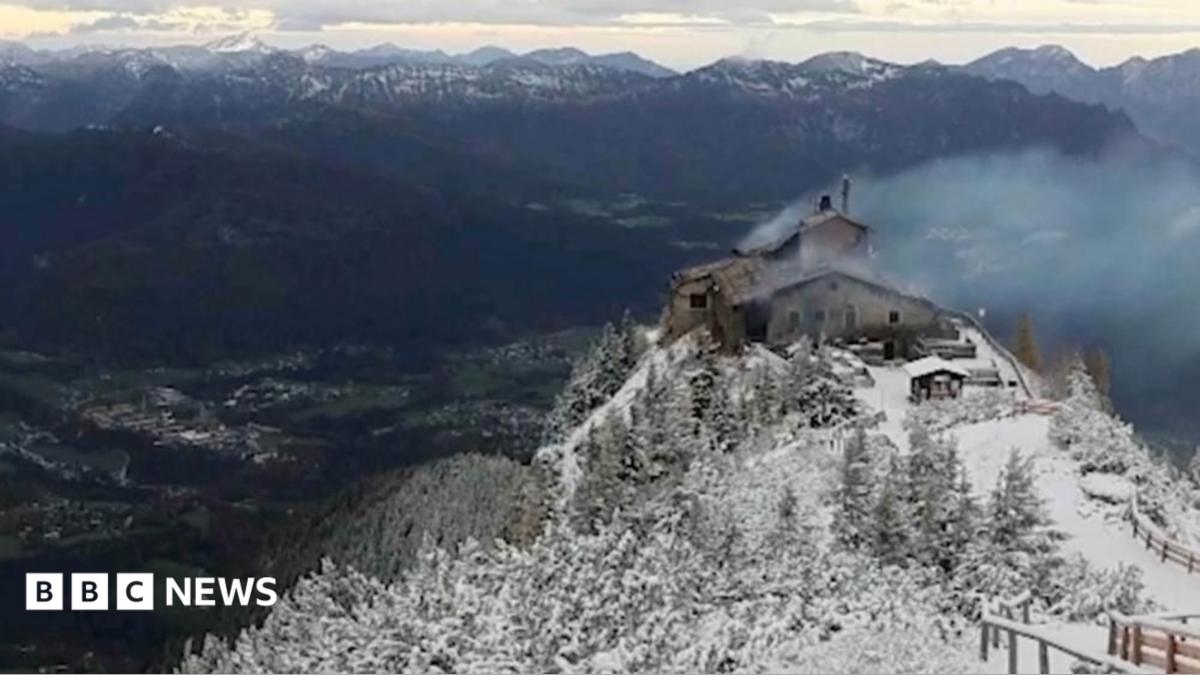
The burned‑out ruins of the Eagle’s Nest, a mountain house built by the Nazis in 1938 and frequented by Adolf Hitler, are now at the center of a heated debate about how Germany should handle its Nazi past. The site, known in German as Kehlsteinhaus, had been a popular tourist attraction and restaurant owned by the state of Bavaria. Visitors could take a bus and then ride the original brass and mirror‑panelled lift to the 1,834‑metre (6,017‑ft) high location overlooking Berchtesgaden. The Eagle’s Nest survived World War II, unlike Hitler’s nearby summer residence, the Berghof, which was bombed and demolished in 1952. In the 1990s a museum, the Obersalzberg Documentation Centre, opened nearby to confront the crimes of the Nazi era, and a photo exhibit had been added to the Kehlsteinhaus about its history.
On the evening of 23 October, the Eagle’s Nest was gutted by a fire that police suspect was arson. A 33‑year‑old man with a history of mental illness has been detained in a secure psychiatric hospital on suspicion of the attack. The documentation centre survived the blaze unscathed.
Some experts argue the site should be left to nature. Professor Sir Richard J. Evans of Cambridge said the rubble should be cleared and the mountain restored to its natural state, citing examples such as the concrete‑filled bunker where Hitler committed suicide, which was later turned into a children’s playground. He described the Kehlsteinhaus as a “Nazi vanity project” that has been romanticised.
Bavarian authorities, however, favour rebuilding. Interior Minister Joachim Herrmann and Minister for the Arts Markus Blume have spoken in favour of reconstruction, arguing that a ruin could encourage neo‑Nazi pilgrims. Sven Keller, head of the Obersalzberg Documentation Centre, said leaving the site in ruins could allow undisturbed visits by such groups and that a full reconstruction is not feasible. Blume has stated that any reconstruction should not cost taxpayers.
Professor Isabel Heinemann of Munich’s Ludwig‑Maximilians‑Universität and head of the Leibniz Institute for Contemporary History cautions against full‑scale reconstruction, suggesting instead that the remains be documented and parts rebuilt in a modern design to illustrate the layers of history.
The debate reflects broader challenges in Germany and Austria over how to handle Nazi‑era sites. Recent far‑right activity, including the rise of the AfD in Germany and the Freedom Party in Austria, has heightened the urgency of Erinnerungskultur, or culture of remembrance. In Saxony, AfD and CDU councillors recently banned “stumbling stones” memorials for Nazi victims, while in Braunau am Inn, Austria, a police station was opened in Hitler’s birthplace to deter neo‑Nazi pilgrimages, though some locals wanted the house to become a centre of responsibility.
The future of the Eagle’s Nest remains unresolved as authorities seek a solution that balances remembrance, public safety, and the site’s historical significance.
Frequently asked questions
Who is suspected of setting the fire at the Eagle’s Nest?
A 33‑year‑old man with a history of mental illness was detained in a secure psychiatric hospital on suspicion of the attack.
What are the main arguments for and against rebuilding the Eagle’s Nest?
Experts argue it should be left to nature, while Bavarian authorities favor reconstruction to prevent neo‑Nazi pilgrimages and say it should not cost taxpayers.
Did the fire damage the Obersalzberg Documentation Centre?
No, the documentation centre survived the blaze unscathed.