India
Delhi Father Praises Daughter’s Move to Helsinki Over Air Quality, Sparks Debate on Children’s Future
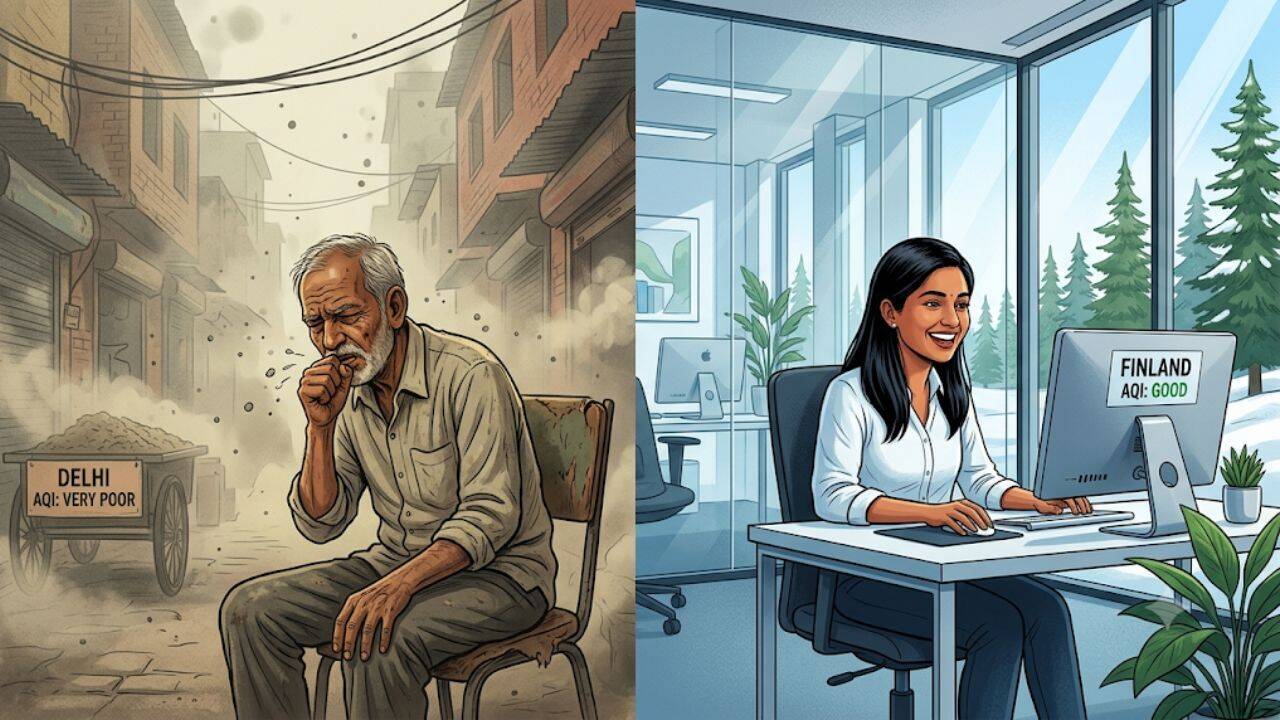
For Manoj Arora, seeing his daughter settle in Helsinki, Finland, is a moment of pride. His recent post on X, however, shows that his happiness extends beyond her career or personal achievements. It reflects a parent’s relief at knowing that his child is living in a city with considerably cleaner air than the one he calls home. As Delhi‑NCR struggles with worsening air quality, Arora shared a comparison between the pollution levels in Delhi and Helsinki. His post on X quickly caught the attention of social media users, bringing up a larger conversation about what parents want for their children and the kind of environment in which the next generation will grow up. Arora wrote, “I am so proud that my daughter is settled in Helsinki, Finland. AQI, Helsinki : 22. I am settled in Delhi. AQI, Delhi: 507. I have been a good parent.” The figures were the air quality readings he cited in his post. While the comparison was brief, it struck a chord with people who have been watching Delhi's pollution levels rise as winter approaches.
The post received responses from parents who could relate to Arora's concerns. For many, the decision to send children abroad is not just about education, better salaries or career opportunities. Access to cleaner air and a healthier living environment can also become part of the discussion. One user responded, “I’m seeing the same thing in my dreams for my child too, sir.” Another wrote, “Mine is leaving next year.” However, not everyone viewed the move as an option available to all families. Some users suggested that settling a child overseas was a privilege largely enjoyed by financially well‑off parents. One user commented, “No you are a rich parent.” Arora responded by explaining that his daughter's journey had involved hard work and academic achievement. He wrote, “I am a simple middle class guy. My daughter went to do her Masters in Helsinki University with 100% scholarship. She worked hard, got a good job, and is now making us proud.” His response shifted attention towards the role of scholarships and individual effort in making international education possible, rather than treating an overseas move as an opportunity limited to wealthy families.
The discussion also brought out another aspect of the daughter's decision. For her, moving to Finland was not simply about escaping Delhi's pollution. Responding to questions about why she chose to settle abroad, Arora explained that she wanted to work with medical professionals and develop analytical models that could help predict human diseases. He said she had explored similar opportunities in India before leaving for her master's degree in Helsinki, but could not find the kind of research opportunity she was looking for. “She wanted to work with medical professionals and create analytical models that can predict human diseases. She tried in India before she went for her master’s to Helsinki. There was no one in India providing such research, irrespective of AQI,” he wrote. The explanation added another dimension to the conversation. Her move, as described by her father, was shaped by both professional aspirations and the quality of life she could build in another country.
Some users also pointed out that moving abroad was not the only way to find cleaner air. One person shared, “No need to go to Finland. I shifted from Delhi to Dehradun; AQI: around 60.” Another said that several places in India could have air quality comparable to Helsinki.
The online discussion comes at a time when Delhi‑NCR's air pollution has once again become a major concern. On November 6, the Supreme Court heard a matter concerning the region's worsening air quality. A three‑judge Bench headed by Chief Justice of India Surya Kant, along with Justices Joymalya Bagchi and V Mohana, discussed the steps needed to address the crisis. The hearing opened with the Chief Justice remarking, “I hope you all are enjoying the weather in Delhi.” Senior advocate Aparajita Singh, assisting the court as amicus curiae, told the Bench that pollution levels were close to the severe category and were affecting people's health. Describing the impact, she said, “We are losing our voice as well. It’s like smoking 30 cigarettes a day!” The court also discussed the contribution of vehicular emissions and crop residue burning. Singh said stubble burning accounted for 14 per cent of Delhi's pollution on November 5, while stressing that transport was a bigger concern. The Bench discussed measures such as announcing crop residue procurement prices in advance and providing machinery to gram panchayats to discourage stubble burning.
For Arora, the comparison between two cities began as a personal expression of pride in his daughter's life abroad. But the reactions it received reveal a wider concern shared by many families: a child's future is about more than professional success. The air they breathe, the opportunities they find and the quality of life they can build are becoming equally important parts of the conversation.
Frequently asked questions
What were the AQI values for Helsinki and Delhi mentioned by Manoj Arora?
Helsinki had an AQI of 22, while Delhi had an AQI of 507.
How did Manoj Arora support his daughter's education in Finland?
His daughter received a 100% scholarship to pursue a Master’s at Helsinki University.
What did the Supreme Court discuss regarding Delhi's air pollution on November 6?
The Bench discussed measures to tackle Delhi’s worsening air quality, noting stubble burning accounted for 14% of pollution on Nov 5 and that transport emissions were a larger concern.