Politics
Hawaii Leads U.S. With 37% Asian Eligible Voters, Pew Study Finds
By Bhanu Pratap
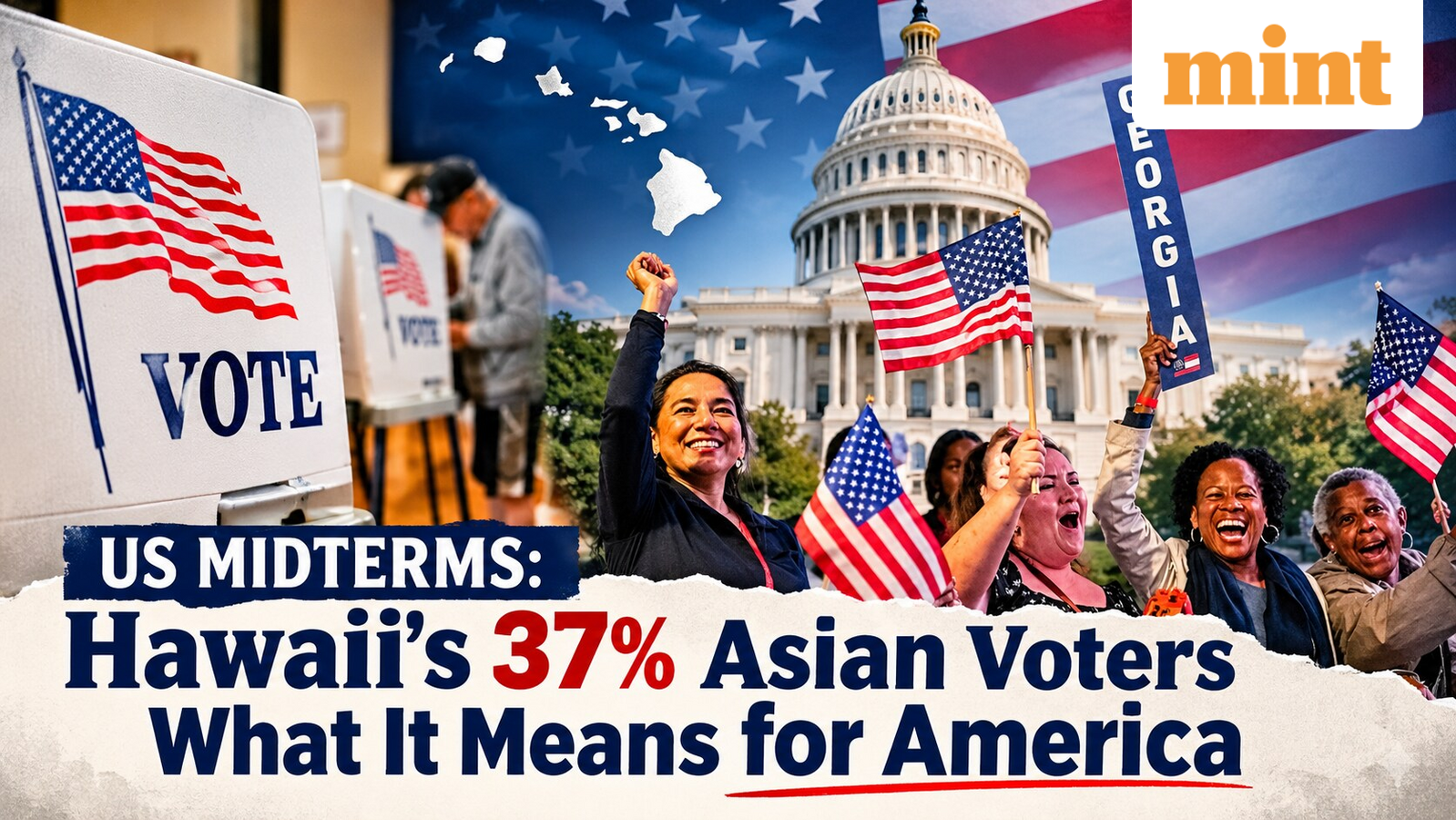
A new Pew Research Center analysis of the 2024 American Community Survey shows that Hawaii has the highest proportion of Asian American eligible voters among all U.S. states, with Asians making up 37% of its electorate. California is second at 15%, followed by Nevada at 9%, and New Jersey and Washington each at 8%. The figures reflect the demographic composition of the electorate, as parties assess the results of the November 3, 2026, midterm elections.
Pew’s data refer to eligible voters—U.S. citizens aged 18 and over—rather than the overall population. The Asian American category includes people who identify as Asian alone and are not Hispanic. Hawaii’s 37% share is more than twice that of California, the state with the second‑largest Asian American electorate.
Hawaii’s demographic profile differs from much of mainland America. Asian Americans have long been established in the islands, with generations of families tracing roots to Japan, China, and the Philippines. Much of this migration was linked to plantation labor and the development of the islands’ economy, leading to deep‑rooted family networks and successive generations of U.S. citizens.
Pew’s analysis also highlights broader trends. In 2026, Asian Americans accounted for 13.65 million eligible voters, up about 2.25 million—or 20%—since 2022, making them one of the fastest‑growing racial groups in the U.S. electorate. Approximately 60% of the Asian American population was eligible to vote in 2024, compared with 81% of White Americans, 74% of Black Americans and 52% of Hispanic Americans. About 25% of Asian Americans were non‑citizens in 2024, versus 21% of Hispanic Americans.
The study found that 65% of Asian eligible voters were naturalized citizens and 35% were U.S. born, explaining why states with large Asian American populations do not always have proportionally large shares of Asian eligible voters.
Geographic differences were also noted for other racial and ethnic groups. Maine has the largest proportion of White eligible voters (92%), followed by Vermont and West Virginia (91% each), New Hampshire (89%) and Iowa (87%). Among Hispanic eligible voters, New Mexico leads at 43%, followed by California (33%), Texas (32%), Arizona (25%) and Florida (23%). The District of Columbia has the largest proportion of Black eligible voters at 41%, with Mississippi at 36%, Georgia and Louisiana each at 31%, and Maryland at 30%. Black eligible voters do not constitute the largest group in any state’s electorate.
Asian American and Pacific Islander (AAPI) voters are attracting increasing attention from political parties. A 2026 Midterm Election Voter Poll by BSP Research and the African American Research Collaborative found that 64% of AAPI voters supported Democratic candidates in U.S. House races, compared with 33% who backed Republicans—a nine‑percentage‑point swing toward Democrats relative to the 2024 presidential election. The survey also noted that one in eight AAPI voters had cast their first ballot in the 2026 elections, and more than half of AAPI voters under 40 had first voted in 2022 or later.
The political environment has been shaped by concerns over anti‑Asian hostility and immigration policies. A September 2026 report by Stop AAPI Hate found that 48% of South Asian adults surveyed had experienced a hate‑related incident because of their race, ethnicity or nationality in 2025, and documented a significant rise in anti‑South Asian slurs online between 2023 and 2025.
Bhanu Pratap is a journalist who reports and writes on foreign affairs, India’s foreign policy, geopolitics and strategic affairs. He closely follows diplomatic developments in New Delhi and has a keen interest in defence and national security. He focuses on in‑depth, interview‑based reports and regularly speaks with experts and policymakers to bring perspectives and context to major developments around the world. He is also interested in stories with strong humanitarian angles. One such report examined the cases of Indian nationals who were allegedly recruited and forced into Russia’s war against Ukraine. While reporting the story, Bhanu spoke to the families of those affected and documented their experiences. The report was later taken into account by the United Nations in its findings on human rights violations linked to the war in Ukraine.
For Bhanu, the zeal to produce meaningful and impactful journalism remains at the heart of his work. He has previously worked with Firstpost, NDTV, Newslaundry and Republic. Bhanu studied at the Delhi School of Journalism, University of Delhi. He initially chose science with plans to pursue engineering, influenced by conventional expectations, but fate led him to journalism.
Beyond the newsroom, Bhanu enjoys exploring culture and history and often spends his days off on heritage walks. He is also passionate about travelling, biking and listening to folk music. For tips, reviews and suggestions, you can reach him at bhanu.pratap@htdigital.in.
Frequently asked questions
What percentage of Asian eligible voters in Hawaii are naturalized citizens?
65% of Asian eligible voters are naturalized citizens.
Which state has the largest proportion of White eligible voters?
Maine has the largest proportion of White eligible voters at 92%.
How many Asian American eligible voters were there in 2026?
There were 13.65 million Asian American eligible voters in 2026.