Politics
Government and Jamaat‑i‑Islami Agree to Continue Fuel‑Relief Talks
By News Desk
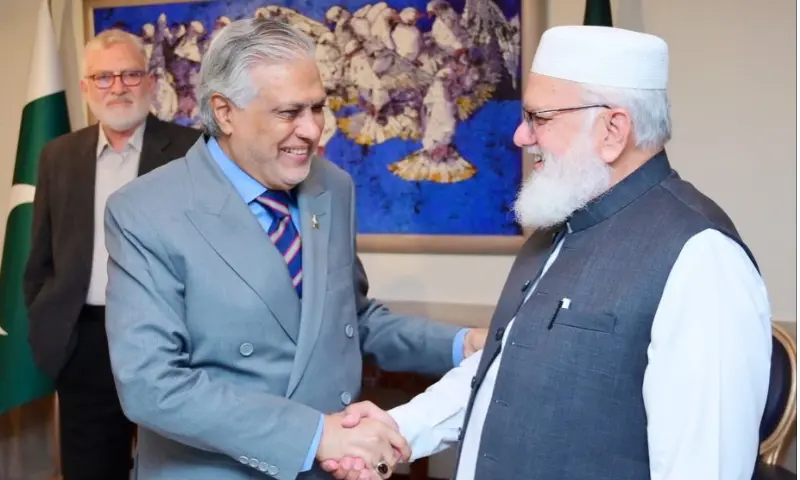
The government and Jamaat‑i‑Islami (JI) held discussions on Tuesday to explore practical measures for easing fuel costs for low‑income citizens. After a meeting with Prime Minister Shehbaz Sharif last week, both sides agreed to create a bipartisan committee to broaden the government’s existing fuel‑relief scheme in response to JI’s demand to abolish the petroleum levy. JI warned that it would resume its postponed march to Islamabad by mid‑November if no relief was announced.
Deputy Prime Minister and Foreign Minister Ishaq Dar met with a JI delegation led by Vice Emir Liaqat Baloch to discuss petroleum prices. The Foreign Office said the parties had "candid discussions" on practical relief measures, focusing on easing the economic burden on low‑income citizens. Both sides agreed to continue consultations in the coming days to formulate a way forward on energy pricing and public relief. During the meeting, DPM Dar reiterated the government’s commitment to prioritising public welfare amid global economic challenges and emphasised that sustained cross‑party dialogue was key to addressing national economic issues.
The government delegation included Planning Minister Ahsan Iqbal, Adviser to Prime Minister Rana Sanaullah, Special Assistant to Prime Minister Tariq Bajwa, the finance secretary, and the Petroleum Division’s special secretary.
After the meeting, JI Vice Emir Baloch held a press conference in Islamabad. He said negotiations over the abolition of the petroleum levy and public relief had entered their final stage. He claimed that the government had agreed to provide relief to the agricultural sector and owners of vehicles up to 1,000cc. The current relief scheme for motorcycles, rickshaws and vehicles up to 800cc was rolled out nationwide on September 17.
Baloch described the meeting as the final round of negotiations and said both sides would meet again the next day to discuss further progress. He listed six proposals presented by JI, including abolishing the petroleum levy, introducing a relief package, reducing public transport costs, and extending relief to owners of vehicles above 800cc and the agricultural sector.
Both negotiating teams will prepare working papers on the gradual elimination of the levy and measures to provide relief to the public. The government will complete its working paper today, and representatives of both sides will meet again tomorrow.
JI Emir Hafiz Naeemur Rehman, currently in Turkiye, will review the draft agreement before the party announces its future course of action. Baloch said he had spoken by telephone with Rehman and briefed him on the progress of negotiations.
Baloch criticised the government for allowing oil refineries to earn excessive profits and said there was no solid justification for continuing the petroleum levy. Under a new arrangement, oil refineries will contribute to the petroleum levy by bearing a monthly cumulative impact of Rs15 billion, which would reduce the petrol price on consumers by Rs14.71.
JI’s primary objective is to secure relief for the people. Baloch said that if the package does not provide substantial relief, Jamaat‑i‑Islami will fulfil its commitment to the people and, in mid‑November, its protest march will set off from Multan towards Islamabad. He added that the protest would be peaceful, dignified and aimed at securing relief for the people.
JI has demanded for over two months that the Centre abolish petroleum levies, citing rising fuel prices due to Middle East conflicts. The Centre and JI had agreed to form committees in early September to recommend measures to reduce the levy. On September 20, the party launched a protest march towards Islamabad, warning that if the government failed to abolish the petroleum levy, the protest could turn into one to oust the government. On September 22, the JI emir said his party’s convoy had reached Multan and the long march was postponed at the request of PM Shehbaz, who had assured a meeting to discuss the matter. When PM Shehbaz and Rehman finally met about a month later, they agreed to form a joint committee to recommend proposals for expanding the fuel relief scheme and for a phased reduction in the petroleum levy for the next budget.