Politics
Black Bloc Protesters: Anarchist Tactics and European Impact
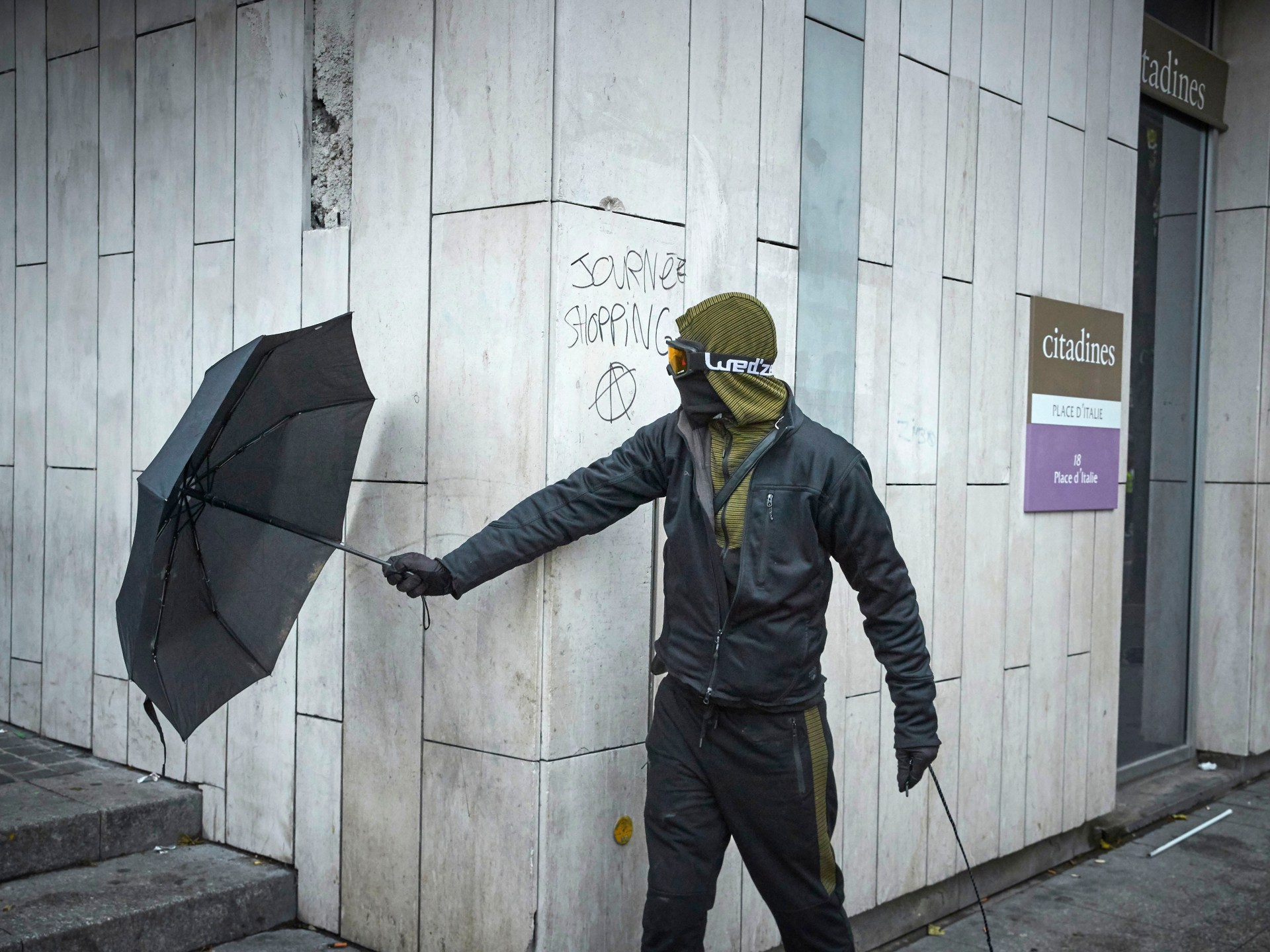
Anarchistic activists who dress in black and clash with police are a regular feature of protests across Europe, from France to Albania. In France, Italy, Spain and Albania, a few hundred young people fully dressed in black have been seen smashing public and private property, setting fire to cars and buildings, and accused of break‑ins and theft of consumer goods. Known as the “Black Bloc,” they bring aggressive energy that can upend otherwise peaceful demonstrations by student groups and professional unions. Some say they bring attention to social, political and economic inequalities; others condemn their violent methods, saying they distract from legitimate demands.
The movement began in the 1980s in Germany, emerging from a social movement called autonomia, or autonomy, according to political science professor Francis Dupuis‑Deri of the University of Quebec in Montreal. He told Al Jazeera that the anarchists were against the state, capitalism, political parties, even communists and unions, and that they believed in living outside the system. Dupuis‑Deri, who has written a book on Black Blocs, explained that the anarchists’ idea was simple: wear black suits, black leather jackets, cotton hoodies, motorcycle helmets, sunglasses and bandanas to avoid recognition by police. “There is no leadership, no hierarchy, no superstars, no spokesperson, no press statements,” he said. He warned against associating the group with any political ideology, left or right, noting that right‑wing nationalist and neo‑Nazi groups in Poland and Germany have used Black Bloc attire and violent tactics, although not in recent years.
France has seen mass student and union demonstrations for weeks, grappling with high levels of violence and property damage. Al Jazeera contacted the office of a left‑wing French MEP whose party has organised and supported recent nationwide rallies about the black‑clad protesters. The office said the issue was too sensitive to discuss. “A few cases of violence are used by the government to criminalise our movement and our party, so we don’t want to enter the strategy of speaking about it,” a person not authorised to speak officially said.
Italy has also witnessed violence in Rome, Milan and Turin, with people clashing with police, setting bins and cars on fire, and in some cases causing extensive property damage and injuries. “Frankly, I’m not aware of any movement inspired by the Black Blocs,” said Mario Furore, an Italian MEP from the Five Star Movement. “In Milan, there have been incidents of looting and vandalism, and those responsible appear to have been very young, many of them minors. To me, this looks more like copy‑cat behaviour and the influence of bad role models than the work of an organised network. However, it will be up to the judicial authorities investigating the incidents to establish the facts.”
The Black Bloc is not a homogeneous or organised movement with any known leadership or structure. It is also politically somewhat irrelevant because governments and law enforcement groups associate the groups with social protests, whether they are “copy‑cats” or genuine. Dupuis‑Deri said the lack of organisational structure allows members to find each other quickly based on their attire, but they also congregate through word of mouth and form relationships over several demonstrations. Mobility is a key feature of the movement. While European governments have not publicised information on the recent demonstrations, Black Blocs are known for having crossed borders in the past to participate in demonstrations in other countries. “They don’t have a membership roster, so no one really knows how many they are. Intelligence services number them around 5,000–7,000 in Europe, with a few hundred showing up in each demonstration,” Dupuis‑Deri said. “Nobody can stop them.”
In January, French Interior Minister Laurent Nunez referenced the group in Parliament, saying: “Today, at every social demonstration of any significant size, we find Black Blocs who come to smash things and attack the internal security forces.” A 2023 Italian government document on advanced training for police described the group, its aims and tactics. “With the aim of inciting vandalism and violence by infiltrating – and subsequently radicalising – demonstrations, the 1980s also saw the consolidation of a persistent anarcho‑insurrectionist tactic: the use of small, loosely organised groups known as the ‘black bloc’,” the document said. It added that they conduct reconnaissance of target locations well in advance of the planned unrest, dividing these areas into sectors assigned to specific teams, and execute diversionary tactics “carried out by one or more teams to draw the attention of law enforcement away from other groups, which are then free to carry out disruptive or destructive acts”. The report said the Black Bloc has a “high degree of mobility” to maximise potential damage while minimising the risk of activists being arrested. Before the recent demonstrations in Europe, perhaps the best‑known Black Bloc performances were during the World Trade Organization ministerial meeting in Seattle, United States, in 1999, and the June 2016 nationwide demonstrations in France against the Loi Travail or labour law. In both cases, there were confrontations with police, with hundreds injured and arrested.
Frequently asked questions
When and where did the Black Bloc movement originate?
The Black Bloc movement began in the 1980s in Germany, emerging from a social movement called autonomia.
What is the typical attire of Black Bloc protesters?
Black Bloc activists typically wear black suits, black leather jackets, cotton hoodies, motorcycle helmets, sunglasses, and bandanas to avoid recognition by police.
How many Black Bloc participants are estimated in Europe?
Intelligence services estimate 5,000–7,000 Black Bloc members in Europe, with a few hundred showing up at each demonstration.