Politics
Punjab Speaker Urges Respect for Indus Waters Treaty, Calls for National Dialogue
By Today News Hours Editorial Desk
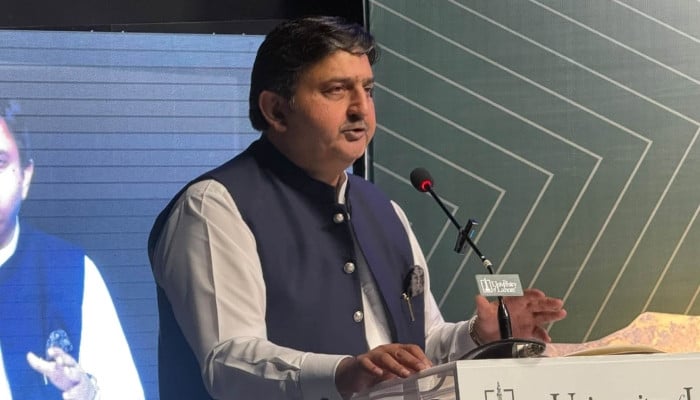
Speaker Malik M Ahmad Khan of the Punjab Assembly said the Indus Waters Treaty is an international agreement whose status and any action concerning it must be determined in accordance with international law and established principles. He warned that unilateral suspension or disregard of the treaty by either party cannot be accepted and urged Pakistan to protect its water rights through a firm legal position, effective diplomacy and national consensus. The remarks were made at a national seminar on “The Indus Waters Treaty and National Security” at the University of Lahore.
Khan emphasized that the water issue is not merely a dispute between two countries but is directly linked to Pakistan’s national security, agriculture, economy, environmental protection and the future of its people. He called for a serious national dialogue on the issue, above political affiliations and regional divisions. He noted that international agreements are governed by established legal requirements and principles, and any suspension, termination or modification of a treaty must follow the relevant legal procedures. Pakistan should rely on sound legal arguments and a well‑considered diplomatic strategy rather than an emotional response to developments surrounding the treaty.
Referring to water pollution and arsenic contamination of groundwater in his constituency, Khan said polluted water was adversely affecting the health, livelihoods and agricultural activities of rural communities. In several areas, groundwater had become unsuitable for drinking and agricultural use, making life increasingly difficult for local residents. He stressed that the water crisis should not be viewed solely through a political or diplomatic lens, as its humanitarian and environmental consequences were equally serious.
Khan also highlighted the fair distribution of water within Pakistan and the concerns of its provinces as national priorities. Sindh’s legitimate concerns over seawater intrusion and the resulting threats to agricultural land, settlements and local livelihoods could not be ignored. Trust, consultation and consensus among the federating units were essential for effective and sustainable water management.
The Speaker called for a more active role for constitutional and parliamentary forums, particularly the Council of Common Interests (CCI), in addressing water‑related issues. Reports, recommendations and provincial positions presented over successive governments should be reviewed comprehensively. Water experts, parliamentarians and provincial representatives should be involved through relevant committees of the national and provincial legislatures to ensure discussions lead to practical policy measures.
Khan cautioned against viewing water disputes through the prism of regional or provincial divisions. Pakistan, he said, is a shared national entity, and the national interest requires safeguarding the legitimate rights and concerns of all provinces. National unity and mutual trust were indispensable to achieving a lasting resolution of water‑related disputes.
Commenting on the regional situation, the Speaker said he was not an advocate of war and did not want to see further destruction or humanitarian suffering in the region. He noted the devastating consequences of conflicts worldwide and affirmed Pakistan’s belief in peace, dialogue and diplomacy, while maintaining the right to respond effectively to any aggression against its sovereignty, independence and national rights.
Khan highlighted the role of universities and parliament, stating that informed debate, research and the exchange of diverse perspectives on national and international issues are essential for sound policymaking. Parliament should serve not only as a forum for legislation but also as a centre for meaningful debate on matters of national importance, while universities can contribute through research and academic guidance.
PPP leader Senator Nisar Ahmed Khuhro also spoke on the occasion, noting the long‑standing conflict between India and Pakistan and the importance of a strong stance by Pakistan’s leadership. He mentioned that the treaty was set aside in 2000 and that the matter went to the International Court, where India’s stance was rejected, though India refused to accept the decision. Khuhro stressed the need for Pakistan’s leadership to take a strong stand and noted the country’s population growth to 250 million, which will bring food security issues to the fore. He reiterated that Pakistan is a nation comprising four provinces and that its strength lies in its people.
Frequently asked questions
Where did Speaker Malik M Ahmad Khan deliver his remarks on the Indus Waters Treaty?
At a national seminar titled 'The Indus Waters Treaty and National Security' held at the University of Lahore.
What did the Speaker say about water pollution in his constituency?
He mentioned that water pollution and arsenic contamination of groundwater were adversely affecting the health, livelihoods, and agricultural activities of rural communities, making groundwater unsuitable for drinking and agricultural use.
What role does the Speaker suggest for the Council of Common Interests (CCI)?
He called for a more active role for constitutional and parliamentary forums, particularly the CCI, in addressing water-related issues and reviewing reports, recommendations, and provincial positions.