Climate & Environment
Nearly 200 Concrete Pipes and Culverts Deployed as Artificial Reef off Jacksonville in 2026
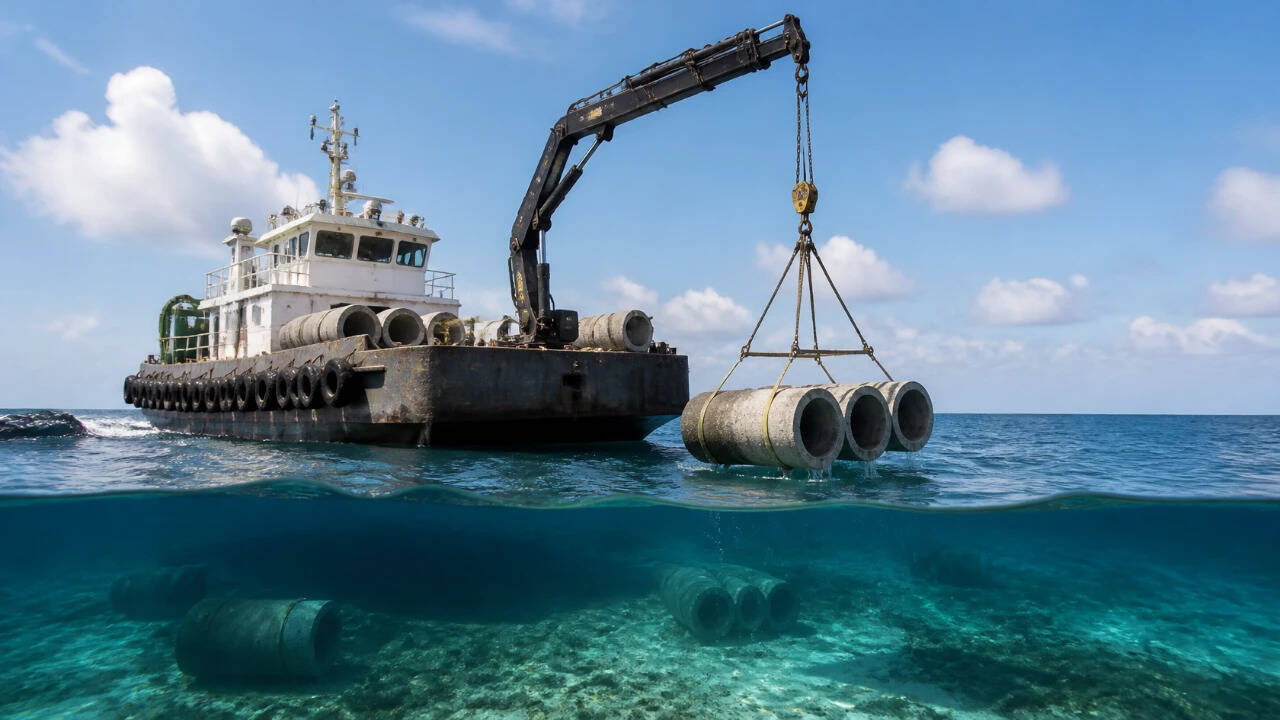
In 2026, almost 200 concrete pipes, culverts and other construction structures that were no longer needed were lowered to the ocean floor off the coast of Florida, creating an artificial reef. The installation, located at Harm’s Ledge about 28 miles off the Mayport jetties near Jacksonville, sits at a depth of roughly 90 feet. The project was led by the Jacksonville Offshore Sport Fishing Club in partnership with conservation groups, government agencies and private companies. The concrete structures were loaded onto a barge with a forklift, transported to the site and carefully lowered to the seabed. The initiative was supported by Think It, Sink It, Reef It, an organization that promotes artificial reef projects using recycled materials. The reef was designed to provide hard surfaces and sheltered spaces in an area where the ocean floor is largely sandy, offering attachment points for algae, barnacles, corals and other organisms. Over time, these organisms could attract smaller fish and eventually larger predatory species, potentially creating a new marine ecosystem. The project began in early 2025 when the club and its partners explored the use of donated concrete. Funding and coordination involved the Jacksonville Waterways Commission, the Florida Fish and Wildlife Conservation Commission, the U.S. Fish and Wildlife Service and other partners. The reef could also offer future opportunities for recreational fishing and diving, depending on how the site develops. This installation follows earlier reef efforts in the region, such as the 2000–2001 project that placed 500 dome‑shaped concrete Reef Balls to form the Charles H. Kirbo Memorial Reef. The new reef represents a continued effort to develop offshore reef habitats in Northeast Florida and to give surplus construction materials a second life in the marine environment.