Business & Finance
KAI Faces Cash Drain and Order Shortfall Amid Export Wins
By Jung Jina
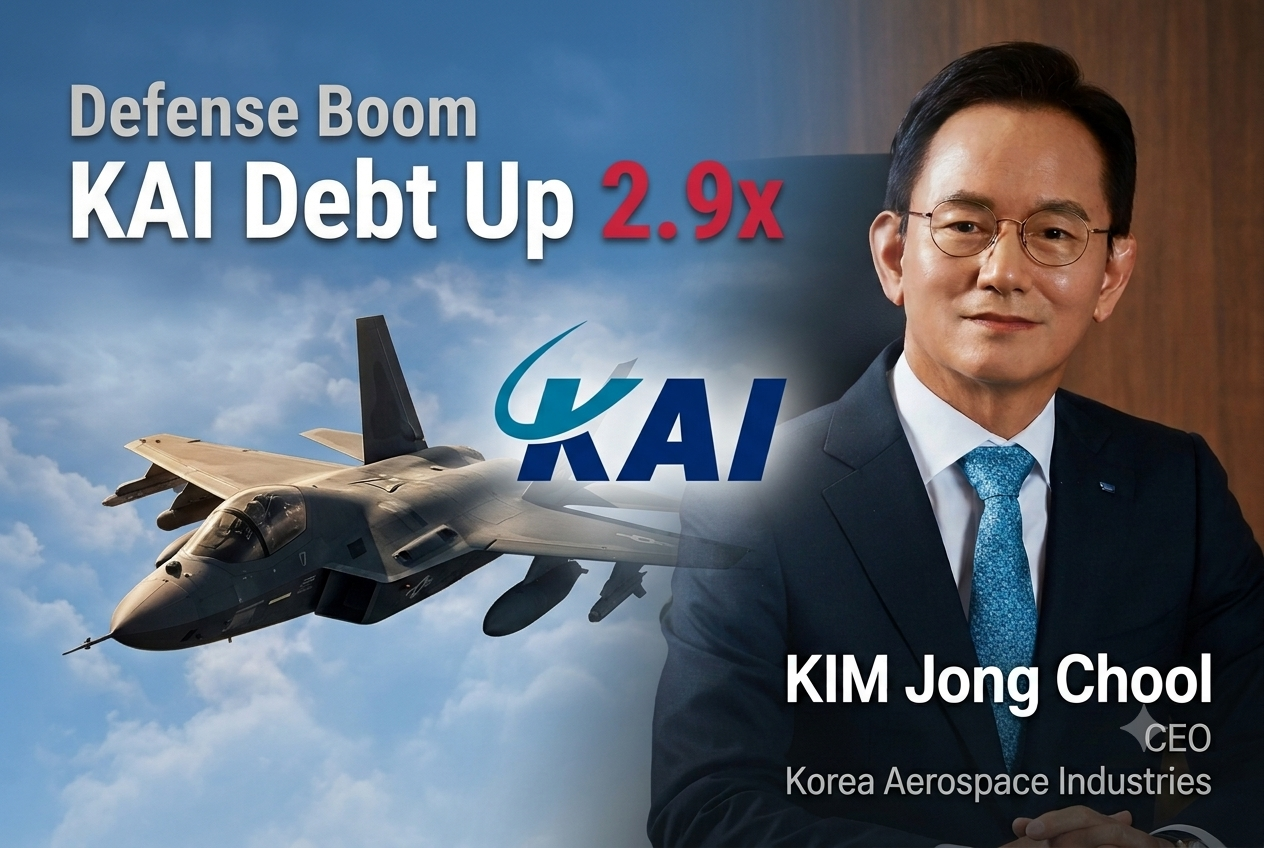
Korea Aerospace Industries (KAI) is South Korea’s sole prime contractor for complete aircraft systems, handling everything from design and component integration to testing and mass production of fighters, trainers and helicopters. Despite being seen as a beneficiary of the country’s defense export boom, its financial statements reveal a different picture.
Over the past three years, KAI’s cash balance fell by KRW 2.3319 trillion. Operating cash flow was negative KRW 700.4 billion in 2023, KRW 728.2 billion in 2024 and KRW 903.3 billion in 2025, marking a third consecutive year in the red. In the first half of 2025 the cash flow deficit was KRW 380.0 billion, a narrowing from KRW 607.3 billion a year earlier but still a continued outflow.
The primary driver is inventory. Inventories rose 2.3‑fold from KRW 1.7365 trillion at the end of 2023 to KRW 3.9926 trillion at the end of June 2025, with work‑in‑progress—aircraft under construction—accounting for KRW 2.1557 trillion. The company financed this growth through borrowing. Gross borrowings increased from KRW 1.0357 trillion at the end of 2024 to KRW 2.1470 trillion at the end of 2025 and KRW 2.9801 trillion at the end of June 2025, a 2.9‑fold rise over 18 months. Short‑term borrowings grew from KRW 492.8 billion to KRW 732.8 billion, and the debt‑to‑equity ratio jumped from 364.66 % to 484.20 %.
Brokerages expect borrowing to remain high. Yuanta Securities projects year‑end gross borrowings of KRW 3.2350 trillion. Daol Investment & Securities forecasts operating cash flow to stay negative at KRW 1.5117 trillion and a debt‑to‑equity ratio of 582.4 % by year‑end, with the interest coverage ratio falling from 4.4 times last year to 2.5 times this year.
Orders have not kept pace. In the first half of 2025, new orders totaled KRW 629.5 billion, only 6 % of the company’s full‑year guidance of KRW 10.4383 trillion. Second‑quarter orders were KRW 319.4 billion, down 89.9 % from KRW 3.1622 trillion a year earlier. KAI cited a base effect from remaining contracts for the KF‑21 and a Philippine FA‑50 contract concentrated in the previous year’s second quarter, and said major domestic and export orders would come in the second half.
The order backlog also shrank, falling KRW 1.5935 trillion from KRW 27.3437 trillion at the end of 2024 to KRW 25.7502 trillion at the end of June 2025. Domestic defense revenue fell from KRW 10.9868 trillion to KRW 10.2355 trillion, complete‑aircraft exports from KRW 5.5232 trillion to KRW 5.0257 trillion, aircraft components from KRW 10.0500 trillion to KRW 9.8076 trillion and the satellite business from KRW 783.7 billion to KRW 681.4 billion.
KAI’s year‑end backlog target is KRW 31.7357 trillion, requiring a net increase of nearly KRW 6 trillion in the second half alone. Mirae Asset Securities estimates full‑year new orders at KRW 8.5 trillion, about KRW 1.9 trillion below the target.
Delivery schedules for secured export orders are slipping. The 36 FA‑50PL jets for Poland are now expected to begin delivery in mid‑2027, with full delivery by early 2029, due to integration testing of the AESA radar and AIM‑9X missile.
KAI also lost several competitive bids. In April, Korean Air was chosen for the KRW 961.3 billion UH‑60 helicopter upgrade program, and KAI lost the Cheollian‑5 satellite program to LIG D&A. Last month, KAI and Hanwha Systems lost the electronic warfare aircraft system program to a consortium of LIG D&A and Korean Air. In the airborne control aircraft program, a U.S.‑based L3Harris model was selected over the KAI‑Saab partnership.
Profitability has weakened. Consolidated revenue remained around KRW 3 trillion for three consecutive years: KRW 3.8193 trillion in 2023, KRW 3.6337 trillion in 2024 and KRW 3.6964 trillion in 2025. First‑half revenue rose 48 % from a year earlier to KRW 2.2606 trillion, driven by system development programs. Operating profit fell 12.5 % to KRW 115.6 billion from KRW 132.0 billion, and operating margin dropped from 8.6 % to 5.1 %. In the second quarter, operating profit fell 43.1 % to KRW 48.4 billion and operating margin declined 6.1 percentage points from 10.3 % to 4.1 %. Gross margin fell 8.0 percentage points from 18.7 % to 10.7 %.
KAI attributes the second‑quarter decline to delivery schedule adjustments for rotary‑wing aircraft and expects mass‑production revenue to be fully reflected once domestic KF‑21 deliveries begin in the second half. Brokerages point to LAH delivery disruptions as a key factor: six units were scheduled for delivery in the second quarter but only one was delivered due to an engine defect; no deliveries were expected in the third quarter because of engine supply issues.
Margins on export projects are lower than before. The FA‑50 programs for Poland and Malaysia have mid‑to‑high single‑digit margins, lower than earlier export projects.
KAI needs a new large‑scale program after KF‑21 system development to sustain its workforce and technology. The company is researching a small unmanned combat aircraft and a manned‑unmanned teaming system for rotary‑wing aircraft.
Weaknesses in the KF‑21’s export competitiveness include no combat record, reliance on the GE F414 engine subject to U.S. export controls, lack of indigenous missiles and an insufficient global logistics network.
Management continuity is also a concern. After former CEO Kang Goo‑young stepped down in July 2024, KAI operated without a formal CEO for about eight months until Kim Jong‑chool was elected at an extraordinary shareholders’ meeting on March 18 2025. Kim said he would secure future growth through software such as AI pilots, MUM‑T and unmanned aircraft, and broaden the portfolio to guided weapon systems and space.
Brokerage expectations have fallen. Yuanta Securities cut its target price for KAI from KRW 236,000 to KRW 182,000, Hyundai Motor Securities from KRW 202,000 to KRW 151,000 and Daol Investment & Securities from KRW 230,000 to KRW 210,000. Yuanta lowered its operating profit estimate for this year by 19.1 % from KRW 485.2 billion to KRW 392.4 billion.
Large contracts in the second half will be crucial for meeting the order target and improving cash flow. How the new management handles the swollen inventory and debt until KF‑21 mass‑production revenue begins will likely determine the company’s performance for the year.
Frequently asked questions
What has been KAI's operating cash flow trend in recent years?
Negative KRW 700.4 billion in 2023, KRW 728.2 billion in 2024, and KRW 903.3 billion in 2025, marking three consecutive years in the red.
How did KAI's inventory levels change between 2023 and June 2025?
Inventories rose 2.3‑fold from KRW 1.7365 trillion at end‑2023 to KRW 3.9926 trillion at end‑June 2025, with work‑in‑progress at KRW 2.1557 trillion.
What is the status of KAI's order backlog and target?
The backlog fell to KRW 25.7502 trillion at end‑June 2025 from KRW 27.3437 trillion at end‑2024, and the year‑end target is KRW 31.7357 trillion.