Science
Nobel Physics Prize Speculations Span Invisibility Cloaks, OLEDs, and Antihydrogen
By AFP
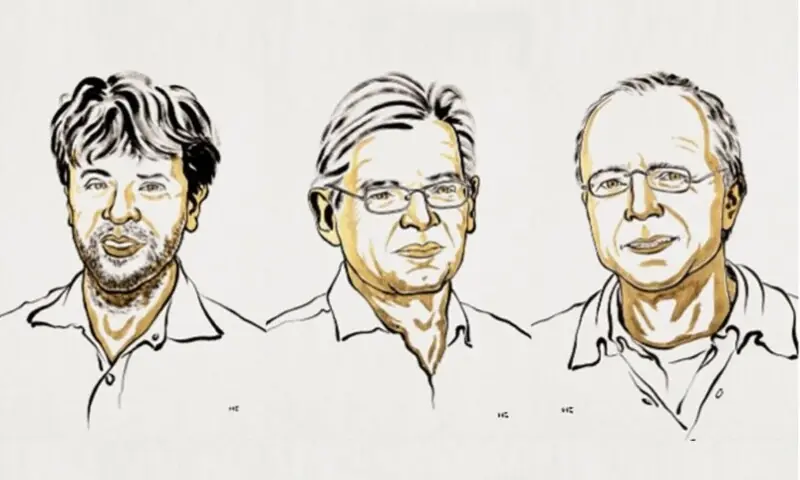
The Nobel physics prize, to be announced at 11:45 am in Stockholm, has attracted speculation that could include achievements in particle physics, astrophysics, or the invention of an “invisibility cloak.” The award follows the Medicine Prize, which was awarded on Monday to US psychiatrist and neurologist Karl Deisseroth and German scientists Peter Hegemann and Georg Nagel for pioneering work in optogenetics.
Commentators have long suggested that metamaterials and Britain’s John B. Pendry, known for his “invisibility cloak” that bends light around an object, might be honored, possibly alongside American David Smith. Italian‑American Federico Capasso, noted for contributions to the quantum cascade laser, is also a potential candidate. Other possibilities include work on graphene, highlighted by the 2010 prize, and twistronics research by Spain’s Pablo Jarillo‑Herrero, Canada’s Allan MacDonald, and Israel’s Rafi Bistritzer, which could lead to superconductivity and an energy revolution.
Research firm Clarivate, which predicts winners based on citations, has spotlighted Japan’s Chihaya Adachi, Americans Stephen R. Forrest and Mark E. Thompson for ultrahigh‑efficiency organic light‑emitting diodes (OLEDs), Swiss‑British Nicola Spaldin for magnetoelectric multiferroics, and China’s Qikun Xue for experimental observation of the quantum anomalous Hall effect. Clarivate also highlighted Swiss‑British researcher Nicola Spaldin and China’s Qikun Xue for their work on energy‑efficient materials.
Hamish Johnston, online editor of Physics World, noted that recent winners suggest both condensed‑matter physics and particle/nuclear physics could be recognized. He mentioned CERN’s ATHENA and ALPHA collaborations, which first trapped cold antihydrogen atoms, and American physicist Jeffrey Hangst, a founder of both collaborations, as possible laureates. Johnston also suggested Belgian physicist Ingrid Daubechies, along with French mathematicians Stephane Mallat and Yves Meyer, could be honored for wavelet theory, which underpins image compression.
In the astrophysics arena, Briton Martin Rees, former Astronomer Royal, has been mentioned, as has research on the James Webb Space Telescope and galaxy formation by Mexican‑British cosmologist Carlos Frenk, Argentinian astrophysicist Julio Navarro, and British scientist Simon White.
The physics prize will be followed by the chemistry award on Wednesday, the literature laureate on Thursday, and the peace prize on Friday. The economics prize concludes the Nobel season on October 12.