World
US Space Weapon Announcement Sparks Debate Over Orbital Arms Race
By Today News Hours Editorial Desk
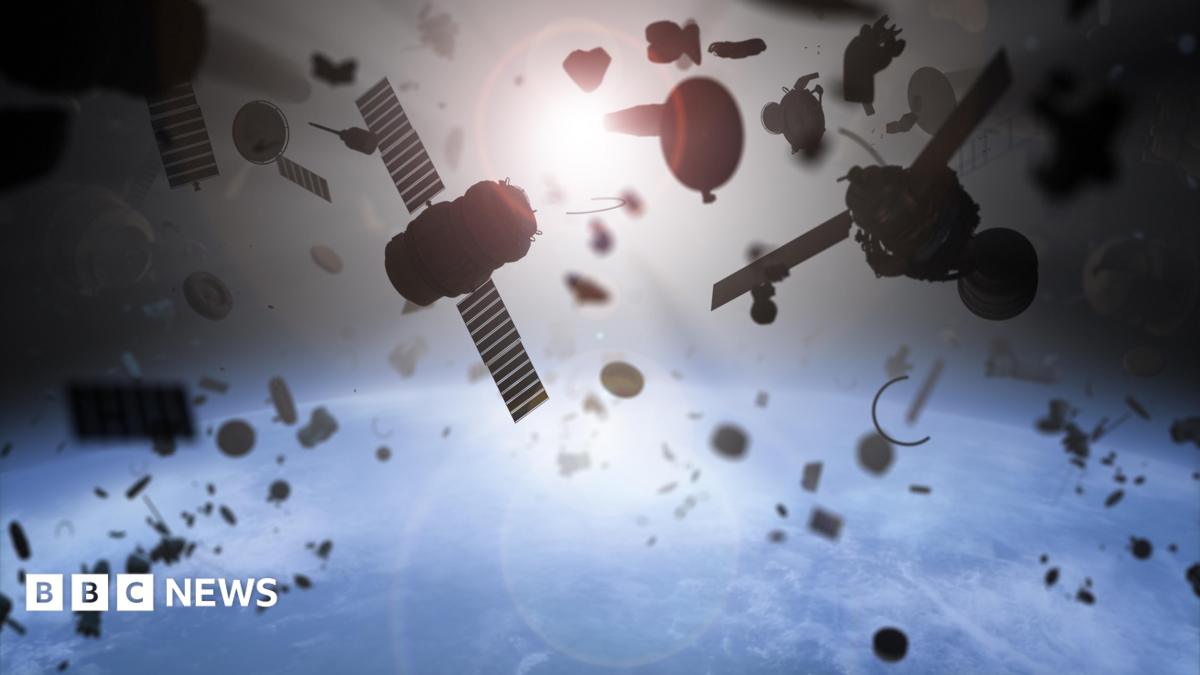
The United States has announced the deployment of a weapon in Earth's orbit, prompting questions about the nature of such weaponry and its role in the competition among major powers for dominance in space. US officials have disclosed few details. Secretary of the Air Force Troy Meink said the "on orbit" weapon was necessary to protect American forces from hostile actions, but did not specify its capabilities or deployment date.
Space has been a militarized domain since the late 1960s, when the Soviet Union developed the Istrebitel Sputnikov program, which used satellites designed to release projectiles that would detonate and damage other satellites, typically American ones. Today, advanced militaries rely on satellites for reconnaissance, secure communications, missile detection, and precision targeting.
Dr. Bleddyn Bowen, an associate fellow in military sciences at the Royal United Services Institute and associate professor in astropolitics at Durham University, speculated that the newly announced US weapon could be an electronic warfare or radio-jamming platform, functioning as a non-destructive anti-satellite tool. "If you take out the radio links then your satellite is very useless," he told BBC Radio 4's Today programme. He also noted that a more destructive option, such as a kinetic kill vehicle capable of ramming into a satellite, could not be ruled out, as well as a "close inspection and grappling satellite."
Juliana Suess, a researcher at the German Institute for International and Security Affairs and former RUSI fellow, said Russia and China have also shown activity suggesting the testing of co-orbital weapons, though details remain unclear, making comparisons with the US system difficult.
Bowen criticized China's response to the US announcement, which warned against a space arms race, calling it hypocritical given that China, Russia, the US, and India have all developed anti-satellite or counter-space capabilities. He noted that Russia and China have deployed technologies in space with significant weapons potential.
Over the past decade, Russia and China have increased so-called rendezvous and proximity operations (RPOs), maneuvering satellites close to Western ones. Dr. Rod Thornton of King's College London said these RPO satellites could theoretically become "hunter-killer" systems capable of colliding with or displacing other satellites. Bowen added that China has demonstrated a "space tug capability," in which a vehicle can grapple a satellite and move it into a different orbit — a capability that could be used either to clear space debris or disable functioning satellites.
Some space weapons also risk generating dangerous amounts of debris. Dr. Mark Hilborne of King's College London cited China's 2007 anti-satellite missile test as an example that left long-lasting debris in orbit. Suess noted that debris from that test remains in orbit and continues to pose a hazard, as even small fragments can cause serious damage due to the high velocities involved.
Thornton said Russia compensates for having fewer satellites by investing heavily in missile capabilities, including ground-based missiles that can strike satellites in low Earth orbit and air-launched anti-satellite missiles. He said Russia views NATO as having a stronger satellite network and has developed its missile arsenal to offset that advantage. Thornton also noted that, as a last resort, Russia could use nuclear weapons in space, with an electromagnetic pulse capable of disabling unprotected satellites over a wide area.
Regarding the possibility of nuclear conflict in space, Bowen said such an event would likely only occur alongside a broader conflict on Earth, rather than as an isolated incident.
Experts generally view the US announcement as more of a political signal than a major technological breakthrough. Bowen suggested it may be a response to China's military modernization, which has expanded its satellite network and created more potential targets for US forces. "There's much more incentive for American space weapons now because China has a lot of vulnerability to space in the same way that the Americans have," he said.
Thornton noted that this dynamic could paradoxically benefit Russia in a potential space conflict, since it operates far fewer satellites than the US or China and would have less to lose. Such a conflict, he said, would likely involve missiles launched into space, satellites designed to disable or destroy others, and ground-based lasers.