World
Armed Settlers Operating as Israeli Reservists Terrorize West Bank Villages Amid Near-Total Impunity
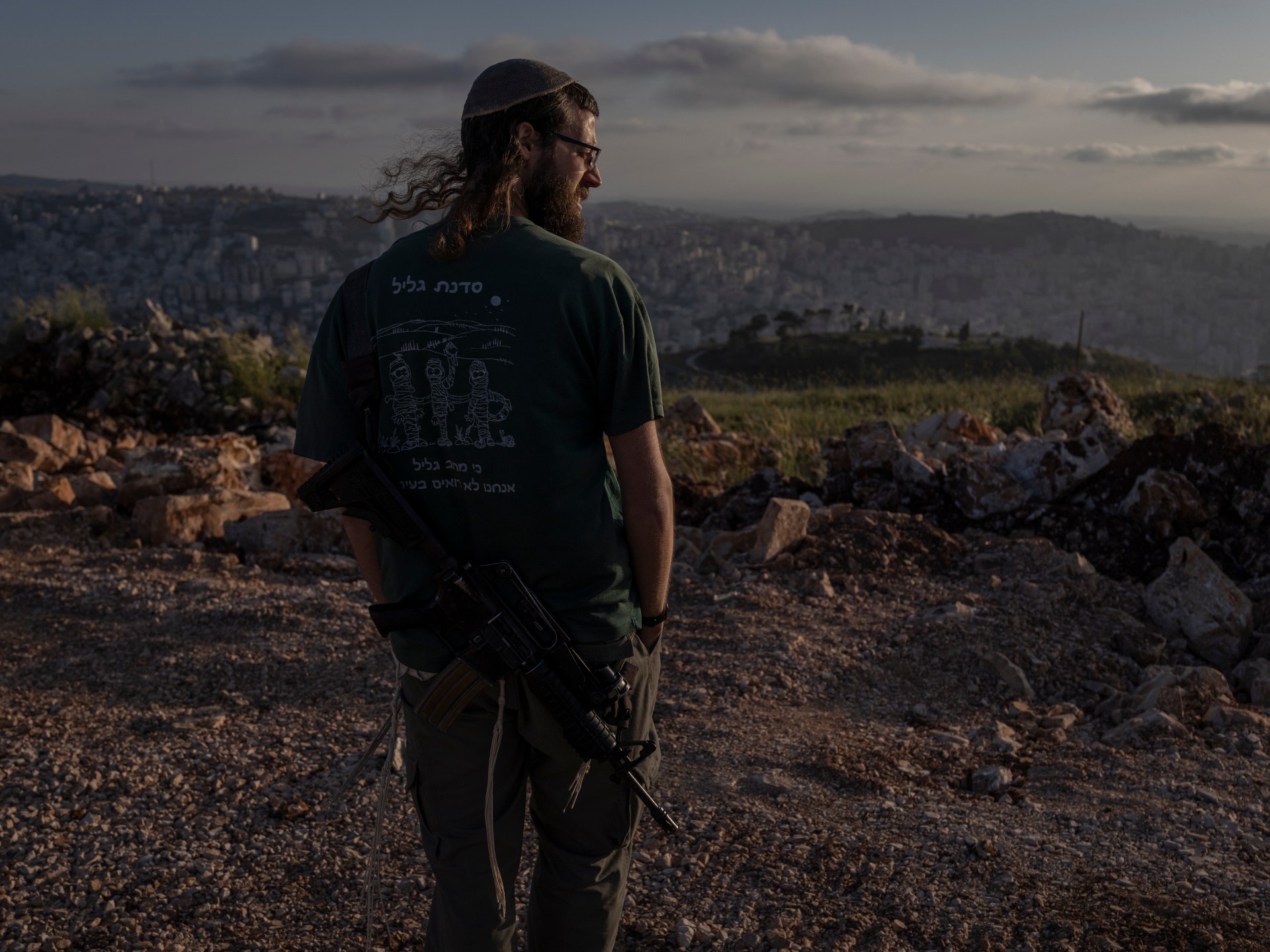
In the West Bank town of Kobar, northwest of Ramallah, Palestinian farmers say an armed settler known locally as "Ghazal" has repeatedly attacked them, part of what residents describe as an ongoing campaign targeting Palestinian communities. Bassema Khader, 63, whose family farms land in the al-Daak area, said she recognized the man even when he wore a mask.
"A settler known as 'Ghazal' has been coming to the area for a long time, wearing an army uniform to intimidate people," Khader told Al Jazeera. "But the residents weren't afraid and continued to hold on to their land."
Khader said the man fired shots and stole sheep and solar panels almost daily, sometimes approaching cars and demanding keys while claiming to be a soldier. When she confronted him as he tried to steal her sheep, he summoned backup, telling her Israeli Border Police were on the way. They arrived and helped him take the sheep to a nearby settlement, she said. "The goal is to steal, to frighten and terrorize people, to stop them from reaching their land, and ultimately to empty the al-Daak area," she said.
In Deir Jarir, northeast of Ramallah, Mohammad Majdi Abu Makho said he was run over by a settler's vehicle and pepper-sprayed while praying near the village entrance on December 25, 2025. "For me, the land is life. It truly is everything," he told Al Jazeera. "What does a farmer — or anyone — have other than their land? It gives us a sense of belonging. It is our identity."
Abu Makho said the settler regularly brought sheep to the village entrance, and when residents tried to drive him off, he opened fire indiscriminately. He later pursued legal action through Israeli courts. The Israeli military confirmed the settler was an army reservist and said he had also fired shots inside Deir Jarir earlier that day while in civilian clothes. His weapon was confiscated and his reserve service suspended pending investigation.
The blending of settler and military roles has at times proven fatal. On April 11, 2026, 23-year-old Ali Majed Hamadneh was killed in Deir Jarir. The Israeli military said forces had been sent after reports that Palestinians were throwing stones at an Israeli, and that a reserve soldier fired into the air before shooting one of the stone-throwers, who was later confirmed dead.
But the Israeli rights group B'Tselem offered a different account on April 13, saying two settlers from the Oranim Farm outpost had brought sheep to graze on Deir Jarir farmland. When residents tried to remove the animals, two more settlers arrived, one of them a reservist in a military Regional Defence Battalion, who "launched a massive volley of shots" as residents fled. B'Tselem said Hamadneh was shot in the back while running away and posed no threat. Its investigation found no military forces present other than the armed reservist. B'Tselem says settler militias have killed at least 35 Palestinians since October 2023.
The integration of settlers into Israel's military structure has expanded significantly since the war on Gaza began in October 2023. An August 9 report by Haaretz found that the Israeli military had mobilized about 5,500 West Bank settlers as reservists, assigning them to regional defense battalions. Soldiers cited in the report said these units often act with wide autonomy, sometimes ignoring the authority of regular commanders. One commander told Haaretz: "They tell you quite openly that they're the lords of the land here, and that's really how it feels on the ground." Another reserve commander said: "Everything else was about dealing with Jews looking for provocations."
Sarah Sanbar, acting Israel and Palestine researcher at Human Rights Watch, said the Israeli government has expanded settlers' security and military functions through reserve mobilizations and the creation of rapid response squads granted special police powers, effectively "arming settlers in the West Bank and militarizing them at unprecedented levels."
Bashar Qaryouti, an anti-settlement activist based south of Nablus, said this dual status gives settlers added leverage. "This gives a settler more than one role in the same place," he said. "He has a direct interest in expanding the settlement, while his military service gives him weapons, experience and connections within the Israeli military system."
The overlap between settlers and Israeli security forces has drawn international attention. In May 2026, the European Union sanctioned the Israeli organization Hashomer Yosh and its president, Avichai Suissa, saying the group provided material support and coordinated volunteers at herding farms backing at least 28 violent outposts and settlements in the West Bank, and recruited armed volunteers involved in attacks.
Qaryouti said Hashomer Yosh supports outposts near Qaryut and al-Mughayyir by supplying volunteers and guards. He said Suissa is known locally for backing outposts and settler groups around Qaryut and alleged he took part in a March 2 attack on the town in which brothers Mohammad and Fahim Muammar were killed and three others wounded.
Sanbar said the merging of settler and military roles makes it difficult for Palestinian victims to identify their attackers' official status at the time of an assault — a problem compounded by low rates of investigation into complaints against Israeli soldiers.
According to the Israeli rights group Yesh Din, 77.3 percent of complaints alleging soldier offenses against Palestinians are closed without a criminal investigation. Of 2,427 complaints filed with the military between 2016 and 2024, only 552 led to criminal investigations (22.7 percent), and just 23 resulted in indictments — 0.9 percent of the total. Nearly half of all complaints took two to five years to process. Yesh Din concluded that by failing to handle complaints promptly and seriously, "the Military Advocate General's Corps sends a clear message to soldiers that the army condones violence, looting property, beating, wounding or even killing Palestinians in the West Bank."