Politics
Spanish Leaders Hold Final Rallies as Election Looms
By Today News Hours Editorial Desk
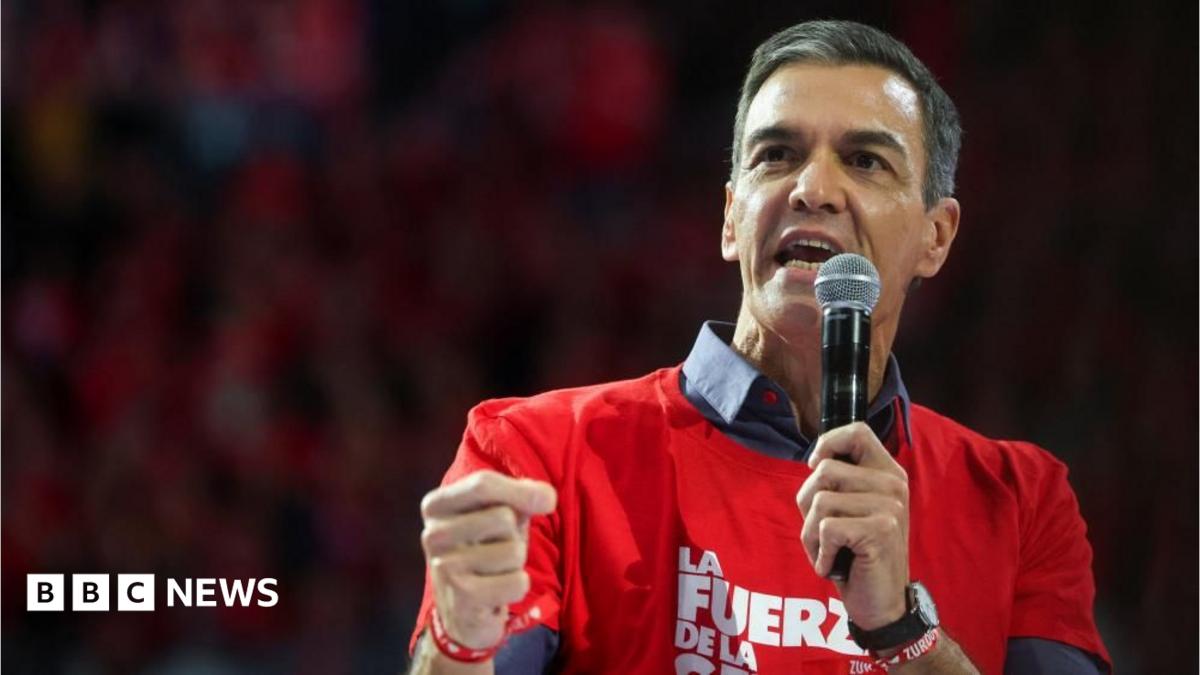
Spanish party leaders held their last rallies before Sunday’s election. Socialist Prime Minister Pedro Sánchez told supporters he believes he can beat the polls, saying, “I cannot imagine us losing.” He posed for selfies with fans wearing red T‑shirts and accused conservative rival Alberto Núñez Feijóo of planning a coalition with the far right. Feijóo’s People’s Party (PP) is slightly ahead in the polls. In the final hours of the campaign he travelled first to Barcelona and then to Seville, promising voters a new era of “truth, decency and good governance.” He criticised Sánchez for avoiding questions on corruption, rail disasters, immigration and the national debt. Sánchez heads one of Europe’s few left‑wing governments, and with France’s presidential election five months away, there is a real possibility that two of the continent’s largest economies could shift rightward in quick succession. Spain has almost 39 million voters, and while commentators expect a high turnout, most polls suggest a close finish. Under Spanish electoral law no polls have been published since Monday.
Feijóo told PP supporters, “This time, yes, we’re going to do it,” echoing his failure to form a government three years ago despite winning the most seats. If he succeeds, he would do so with the support of the anti‑immigration party Vox, led by Santiago Abascal. Vox’s final rally was held in a bull‑ring in Valencia, where thousands gathered. The venue was decorated with Spanish flags and green Vox banners. Abascal called for “less burka and less halal,” and a small section of the crowd chanted “Viva Franco,” referencing the dictator whose death in 1975 marked the start of Spain’s transition to democracy. Several first‑time voters said they supported Vox because of its immigration policies. Lledó, 18, said the summer incident in Ceuta, where more than 70,000 migrants crossed into Spanish territory from Morocco, showed Sánchez could not control the border. She came to the rally with her mother and aunt, Carli Chilet, who said Vox “are the best for women’s rights.” Vox hopes to almost double its seats from the 33 it won three years ago. It backs policies such as “national priority,” giving Spanish citizens first priority for welfare, and “remigration,” for foreigners not considered to contribute to the economy.
The final day of campaigning followed a four‑way TV debate the night before that highlighted Spain’s sharply polarised politics. All four leaders offered solutions for the housing crisis. Feijóo said the PP would build a million homes over four years, while Sánchez said housing should be a right, not a speculative asset. The conservatives focused on scandals that have shadowed the Socialists’ term, whereas Sánchez and his left‑wing ally Ada Colau, head of Frente Amplio, emphasised women’s rights. During the debate, Feijóo accused Colau and the left of staying quiet during a flood disaster in Valencia, using the word “calladita,” a diminutive that can also be a condescending way to tell a woman to keep quiet. Sánchez responded immediately, demanding respect and accusing Feijóo of sexism. Feijóo later clarified his remarks and accused Colau of remaining silent during “these years of corruption.” His decision to end the campaign in Seville was significant, as Andalusia holds 61 seats in Spain’s 350‑seat parliament, more than any other region. Andalusia is also run by a coalition of the PP and Vox, as are Extremadura, Aragón and Castilla y León. Feijóo insists he wants to govern with a majority, backed by “parliamentary support agreements” with Vox, and says he has never spoken to Abascal about giving Vox ministerial power. Sánchez took the stage in Madrid with his wife Begoña Gómez, wearing a red T‑shirt that read “power of the people.” He praised Colau and her coalition’s campaign. While speaking, Colau told a large audience in southern Madrid that they would not remain silent and would win, vowing to form another progressive government.
Frequently asked questions
Who are the main candidates in Spain’s upcoming election?
The main candidates are Socialist Prime Minister Pedro Sánchez and People’s Party leader Alberto Núñez Feijóo, with Feijóo seeking support from Vox.
What key issues were highlighted during the final TV debate?
The debate focused on the housing crisis, with Feijóo proposing a million new homes and Sánchez advocating housing as a right; it also covered corruption, immigration, and women’s rights.