Law & Justice
San Diego Auto‑Repair Site Dispute Allows Lawsuit to Continue in Court
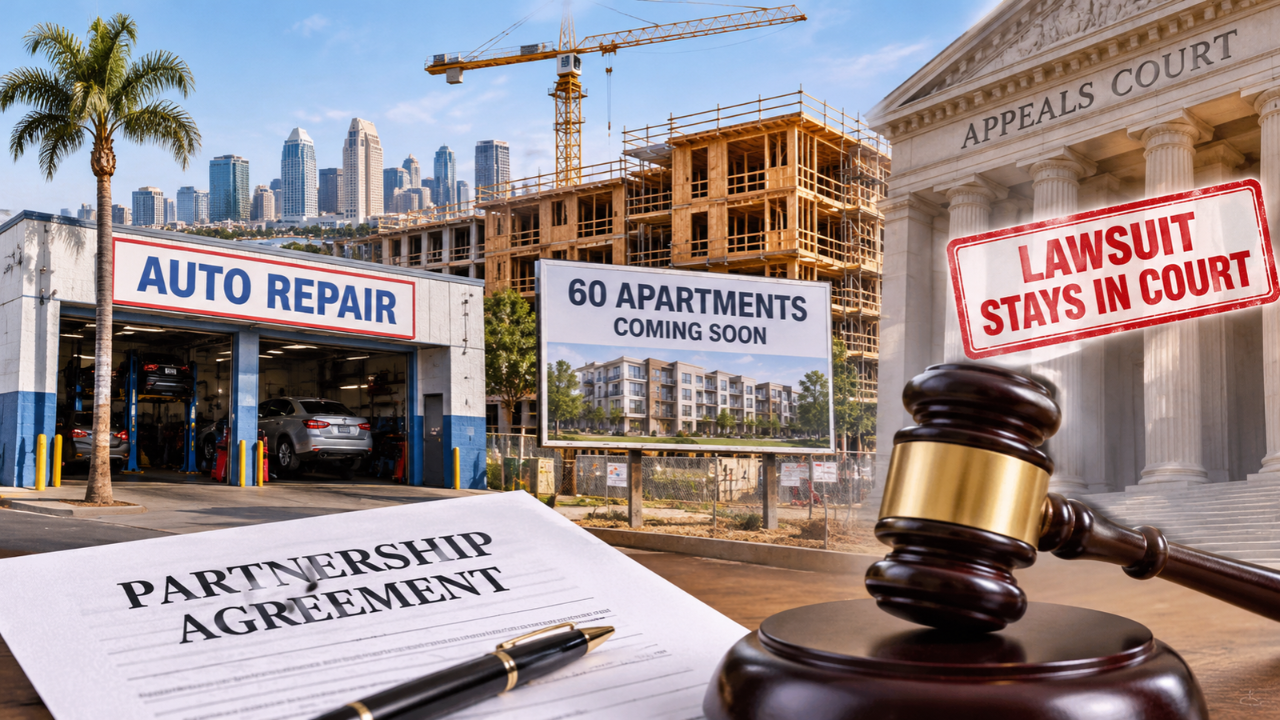
A plan to replace a family‑run auto‑repair shop at 4040 Park Boulevard in San Diego with a 60‑unit apartment building has led to a legal dispute after the development stalled and the partners disagreed over their responsibilities. The owners, represented by E&N, Inc., sued developer Daniel Haas and his companies in July 2024, alleging misrepresentation of the project’s timeline and income, failure to take preliminary construction steps, and denial of access to financial records. The claims include intentional and negligent misrepresentation, violations of state securities laws, negligence, breach of the duty of good faith and fair dealing, unjust enrichment, and a request for an accounting.
Haas sought to move the dispute to arbitration under a clause in the operating agreement of the joint‑venture company, 4040 Park LLC, which required disputes to be arbitrated after nonbinding mediation. E&N opposed the arbitration, arguing that the clause did not satisfy California Code of Civil Procedure section 1298. The trial court denied the motion to compel arbitration.
In a November 23, 2026 ruling, the California Court of Appeal, Fourth Appellate District, Division One, upheld the trial court’s decision. The appellate court held that the operating agreement required E&N to transfer the property to the new company, making it a contract to convey real estate. Therefore, the agreement fell under the state’s rules for arbitration clauses in property‑conveyance contracts, which require a clearly labeled heading, specified formatting, and a notice that agreeing to arbitration waives the right to have disputes decided in court. The parties did not dispute that the clause failed to meet those requirements.
The appellate court also declined to consider Haas’s federal securities‑law argument because he had not identified a specific federal law, and it rejected his late‑filed Federal Arbitration Act argument. The court affirmed the denial of arbitration and awarded E&N its appeal costs. The ruling does not determine liability or the financial outcome of the dispute; it simply allows the owners’ lawsuit to proceed in court rather than being sent to arbitration.
Frequently asked questions
Why was the arbitration motion denied?
The arbitration clause in the operating agreement did not meet California Code of Civil Procedure section 1298 requirements, lacking a clearly labeled heading, specified formatting, and a notice that waives the right to have disputes decided in court.
What did the appellate court decide about the arbitration clause?
The court held that the clause applied to a property‑conveyance contract and failed to satisfy statutory requirements, so the dispute must be decided in court.
What is the current status of the lawsuit?
The lawsuit can proceed in court; the appellate court affirmed the denial of arbitration and awarded E&N its appeal costs, but did not determine liability or financial outcome.