India
British Survey Pillar Identified Near Thirupparankundram Dargah
By B. Kolappan
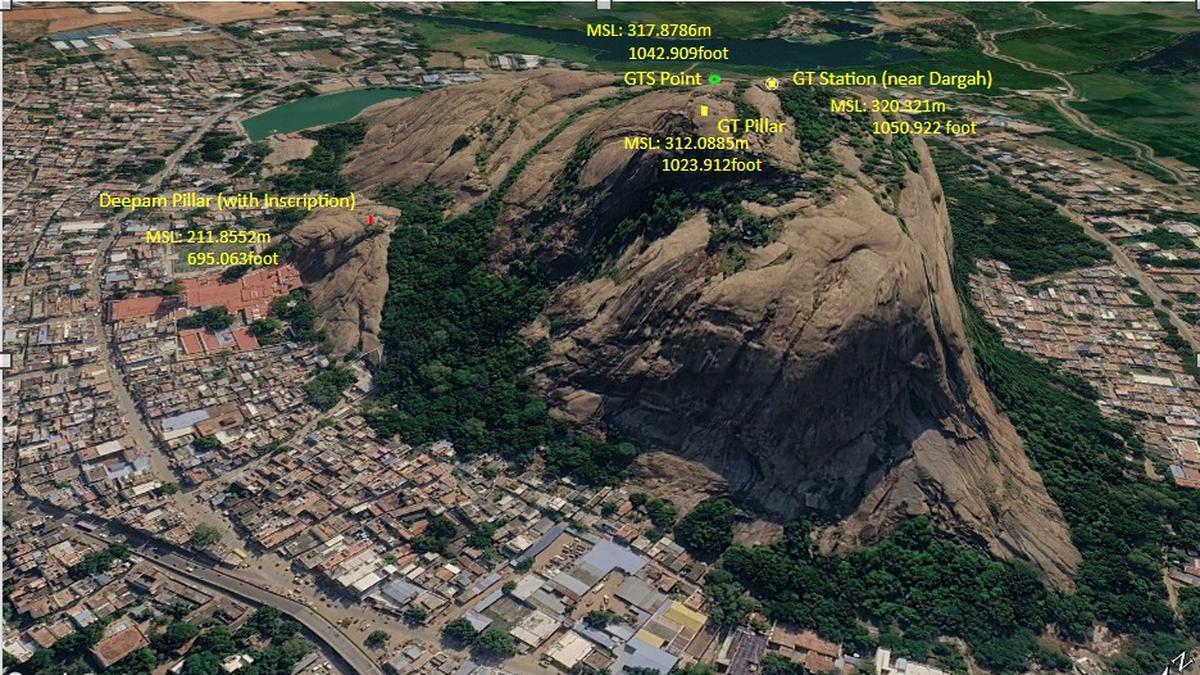
A 2026 report by Tamil Nadu’s Departments of Survey and Settlement and Archaeology confirms that the pillar near the Sikandar Badusha Dargah on Thirupparankundram hill is a Great Trigonometrical Survey (GTS) pillar erected by the British. The map shows the original Deepathoon (lamp pillar) to be below the dargah. The report comes amid renewed interest in the dispute over lighting the Karthigai Deepam on the hill, after the Supreme Court allowed a one‑time lighting of the lamp at the newly identified deepathoon. The report states that triangulation bearings from Sikandarmalai hill station to other stations—Nagamalai, Sadragiri, Gopalswami, Kutiparai, Meenakshi Amman temple in Madurai, Ponurikimalai and Perumalmalai—taken in the current survey match values in the colonial GTS report. It concludes that the pillar and the engraved mark on the rock, featuring a circle with a dot, are a survey pillar. The five‑volume, 1,800‑page report identified more than 800 stations in the first phase; 484 stations, including 210 primary and 274 secondary stations, were physically documented. Thirupparankundram was a secondary station with a stone pillar and stone mark. The work followed an order from the Revenue and Disaster Management Department issued in December 2025 to systematically identify and document all GTS stations. Permission to publish the report was granted by the Revenue Department in August 2026. The Survey and Settlement Department, under the Revenue and Disaster Management Department, notes that triangulation—measuring angles between points relative to a baseline—was used to establish stations. Hills offered clear sightlines, while flat areas required more stations. The order highlighted that many original physical station points have become untraceable due to urbanisation, natural calamities, industrialisation and vandalism. The Director of Survey and Settlement proposed a comprehensive field exercise to identify, map, document and preserve all GTS stations in Tamil Nadu and to use their coordinates for future surveys. Published – November 23, 2026 09:28 pm IST
Frequently asked questions
What did the 2026 report confirm about the pillar near Thirupparankundram hill?
The report confirmed that the pillar near the Sikandar Badusha Dargah is a Great Trigonometrical Survey (GTS) pillar erected by the British.
How many stations were documented in the first phase of the survey?
The report identified more than 800 stations in the first phase, with 484 stations physically documented, including 210 primary and 274 secondary stations.