World
Same Three Advisers Who Split Over Iraq Troop Deployment Now Weigh In on Hormuz Decision
By News Team
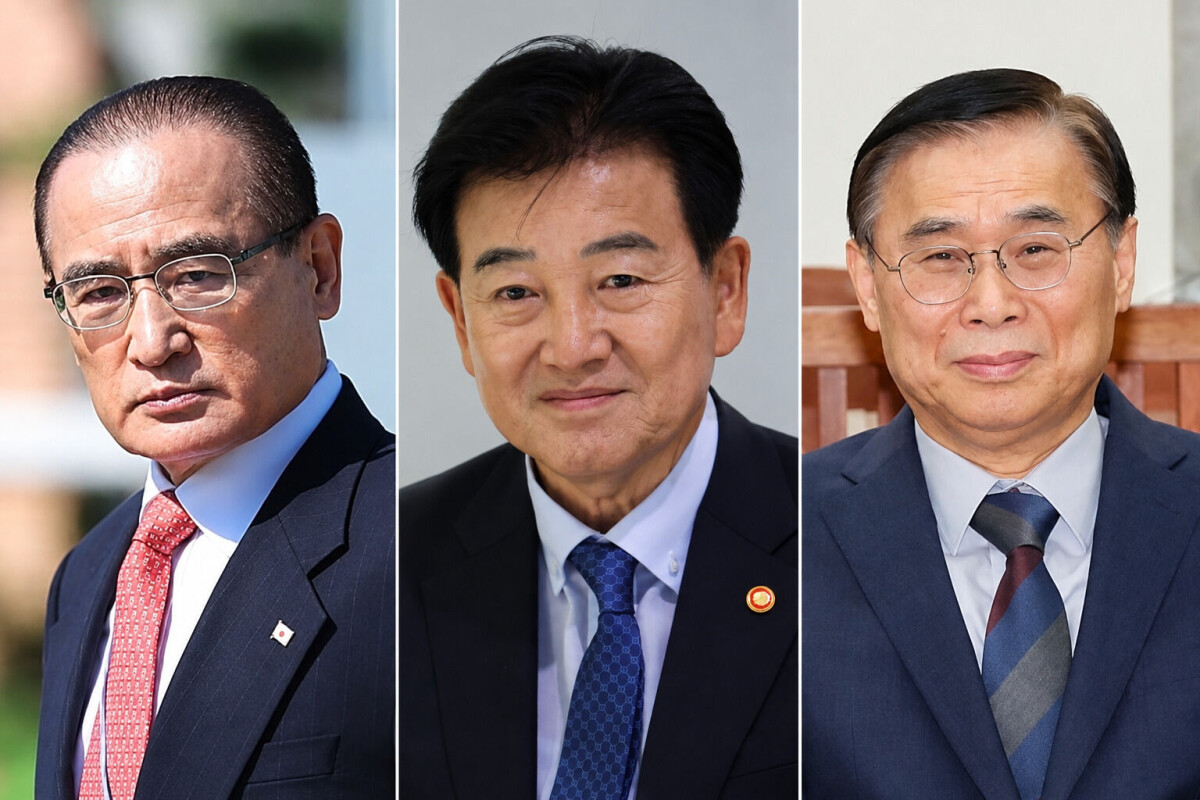
South Korea's deliberations over whether to send troops to the Strait of Hormuz are being shaped by the same three officials who took opposing positions on deploying troops to Iraq 23 years ago. National Security Adviser Wi Sung-lac, National Intelligence Service Director Lee Jong-seok and Unification Minister Chung Dong-young are once again set to advise the president on a major troop deployment decision, this time under President Lee Jae Myung.
Speaking at a town hall meeting with civic groups at the Blue House on Friday, President Lee acknowledged the difficulty of the issue. "Sending troops overseas is a really difficult matter to discuss," he said, adding that no progress had been made on a final decision. His comments came shortly after liberal lawmakers aligned with his administration voiced strong opposition to deploying troops to Hormuz.
Despite the public impasse, government activity on the matter has continued behind the scenes. A working-level National Security Council meeting is expected Thursday to begin assessing the possibility and scale of a deployment. The NSC includes the president, prime minister, foreign minister, unification minister, defense minister and NIS director. Officials plan to brief President Lee after his return from France, followed by another meeting the following Tuesday to decide whether to seek parliamentary approval. Substantive deliberations by the NSC Standing Committee could begin around Sept. 17.
The current debate echoes divisions from 2003, when the United States asked South Korea to send additional combat-capable troops to Iraq. At the time, Wi Sung-lac, then head of the Foreign Ministry's North American Affairs Bureau, argued that some form of deployment was unavoidable given South Korea's national interest. His view contrasted with that of Moon Jae-in, then a presidential aide, who questioned the moral justification for the war.
A source familiar with the discussions said Wi's pragmatic stance—factoring in relations with Washington—stood out against what had become near-dogmatic opposition within the ruling bloc. Wi and then-Foreign Minister Yoon Young-kwan eventually persuaded then-President Roh Moo-hyun, who by mid-October 2003 had agreed in principle to send more troops.
Wi is reportedly taking a similar position now, favoring a deployment to Hormuz to avoid straining ties with Washington.
In 2003, once the principle of deployment was settled, debate shifted to its scale. The Foreign and Defense Ministries considered a large combat force, with the Defense Ministry proposing as many as 10,000 troops. Opposing this was Lee Jong-seok, then NSC deputy secretary, who favored a smaller, largely noncombat mission. His camp argued that deploying 10,000 combat troops would erase any diplomatic benefit to South Korea.
Despite President Roh's instructions for officials to avoid public comment, Lee Jong-seok told reporters in October 2003 that a deployment of 2,000 to 3,000 troops would be reasonable, prompting pushback from other officials and revealing the internal rift. Roh ultimately chose a middle path, forming the Zaytun Division with fewer than 3,000 troops focused mainly on reconstruction, though some combat personnel were included. Lee Jong-seok, now NIS director, told the JoongAng Ilbo last year that Roh had made