Technology
Bengaluru Startup Develops Net‑Based System to Capture Hostile Drones
In a field in West Bengaluru’s Kottigepalya, a trio of aerospace engineers from Saubha Aerial Systems launched a net and caught a drone, demonstrating a new anti‑drone technology. Saubha, founded in January 2025 by 25‑year‑olds Naijith Rai, Ruturaj Yellurkar and Ksheeraj Krishna, originally sold parachute systems that safely recover drones. The company is now developing a net‑based interceptor to capture hostile drones, a growing security concern along India’s borders with Pakistan. Drones have been used to smuggle narcotics and weapons into Punjab and Jammu and Kashmir, where authorities have seized more than 68,000 kg of drugs and hundreds of weapons, according to The Indian Express. The Ministry of Home Affairs reported that 292 drones were seized or recovered along the India‑Pakistan border in 2025. Senior police officers have said that drones ferry narcotics, weapons and explosives from launchpads in Pakistan’s Punjab into India, often at night. In 2024 and 2025, the Border Security Force and allied agencies intercepted nearly 300 Pakistani drones in Punjab.
Saubha’s founders met at Bengaluru’s RV College of Engineering in 2019 and shared a fascination with drones. Their interest grew during a 2022 SAE Aerothon competition, where they built a drone on a Rs 1 lakh budget that crashed during testing, prompting them to consider safety mechanisms. A subsequent incident involving a 25‑kg agricultural drone that crashed into a construction site highlighted the need for protective solutions. After graduating in 2023, the trio ran ProjectX Labs, a workshop that helped them generate working capital.
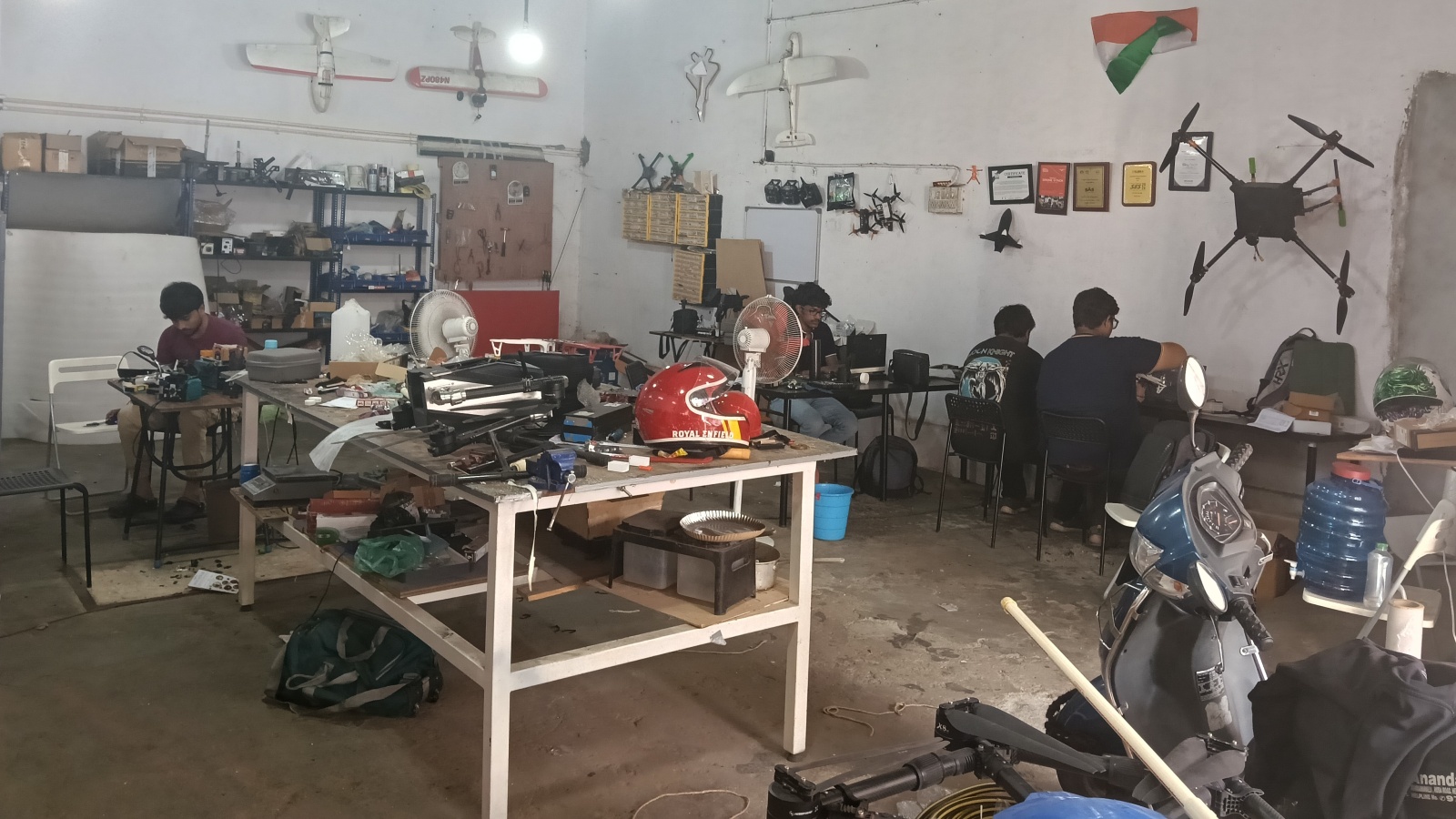
Saubha built its parachute prototypes in a warehouse in Kottigepalya. The company has sold parachute systems to Tata Advanced Systems, Arka Aerospace, Johnette Technologies and Skye Air Mobility, earning Rs 20 lakh in revenue. Prices vary with drone size and deployment method.
The new net system was conceived after Operation Sindoor, when many Pakistani drones did not respond to soft‑kill jammers and were only downed by missiles. Saubha’s hand‑launched net uses a pyrotechnic charge to deploy a weighted net that entangles and brings a drone down. The team aims to extend the launcher’s range to 40 m for handheld use and 100 m for vehicle‑mounted systems. They are exploring a pre‑timed capsule that could open near the drone to overcome air resistance.
Six units across India have tested prototype net launchers. After Operation Sindoor, security agencies expressed keen interest in procuring cost‑effective anti‑drone systems. Police forces in two cities have also requested demonstrations of an autonomous drone interceptor incorporating a net. The company continues to refine its technology and seeks to meet the operational requirements of Indian security agencies.