Technology
Bengaluru Inventor Claims New Process Could Turn Mercury into Gold and Silver
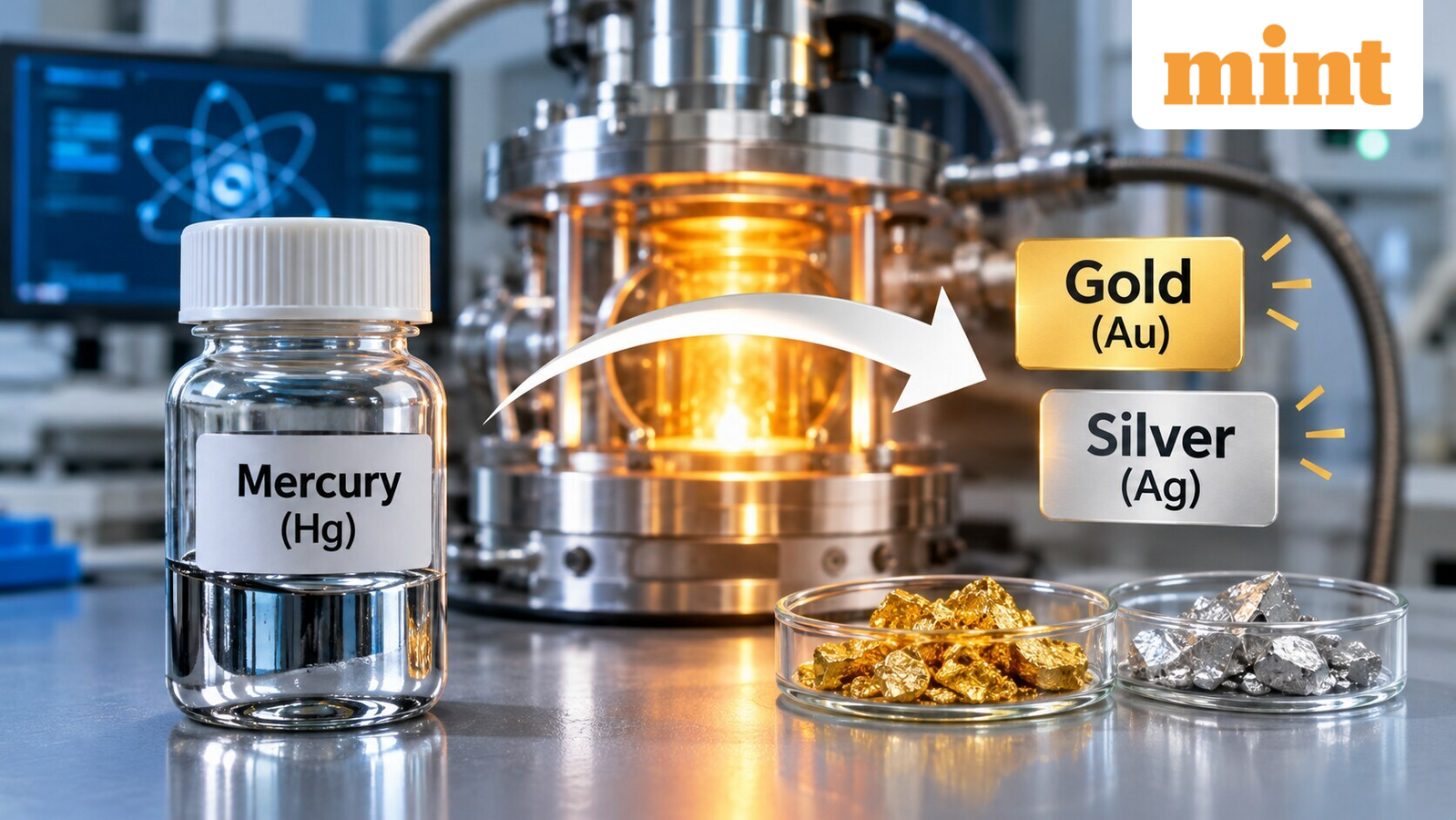
A Bengaluru‑based inventor, Rajah Vijay Kumar, has announced a technology that he says can convert ordinary chemical elements into precious metals such as gold and silver. Kumar has secured an Indian patent for a process called Gravitoradiophysical Nuclear Transmutation (GNT), which he claims can change one element into another using specially generated frequencies. The invention has attracted attention because it purports to achieve a goal that has fascinated scientists and alchemists for centuries: producing gold from another metal. The process uses a reactor called the ‘Boom Tube’ and is said to work without conventional nuclear fission or fusion.
According to reports by The Economic Times and The Times of India, laboratory tests on mercury samples processed with the technology detected traces of gold, silver and other elements. However, the findings do not yet establish that mercury was successfully converted into gold. Independent scientific testing is still needed to verify the claim.
Kumar is the director and chief scientific officer of the Scalene Energy Research Institute, part of the Organization de Scalene Foundation. His invention, GNT, is based on the idea that specially generated frequencies can separate elements from chemical compounds and then attempt to transform one element into another. The patent application was filed in November 2017 and the patent was granted in 2025. The apparatus described in the patent includes a frequency generator, heating system, vacuum pump, pressure gauges and a reactor known as the Boom Tube.
The inventor explains that the GNT technology uses a two‑stage process. Stage 1 involves using specially generated frequencies to break the chemical bonds in a compound and separate the element from the material it is part of. Stage 2 applies another element‑specific frequency inside the Boom Tube reactor to bring about a change in the element itself. The process is claimed to use electromagnetic frequencies and controlled conditions inside the reactor rather than conventional nuclear reactors.
The patent‑related experiments reportedly involved mercuric sulphate mixed with distilled water. Some of the mixture was kept untreated for comparison, while the remaining samples were processed using the GNT technology. Laboratory analysis reportedly found gold at concentrations of 1.91 mg L⁻¹ in one sample and 2.3 mg L⁻¹ in another. The second sample also showed silver at 11 mg L⁻¹. The tests also recorded a reduction in mercury content from 33.45 g to 8.67 g after treatment. The samples were examined using Inductively Coupled Plasma Atomic Emission Spectroscopy (ICP‑AES), which identifies and measures the elements present in a material.
Detecting gold in a sample does not automatically prove that mercury has been converted into gold. ICP‑AES can identify the presence of an element, but it cannot establish how that element was produced or whether it was already present as an impurity. For the claim to be scientifically established, independent laboratories would need to repeat the experiments under controlled conditions and examine the atomic and nuclear properties of the resulting material.
In principle, converting mercury into gold would require a nuclear reaction that changes the number of protons in the nucleus, because gold has 79 protons while mercury has 80. Ordinary chemical reactions cannot achieve this because they only change how atoms interact with one another, not their nuclear structure. This is why Kumar’s claim is attracting scientific interest. If the GNT process can demonstrate the proposed transformation through independent and repeatable experiments, it could become an important development in material science. For now, however, the patent and reported laboratory findings should not be treated as proof that the technology can commercially produce gold or silver. Its working mechanism, reliability and potential for large‑scale use still need to be established.
Frequently asked questions
What is the name of the patented process claimed by Rajah Vijay Kumar?
The patented process is called Gravitoradiophysical Nuclear Transmutation (GNT).
What were the results of the laboratory tests on mercury samples using the GNT technology?
Laboratory analysis detected gold at concentrations of 1.91 mg L⁻¹ and 2.3 mg L⁻¹, silver at 11 mg L⁻¹, and a reduction in mercury content from 33.45 g to 8.67 g.
Has the GNT technology been proven to convert mercury into gold?
No, the findings do not yet establish that mercury was successfully converted into gold, and independent scientific testing is still needed to verify the claim.