Climate & Environment
Lula Meets 94‑Year‑Old Chief Raoni as Brazil Grants Permanent Status to Kayapo and Yudja Land
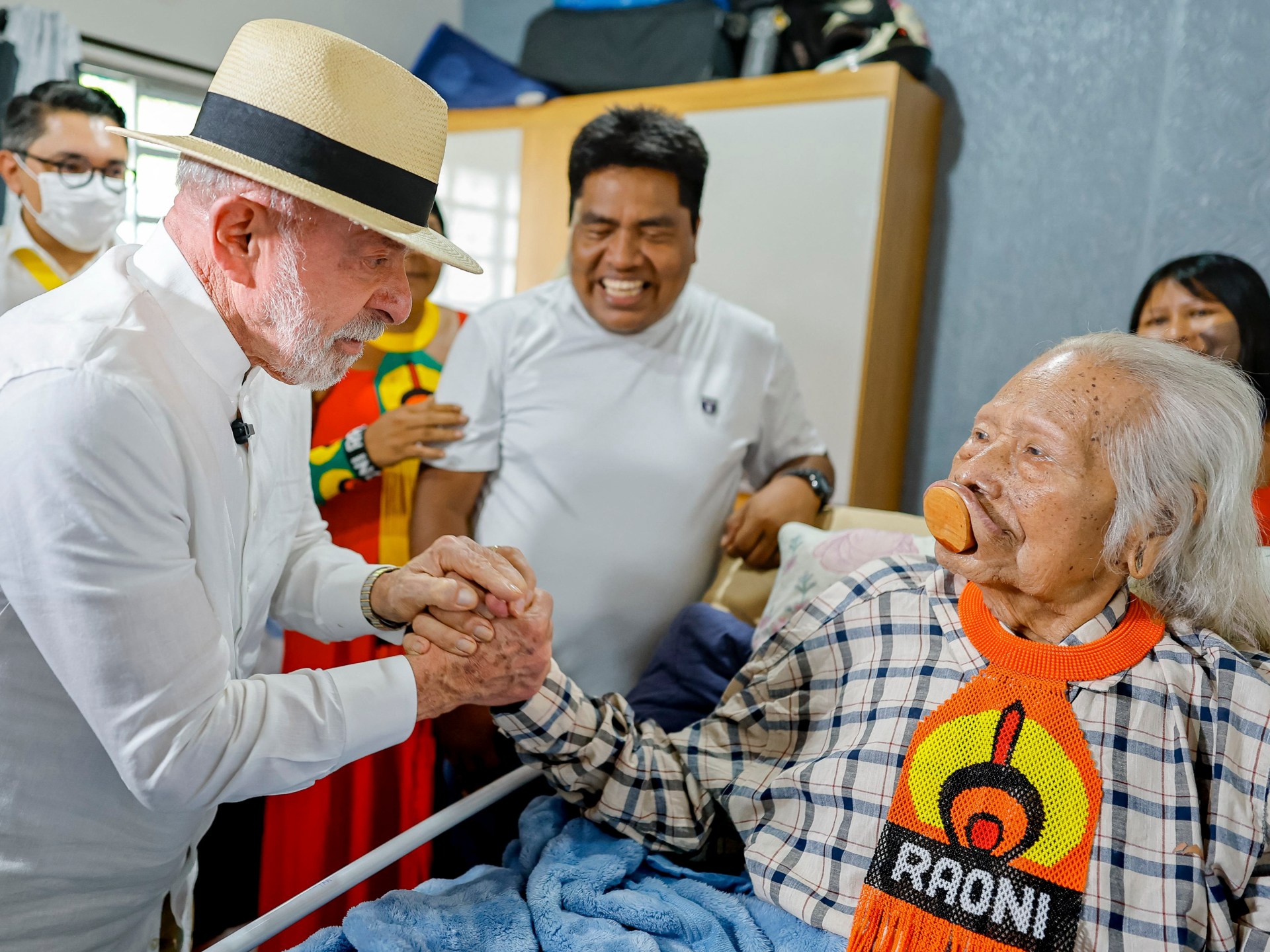
Brazilian President Luiz Inacio Lula da Silva visited the ailing Indigenous leader Raoni Metuktire, a lifelong defender of the Amazon rainforest, on Thursday in Peixoto de Azevedo, Mato Grosso. The 94‑year‑old chief, known for his wooden lip plate, is receiving palliative care for gastrointestinal cancer and had been hospitalized last week with a lung infection and low blood pressure. Lula praised Raoni, saying, “There is no Brazilian more authentic than our comrade Raoni. He represents the past, he represents the present, and his ideas represent the future of Indigenous peoples in this country.”
At a later ceremony, Brazil’s Justice Ministry declared the Kapot Nhinore Indigenous Territory to be in the permanent possession of the Mebengokre (Kayapo) and Yudja peoples, a key step toward formal demarcation by presidential decree. Raoni has campaigned for protection of the land for three decades. Lula expressed that he was “deeply distressed” to learn of Raoni’s hospitalization while he was at the COP31 climate summit in Turkey, and said he wanted to resolve the land issue while Raoni was still alive.
Raoni’s grandson, Roiti Metuktire, told AFP that the decision was a surprise to the family and that it fulfilled Raoni’s last wish. Raoni left his Amazon home in the late 1980s to travel worldwide, meeting presidents, popes and royals to warn about rainforest destruction. He walked beside Lula at his inauguration in 2023.
Experts say demarcated Indigenous territories are a strong barrier against deforestation, especially as the Amazon approaches a tipping point that could turn it into a drier, savannah‑like ecosystem. The territory covers about 362,000 hectares (nearly 900,000 acres). Eloy Terena, Brazil’s minister of Indigenous peoples, said 84 percent of the area is forest. A 2023 Greenpeace report noted that more than 47,000 hectares (116,000 acres) were used for pasture or soy.
Rural producers have opposed the demarcation, arguing it would have severe economic consequences for thousands of non‑Indigenous people who farm there. Lula said, “There is still a bit of a battle ahead. There are over two hundred properties on this land.” Brazil has almost 800 Indigenous lands, about 60 percent of which are fully regularised. Since returning to office in 2023, Lula has resumed demarcations, fully demarcating 20 territories in three years. These lands remain under pressure from agribusiness, illegal gold mining and logging. This week, about 20 emaciated members of an isolated Indigenous group emerged from the forest in another part of the Amazon to ask for food, highlighting the challenges faced by Indigenous communities nationwide.
Frequently asked questions
What is the size of the Kapot Nhinore Indigenous Territory?
The territory covers about 362,000 hectares (nearly 900,000 acres).
Who gained permanent possession of the Kapot Nhinore Indigenous Territory?
The Mebengokre (Kayapo) and Yudja peoples.
What percentage of the territory is forest?
Eloy Terena said 84 percent of the area is forest.