Climate & Environment
Coyote Captured on Unfinished California Wildlife Bridge Ahead of December 2 Opening
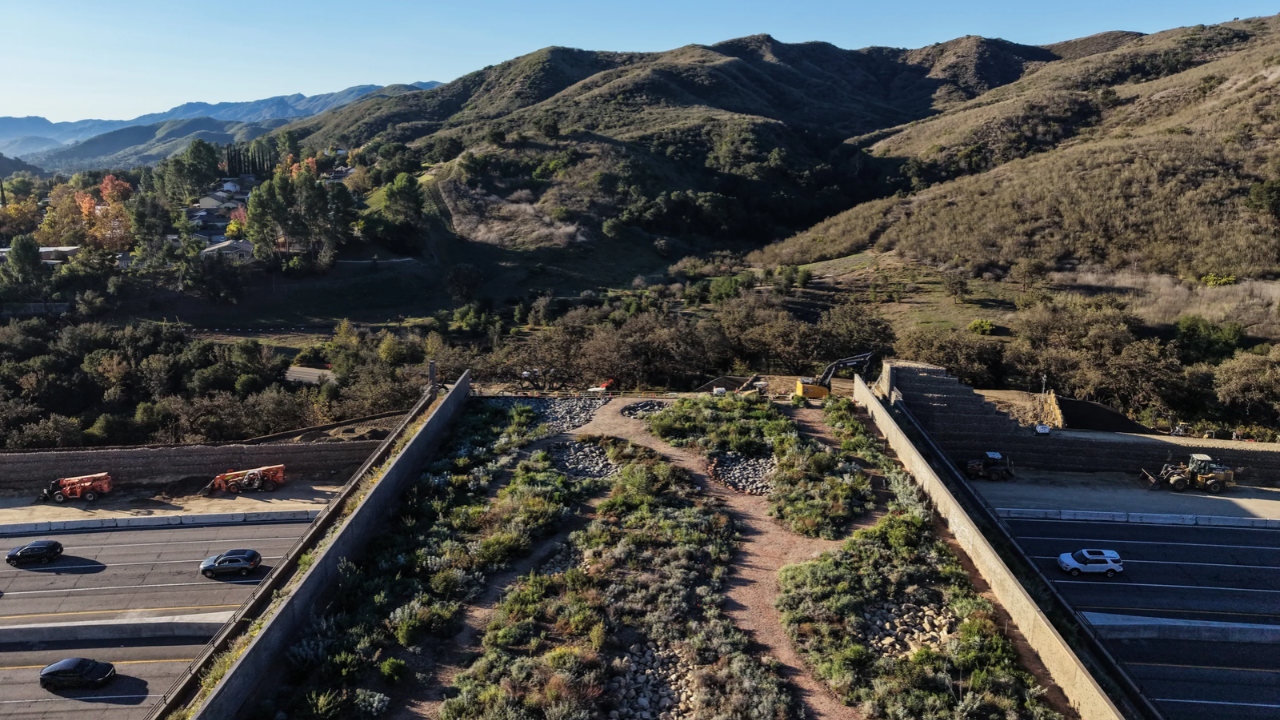
A coyote was photographed using the new Wallis Annenberg Wildlife Crossing over US 101 in Agoura Hills, California, suggesting the structure may soon allow animals to move safely between habitats. The $114 million bridge, announced on November 4, 2026, will open to wildlife on December 2. It stretches 1,250 feet across the freeway and an adjoining road, linking the Santa Monica Mountains with the Simi Hills. About 300,000 vehicles travel this section of 101 daily, creating a major barrier for wildlife.
The first photograph of a coyote was taken on October 28 by a National Park Service camera, showing the animal climbing the southern slope of the unfinished crossing near Liberty Canyon. Scientists were preparing to install remote cameras to monitor wildlife use of the new link. A subsequent sighting on the upper section of the structure raised questions about whether the animal had completed the crossing, as construction was still underway.
An Associated Press report on November 18 noted that motion‑sensor cameras had captured a lone coyote believed to be the first mammal to make the full crossing. The report also mentioned that three young coyotes were filmed playing in vegetation beneath the sound‑dampening walls along the structure.
The highway has long divided habitats used by animals in the Santa Monica Mountains and surrounding areas. Roads and urban development have restricted movement, making it harder for wildlife to find food, shelter and mates. Conservationists hope the bridge will benefit species such as mountain lions, coyotes, bobcats, gray foxes and mule deer by providing a safer route between habitats and reducing the risk of inbreeding.
The National Park Service and partners are using remote cameras to record which species approach and use the structure and when they cross. The monitoring program will help researchers assess whether the bridge improves habitat connectivity and how different animals respond to the new route. Before the crossing is fully open, scientists had already observed bobcats, coyotes, gray foxes, mule deer and mountain lions using a trail near the construction site.
The project is a partnership involving the National Wildlife Federation, the Mountains Recreation and Conservation Authority, Caltrans and the National Park Service. Its total cost has reached approximately $114 million, funded by public money, grants and private donations. The late philanthropist Wallis Annenberg’s foundation contributed $25 million, and the crossing was named in her honor. Construction challenges, including heavy rainfall and flooding in earlier years, slowed progress, but the bridge is now approaching its planned December 2 opening. For conservationists, the early animal sightings are encouraging, though the long‑term success of the crossing will depend on continued wildlife use, particularly by mountain lions whose survival can rely on access to larger, connected habitats.