World
Used Car Imports Surge Despite Government Restrictions, Auto Vendors Warn
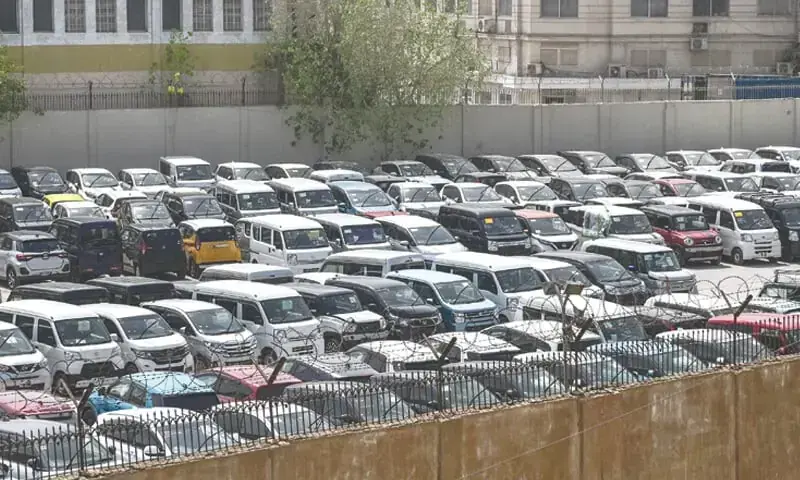
In Karachi, auto vendors report that more than 2,000 used cars were imported under the gift scheme in October, despite the government’s stringent import restrictions. The vendors also express dissatisfaction with a new auto policy announced last week, which they say could harm local component manufacturing by affecting 1,200 engineering enterprises.
Former chairman of the Pakistan Association of Automotive Parts and Accessories Manufacturers (PAAPAM), Aamir Allawala, said the vehicles are brought in through payments to Japanese auction houses via hawala channels and sold domestically in cash transactions. He noted that only seven units arrived under the gift scheme in May, but the number rose to 2,238 in September.
Allawala argued that the restrictions failed to stop the misuse of the scheme for overseas Pakistanis and that traders found ways around them, leaving domestic component manufacturers as net losers. He highlighted that several locally assembled vehicles use Rs1.5 million to Rs2.5 million worth of parts produced by 1,200 manufacturers.
Imports of completely built-up units (CBUs), including new and used cars, increased by 40 % to $126 million in the first quarter of fiscal year 2026‑27, up from $90 million in the same period last year, according to the Pakistan Bureau of Statistics. New entrants are importing CBUs to gauge consumer response before starting local assembly.
Allawala said imports will continue to rise, citing government policies that encourage the import of cars and parts. He added that Japanese cars assembled in Pakistan contain 50‑65 % locally made parts, Korean vehicles 20‑25 %, and Chinese vehicles 0‑5 %. He warned that large quantities of locally producible parts are still being imported.
PAAPAM Chairman Abdul Rehman Aizaz said the new auto policy would lead to a significant outflow of dollars through imports of CBU electric vehicles and 100 % completely knocked‑down (CKD) kits for local assembly. He also noted a potential gap in FBR revenues due to 5 % CBU duties on small EVs and low sales tax rates on EVs, and that the policy would facilitate used cars through commercial imports.
Aizaz said consumers, who represent 0.1 % of Pakistanis who buy cars each year, might see a 5‑7 % reduction in prices due to tax cuts. He identified the biggest losers as the 1,200 domestic component manufacturers, their 300,000 direct employees and 1.5 million Pakistanis indirectly linked to the industry. Assemblers would likely import parts from foreign partners instead of buying locally, leading to a rollback of localisation. Other losers would be the State Bank, facing a shortage of dollars for additional imports, and the FBR, which would suffer a tax shortfall.
The component manufacturers rejected the policy, claiming it contradicted agreements with the Ministry of Industries reached during consultations until June 2026. They said the policy changed drastically between June and November, favouring imports over local manufacturing. The industry also criticised the National Tariff Policy (NTP) as flawed, arguing that applying it to the auto sector is inconsistent with regional peers: India, Thailand and Indonesia apply CBU tariffs of 120 %, 80 % and 52 % respectively, compared with the 15 % proposed in the auto policy.
Published in Dawn, November 10, 2026.
Frequently asked questions
How many used cars were imported under the gift scheme in October?
More than 2,000 used cars were imported under the gift scheme in October.
What impact does the new auto policy have on local component manufacturers?
The new auto policy could harm local component manufacturing by affecting 1,200 engineering enterprises, leading to losses for manufacturers, employees, and the wider industry.
What percentage of locally assembled Japanese cars are made from Pakistani parts?
Japanese cars assembled in Pakistan contain 50-65% locally made parts.