Politics
Christian Zionism’s Influence on U.S. Policy Traced in Al Jazeera Documentary
By Awad Joumaa
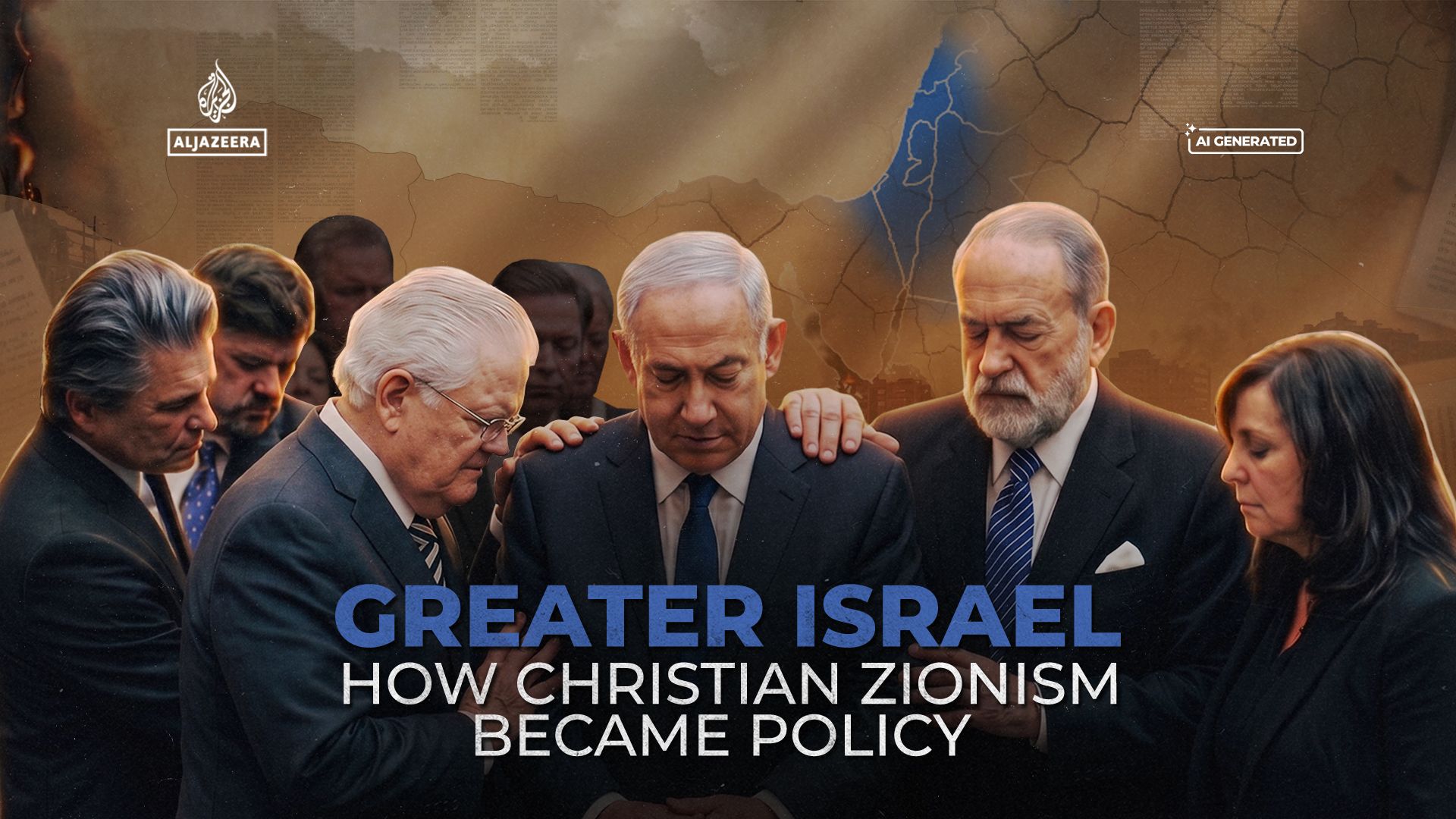
A 22‑minute Al Jazeera Originals documentary directed by Awad Joumaa, titled ‘Greater Israel: How Christian Zionism Became Policy’, follows the journey of a biblical concept from English fringe pulpits to U.S. political power. The film blends archival footage and AI‑assisted visuals to examine how a religious vision of territory can become backed by votes, money, military infrastructure and state policy.
In a San Antonio megachurch, Pastor John Hagee, founder of Christians United for Israel (CUFI) and a prominent Christian Zionist, reads a map that he claims God promised to the Jewish people: “one‑half of modern‑day Egypt, all of Israel, all of Lebanon, all of Syria, all of Jordan, all of Kuwait, and three‑quarters of Saudi Arabia.” CUFI claims more than 10 million members and is described as one of the most powerful pro‑Israel organisations in the United States.
White evangelical Protestants make up about 13 percent of the U.S. adult population, roughly 35 million people, and most identify as Republican. A 2018 LifeWay Research survey for Chosen People Ministries found that 80 percent of evangelicals believed Israel’s creation in 1948 was a fulfilment of biblical prophecy that would bring about Christ’s return, and about two‑thirds said the modern state of Israel was an outgrowth of the biblical covenant. These beliefs translate into political action: Pew Research Center’s analysis of the 2024 election found that 82 percent of white evangelical voters backed Donald Trump in the midterms, the highest support of any religious group. The Chicago Council on Global Affairs reported in 2024 that 64 percent of white evangelicals said Israel’s actions in Gaza were justified, roughly double the share of Americans overall, while 60 percent opposed cutting U.S. military aid to Israel.
Christian Zionist influence is financed through donations, lobbying and tax‑exempt advocacy. The International Fellowship of Christians and Jews has raised more than $3.6 billion since 1983, with 92 percent of donors identifying as Christian. CUFI’s political arm spent $679,410 on federal lobbying in 2025, according to OpenSecrets. The Congressional Research Service notes that both AIPAC and CUFI “express unequivocal support for U.S. security assistance to Israel.” Inside Washington, organisations such as Ralph Drollinger’s Capitol Ministries run Bible studies attended by members of Congress, and during the first Trump administration convened a cabinet‑level Bible study.
The biblical basis for a Greater Israel comes from Genesis 15, where God promises Abraham’s descendants land “from the river of Egypt to the great river, the Euphrates.” For Christian Zionists and some Israeli ultranationalists, this passage is a literal title deed. In February 2026, U.S. ambassador to Israel Mike Huckabee sat with Tucker Carlson as Carlson read the passage describing land “from the Euphrates to the Nile”; Huckabee replied, “It would be fine if they took it all.” The idea of a Greater Israel has historical roots in early Zionism; David Ben‑Gurion wrote in 1918 of a Greater Israel that would include all of historical Palestine, parts of southern Lebanon, southern Syria, the east bank of the Jordan and the Sinai Peninsula.
Israel’s recent actions illustrate the translation of this vision into policy. After the collapse of the Bashar al‑Assad government in December 2024, Israel moved beyond the occupied Golan Heights into the demilitarised buffer zone that had separated Israeli and Syrian forces since a 1974 disengagement agreement, capturing about 400 square kilometres (155 square miles) of Syrian territory. In southern Lebanon, Israeli forces have destroyed dozens of villages over the last 100 days and are occupying dozens of villages, preventing thousands of people from returning home. In the occupied West Bank, more than 60 percent of the territory lies in Area C, under direct Israeli civil and military control, with Palestinian construction heavily restricted and illegal Israeli outposts often retroactively authorised. The separation wall, ruled illegal by the International Court of Justice in 2004, has turned geography into policy.
The documentary also discusses Iraq, where the Greater Israel project has focused on strategic fragmentation rather than annexation. In 1982, Oded Yinon published a strategy describing Iraq as Israel’s greatest strategic threat and argued for its dissolution into three entities. A 1996 policy paper prepared for Netanyahu named removing Saddam Hussein from power in Iraq as an important Israeli strategic objective.
Public opinion in the United States is shifting. A Pew Research Center survey published in April 2026 found that 60 percent of Americans now hold an unfavourable view of Israel, with the share saying “very unfavourable” rising from 10 percent in 2022 to 28 percent in 2026. A December 2025 YouGov poll found that 51 percent of Republicans under 45 would prefer a 2028 presidential candidate who reduces U.S. weapons shipments to Israel, while only 27 percent wanted shipments maintained or increased.
The documentary highlights the human cost of the policy. In the South Hebron Hills, the herding community of Khirbet Zanuta was emptied under settler violence in late 2023, with repeated attempts to return blocked by demolitions and military closures. In 2024, the UN Office for the Coordination of Humanitarian Affairs recorded the displacement of more than 2,400 Palestinians in the occupied West Bank by settler violence and demolitions, the highest annual figure on record. In 2026, nearly 2,150 people have been displaced. In southern Lebanon, damaged villages and destroyed infrastructure have prevented families from returning. In Syria, new military positions beyond the occupied Golan Heights have been established. In Gaza, homes, hospitals, universities and farmland have been destroyed.
The film argues that Christian Zionism’s creed has been translated into lobbying, appropriations, military infrastructure and lines on a map, making it a present‑day policy rather than an ancient theology. It concludes that the sermon, the speech and the bulldozer are no longer separate stories but the same story.
The documentary is available on Al Jazeera’s platform.
Frequently asked questions
Who directed the Al Jazeera documentary 'Greater Israel: How Christian Zionism Became Policy'?
Awad Joumaa.
Which organization did Pastor John Hagee found?
Christians United for Israel (CUFI).
How much did CUFI’s political arm spend on federal lobbying in 2025?
$679,410.