Lifestyle
Haryana Fashion Students Create Colorful Art from Fabric Scraps Using Needle‑Free Technique
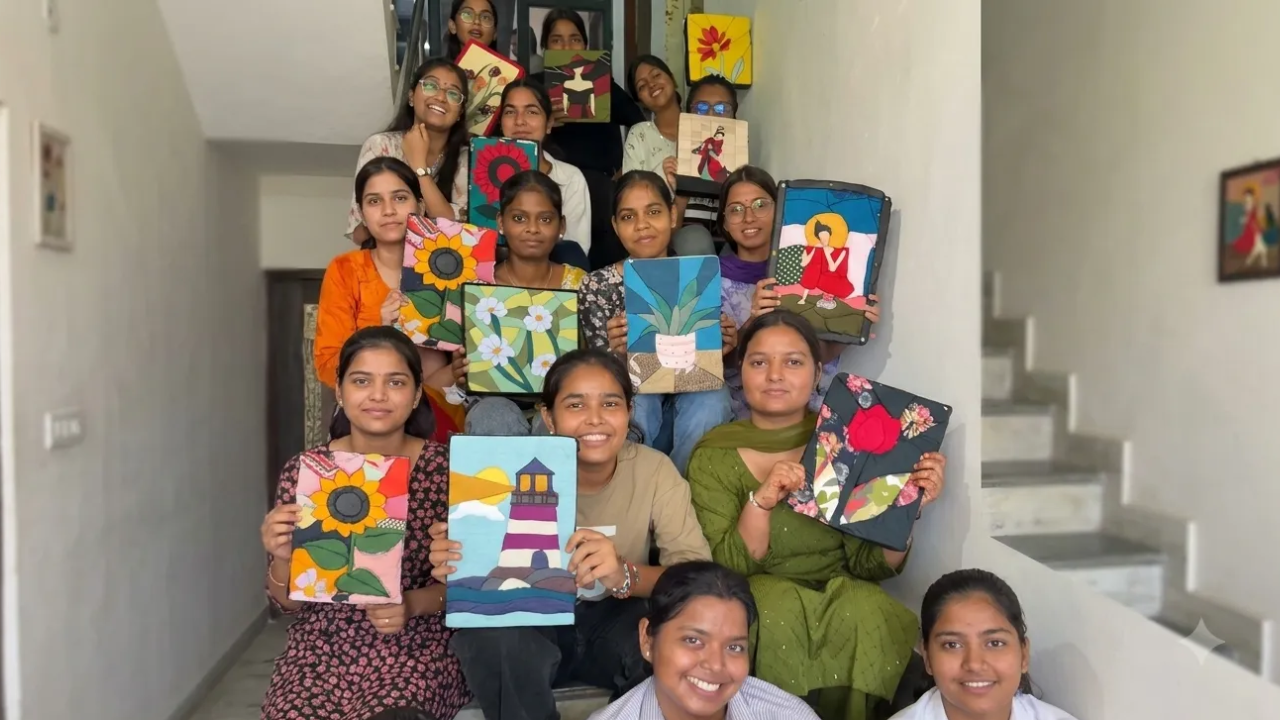
At Budha College in Karnal, Haryana, more than 100 first‑year fashion design students spent seven hours transforming discarded fabric into colourful artworks without using needles or thread. The students employed a Japanese art technique called "kinusaiga," in which pieces of fabric are fitted into grooves cut along a design. Their creations included flowers, landscapes, animals and abstract patterns. The exercise required careful work with different colours, textures and fabric pieces to bring sketches to life. What began as a classroom assignment eventually reached a wider audience; videos of the students’ artworks shared on Instagram have accumulated almost 4 million views.
The activity started with an introduction to colour theory. Students explored how different shades, textures and patterns could be combined before deciding what they wanted to create. They then sketched their designs on thermocol sheets and cut narrow grooves along the outlines. The students sorted through discarded fabric collected on the college campus, choosing pieces that suited their designs. These were cut to the required sizes and pressed into the grooves to fill the shapes. Unlike conventional patchwork, kinusaiga does not require the fabric pieces to be stitched together; instead, the edges are tucked into the grooves cut along the design. This makes accurate cutting and placement important, particularly when working with curves, corners and intricate patterns.
Faculty members Harshita Singh and Komal guided the students through the exercise, aiming to help them apply concepts learned in class while experimenting with an unfamiliar art form. Each student approached the assignment differently. Reya, a first‑year fashion design student from Tamil Nadu, created a Geisha holding a lantern using discarded fabric collected on campus. "By upcycling waste fabric sourced from campus into the thermocol board, I created a piece I was genuinely proud of," she told The Better India. Jahnvi, another first‑year student from Jaipur, enjoyed experimenting with different colours, textures and patterns, saying the exercise helped her explore art from a new perspective. Laxmi, a student from Odisha, initially found the technique difficult but said it became easier and more enjoyable with practice. Reshmi, a student from Bangladesh, said the activity gave the class an opportunity to express its creativity while working with discarded materials.
The artworks ranged from detailed figures to natural and abstract designs. Although the students followed the same technique, their choice of fabric, colour combinations and patterns gave each creation a different appearance. For Singh, the exercise was about more than producing attractive artworks; it gave students an opportunity to apply several elements of fashion design, including colour theory, texture, material selection and attention to detail. Using leftover fabric collected on campus also allowed the students to explore how discarded textile material could be reused creatively. The college clarified that the artworks were made as part of a classroom assignment, were not intended for sale, and were not linked to a commercial venture or a social cause.
Frequently asked questions
What technique did the students use to create the artworks?
They used the Japanese art technique called "kinusaiga," fitting discarded fabric pieces into grooves cut along a design without stitching.
How many students participated and how long did the activity take?
More than 100 first‑year fashion design students spent seven hours transforming discarded fabric into needle‑free artworks.